


Intervention Helps Family Caregivers of People With Dementia Attain Own Therapy Goals
- PMID: 29660988
- PMCID: PMC10852505
- DOI: 10.1177/1533317518769475
Intervention Helps Family Caregivers of People With Dementia Attain Own Therapy Goals
Abstract
Introduction: Caregiver intervention studies typically assess whether participants attain general goals (eg, improved mental/physical health) but not their own individual goals. We used goal attainment scaling to evaluate whether participants of a telephone intervention based on cognitive behavioral therapy (CBT) attained their personal goals. We also evaluated treatment compliance and implementation.
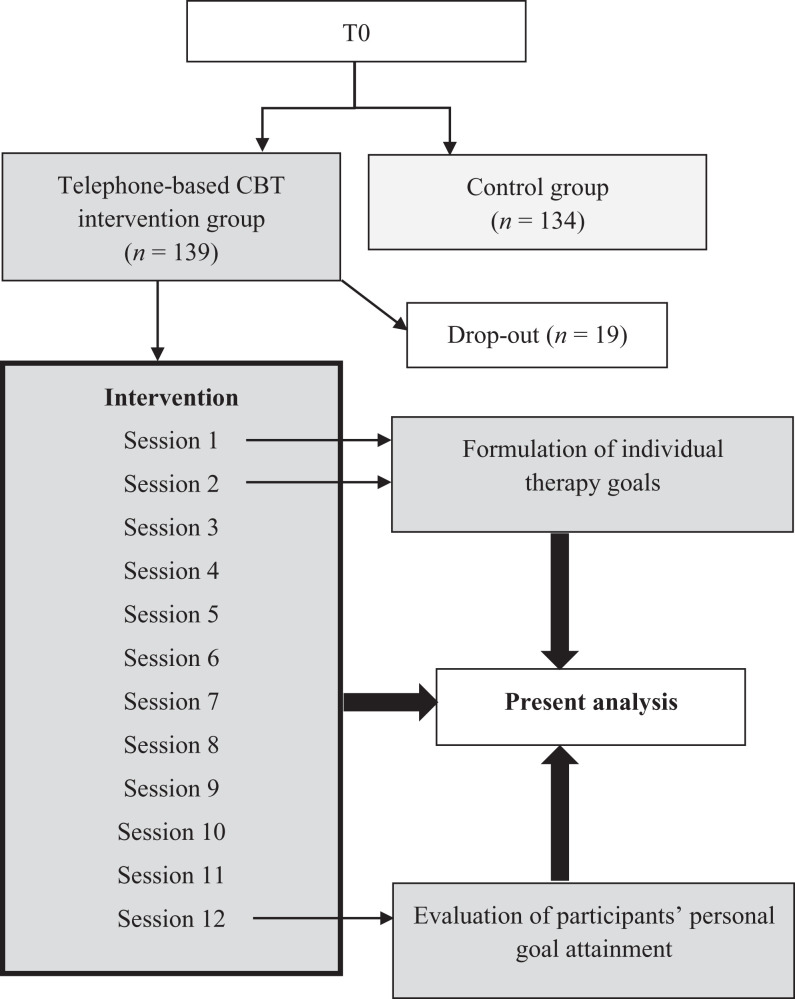
Methods: A sample of 139 family caregivers of people with dementia received 12 telephone sessions over 6 months. Participants personal goals were specified during the first and second sessions. Participants and therapists assessed goal attainment at the end of the intervention.
Results: Nearly all participants reported meaningful improvements with regard to their personal goals. Specifically, 20.9% exceeded, 56.4% completely attained, and 21.8% partially attained at least one of their personal goals. There was high agreement between self- and therapist ratings. Treatment compliance and implementation were highly satisfactory.
Conclusions: The CBT telephone intervention successfully helped participants attain their personal goals.
Keywords: cognitive behavioral therapy; dementia; evaluation; family caregivers; goal attainment scaling; psychotherapy; telephone; treatment compliance.
Conflict of interest statement
The authors declared no potential conflicts of interest with respect to the research, authorship, and/or publication of this article.
Figures

References
-
- Gallagher-Thompson D, Coon DW. Evidence-based psychological treatments for distress in family caregivers of older adults. Psychol Aging. 2007;22(1):37–51. doi:10.1037/0882-7974.22.1.37. - PubMed
-
- Losada A, Márquez-González M, Romero-Moreno R, et al. Cognitive-behavioral therapy (CBT) versus acceptance and commitment therapy (ACT) for dementia family caregivers with significant depressive symptoms: results of a randomized clinical trial. J Consult Clin Psychol. 2015;83(4):760–772. doi:10.1037/ccp0000028. - PubMed
-
- Mittelman MS, Haley WE, Clay OJ, Roth DL. Improving caregiver well-being delays nursing home placement of patients with Alzheimer disease. Neurology. 2006;67(9):1592–1599. doi:10.1212/01.wnl.0000242727.81172.91. - PubMed
-
- Schulz R, Martire LM, Klinger JN. Evidence-based caregiver interventions in geriatric psychiatry. Psychiatr Clin North Am. 2005;28(4):1007–1038. doi:10.1016/j.psc.2005.09.003. - PubMed
Publication types
MeSH terms
LinkOut - more resources
Full Text Sources
Other Literature Sources
Medical
