


CKD and ESRD in US Hispanics
- PMID: 29661541
- PMCID: PMC6186206
- DOI: 10.1053/j.ajkd.2018.02.354
CKD and ESRD in US Hispanics
Abstract
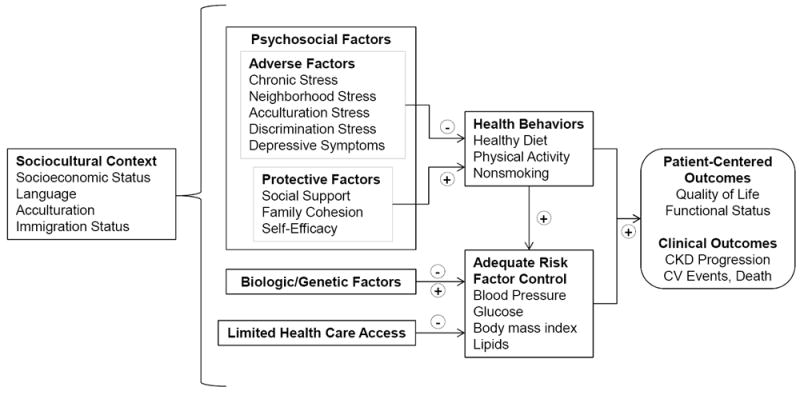
Hispanics are the largest racial/ethnic minority group in the United States, and they experience a substantial burden of kidney disease. Although the prevalence of chronic kidney disease (CKD) is similar or slightly lower in Hispanics than non-Hispanic whites, the age- and sex-adjusted prevalence rate of end-stage renal disease is almost 50% higher in Hispanics compared with non-Hispanic whites. This has been attributed in part to faster CKD progression among Hispanics. Furthermore, Hispanic ethnicity has been associated with a greater prevalence of cardiovascular disease risk factors, including obesity and diabetes, as well as CKD-related complications. Despite their less favorable socioeconomic status, which often leads to limited access to quality health care, and their high comorbid condition burden, the risk for mortality among Hispanics appears to be lower than for non-Hispanic whites. This survival paradox has been attributed to a complex interplay between sociocultural and psychosocial factors, as well as other factors. Future research should focus on evaluating the long-term impact of these factors on patient-centered and clinical outcomes. National policies are needed to improve access to and quality of health care among Hispanics with CKD.
Keywords: CKD progression; Hispanics; Latinos; acculturation; cardiovascular disease; chronic kidney disease (CKD); diabetic kidney disease; end-stage renal disease (ESRD); ethnic differences; health disparities; minorities; nonmodifiable risk factor; proteinuria; socioeconomic status; undocumented immigrants.
Copyright © 2018 National Kidney Foundation, Inc. Published by Elsevier Inc. All rights reserved.
Figures
References
-
- [October 4, 2017];US Census Bureau: Hispanic Heritage Month 2017. https://www.census.gov/newsroom/facts-for-features/2017/hispanic-heritag....
-
- Kidney Disease Statistics for the United States ∣ NIDDK. [August 9, 2017];National Institute of Diabetes and Digestive and Kidney Diseases. https://www.niddk.nih.gov/health-information/health-statistics/kidney-di....
Publication types
MeSH terms
Grants and funding
LinkOut - more resources
Full Text Sources
Other Literature Sources
Medical
