


Association of Hemoglobin A1c and Wound Healing in Diabetic Foot Ulcers
- PMID: 29661917
- PMCID: PMC6014539
- DOI: 10.2337/dc17-1683
Association of Hemoglobin A1c and Wound Healing in Diabetic Foot Ulcers
Abstract
Objective: This study evaluated the association between hemoglobin A1c (A1C) and wound outcomes in patients with diabetic foot ulcers (DFUs).
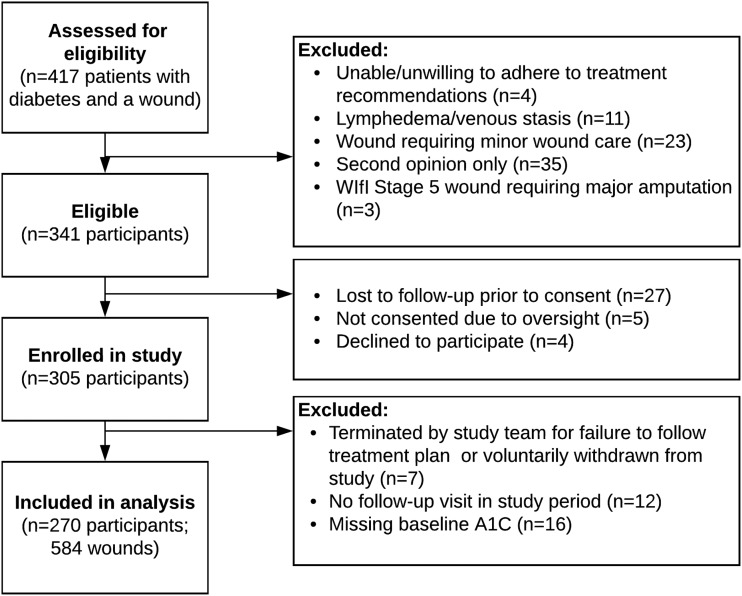
Research design and methods: We conducted a retrospective analysis of an ongoing prospective, clinic-based study of patients with DFUs treated at an academic institution during a 4.7-year period. Data from 270 participants and 584 wounds were included in the analysis. Cox proportional hazards regression was used to assess the incidence of wound healing at any follow-up time in relation to categories of baseline A1C and the incidence of long-term (≥90 days) wound healing in relation to tertiles of nadir A1C change and mean A1C change from baseline, adjusted for potential confounders.
Results: Baseline A1C was not associated with wound healing in univariate or fully adjusted models. Compared with a nadir A1C change from baseline of -0.29 to 0.0 (tertile 2), a nadir A1C change of 0.09 to 2.4 (tertile 3) was positively associated with long-term wound healing in the subset of participants with baseline A1C <7.5% (hazard ratio [HR] 2.07; 95% CI 1.08-4.00), but no association with wound healing was seen with the mean A1C change from baseline in this group. Neither nadir A1C change nor mean A1C change were associated with long-term wound healing in participants with baseline A1C ≥7.5%.
Conclusions: There does not appear to be a clinically meaningful association between baseline or prospective A1C and wound healing in patients with DFUs. The paradoxical finding of accelerated wound healing and increase in A1C in participants with better baseline glycemic control requires confirmation in further studies.
© 2018 by the American Diabetes Association.
References
-
- Singh N, Armstrong DG, Lipsky BA. Preventing foot ulcers in patients with diabetes. JAMA 2005;293:217–228 - PubMed
-
- Apelqvist J, Larsson J. What is the most effective way to reduce incidence of amputation in the diabetic foot? Diabetes Metab Res Rev 2000;16(Suppl. 1):S75–S83 - PubMed
-
- Gregg EW, Gu Q, Williams D, et al. Prevalence of lower extremity diseases associated with normal glucose levels, impaired fasting glucose, and diabetes among U.S. adults aged 40 or older. Diabetes Res Clin Pract 2007;77:485–488 - PubMed
-
- Boyko EJ, Ahroni JH, Stensel V, Forsberg RC, Davignon DR, Smith DG. A prospective study of risk factors for diabetic foot ulcer. The Seattle Diabetic Foot Study. Diabetes Care 1999;22:1036–1042 - PubMed
-
- Fortington LV, Geertzen JH, van Netten JJ, Postema K, Rommers GM, Dijkstra PU. Short and long term mortality rates after a lower limb amputation. Eur J Vasc Endovasc Surg 2013;46:124–131 - PubMed
Publication types
MeSH terms
Substances
Grants and funding
LinkOut - more resources
Full Text Sources
Other Literature Sources
Medical
