


NKG2D and Its Ligands: "One for All, All for One"
- PMID: 29662484
- PMCID: PMC5890157
- DOI: 10.3389/fimmu.2018.00476
NKG2D and Its Ligands: "One for All, All for One"
Abstract
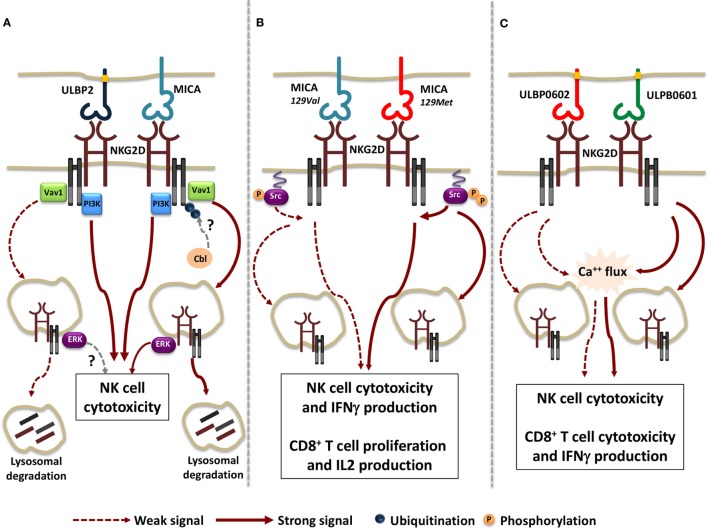
The activating receptor NKG2D is peculiar in its capability to bind to numerous and highly diversified MHC class I-like self-molecules. These ligands are poorly expressed on normal cells but can be induced on damaged, transformed or infected cells, with the final NKG2D ligand expression resulting from multiple levels of regulation. Although redundant molecular mechanisms can converge in the regulation of all NKG2D ligands, different stimuli can induce specific cellular responses, leading to the expression of one or few ligands. A large body of evidence demonstrates that NK cell activation can be triggered by different NKG2D ligands, often expressed on the same cell, suggesting a functional redundancy of these molecules. However, since a number of evasion mechanisms can reduce membrane expression of these molecules both on virus-infected and tumor cells, the co-expression of different ligands and/or the presence of allelic forms of the same ligand guarantee NKG2D activation in various stressful conditions and cell contexts. Noteworthy, NKG2D ligands can differ in their ability to down-modulate NKG2D membrane expression in human NK cells supporting the idea that NKG2D transduces different signals upon binding various ligands. Moreover, whether proteolytically shed and exosome-associated soluble NKG2D ligands share with their membrane-bound counterparts the same ability to induce NKG2D-mediated signaling is still a matter of debate. Here, we will review recent studies on the NKG2D/NKG2D ligand biology to summarize and discuss the redundancy and/or diversity in ligand expression, regulation, and receptor specificity.
Keywords: NK cells; NKG2D ligands; NKG2D receptor; cancer; virus infection.
Figures
References
-
- Rolle A, Mousavi-Jazi M, Eriksson M, Odeberg J, Soderberg-Naucler C, Cosman D, et al. Effects of human cytomegalovirus infection on ligands for the activating NKG2D receptor of NK cells: up-regulation of UL16-binding protein (ULBP)1 and ULBP2 is counteracted by the viral UL16 protein. J Immunol (2003) 171(2):902–8. 10.4049/jimmunol.171.2.902 - DOI - PubMed
Publication types
MeSH terms
Substances
LinkOut - more resources
Full Text Sources
Other Literature Sources
Medical
Research Materials
