Review
. 2018 Mar 23:9:585.
doi: 10.3389/fimmu.2018.00585. eCollection 2018.

Regulatory T-Cells: Potential Regulator of Tissue Repair and Regeneration

Affiliations
Review

Regulatory T-Cells: Potential Regulator of Tissue Repair and Regeneration

Jiatao Li et al. Front Immunol. .

Abstract

The identification of stem cells and growth factors as well as the development of biomaterials hold great promise for regenerative medicine applications. However, the therapeutic efficacy of regenerative therapies can be greatly influenced by the host immune system, which plays a pivotal role during tissue repair and regeneration. Therefore, understanding how the immune system modulates tissue healing is critical to design efficient regenerative strategies. While the innate immune system is well known to be involved in the tissue healing process, the adaptive immune system has recently emerged as a key player. T-cells, in particular, regulatory T-cells (Treg), have been shown to promote repair and regeneration of various organ systems. In this review, we discuss the mechanisms by which Treg participate in the repair and regeneration of skeletal and heart muscle, skin, lung, bone, and the central nervous system.

Keywords: CD4+ regulatory T-cells; heart regeneration; macrophages; stem cells; tissue repair and regeneration.


Figures
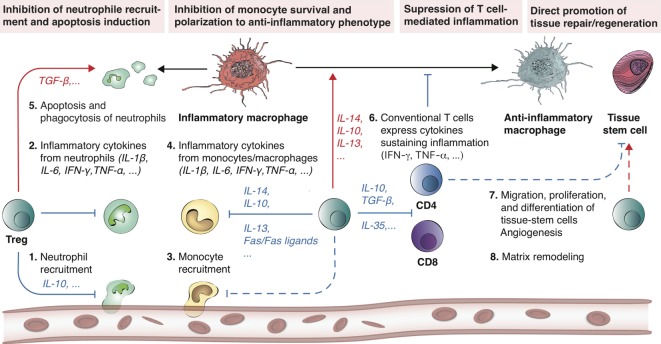
Figure 1
Figure 1
Treg promote tissue repair and regeneration by modulating inflammation. Treg have demonstrated the ability to promote tissue repair and regeneration by controlling both the innate and adaptive immune systems. Following tissue injury, a cascade of immune events is triggered (steps 1–6) until a new tissue is formed (steps 7–8). Treg are involved in all these different steps. At the onset of inflammation, Treg can neutralize inflammatory cytokine secretion (e.g., IL-6, IFN-γ, TNF-α, and IL-1β) by inhibiting neutrophil extravasation via IL-10. In addition, Treg are able to promote apoptosis of neutrophils and encourage phagocytosis of dead neutrophils by macrophages. Concomitantly, Treg further inhibit monocyte activity, survival, and stimulate macrophage polarization toward an anti-inflammatory phenotype (M2) via the release of anti-inflammatory cytokines (e.g., IL-4, IL-10, IL-13). Similarly, Treg have the natural ability to suppress CD4 and CD8 T cell-mediated inflammation (via IL-10, TGF-β, and IL-35). Overall, these Treg-mediated mechanisms result in the inhibition of neutrophil, inflammatory macrophage, as well as CD4 and CD8 T-cell activity, which is generally favorable for tissue repair and regeneration. Dashed lines indicate a hypothetical mechanism. Red arrows indicate induction, while blue arrows indicate inhibition.
Figure 2
Figure 2
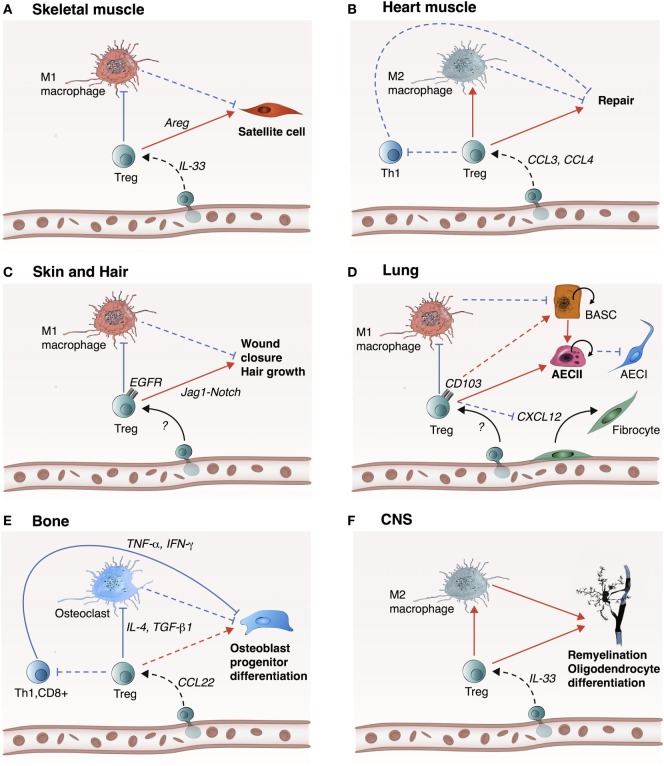
Treg likely promote tissue repair and regeneration in a tissue-specific manner. Treg play an important role in the repair and regeneration of skeletal muscle, heart muscle, skin and hair, lung, bone, and central nervous system (CNS). (A) In skeletal muscle, IL-33 participates to Treg recruitment into the site of injury. Treg inhibit M1 macrophage-mediated inflammation, which promote transition to the resolution phase. Treg also directly activate satellite cell proliferation and differentiation through Areg. (B) In the heart, Treg are recruited via CCR5 signaling (e.g., CCL3 and CCL4) allowing inhibition of Th1 cell activity and inhibition of M1 macrophages. (C) In skin and hair, mechanism of Treg recruitment is still unknown, but upon recruitment, Treg inhibit M1 macrophage inflammatory activity and promote wound closure and hair growth via the Jag1-Notch signaling pathway. (D) In the lung, Treg inhibit M1 macrophage inflammatory activity and encourage proliferation and differentiation of damaged alveolar type 2 epithelial cells (AECII) into AECIs. This step can be mediated by Areg or CD103 to E-cadherin ligand-receptor binding. Alternatively, Treg could potentially activate progenitor bronchioalveolar stem cells (BASCs) to differentiate into AECII cells. Concurrently, Treg prevent fibrosis by inhibiting fibrocyte recruitment and proliferation via CXCL12. (E) In the bone, Treg are most likely recruited via CCL22, which act on inhibiting Th1, CD8+, and M1 macrophages to support osteoblast progenitor differentiation. (F) In CNS, Treg are recruited by IL-33 and play a reparative role by encouraging M2 macrophage polarization to facilitate re-myelination and differentiation of oligodendrocytes. Treg may also directly act on oligodendrocytes via CCN3. Dashed lines indicate a hypothetical mechanism. Red arrows indicate induction, while blue arrows indicate inhibition.

References

    1. Lozano R, Naghavi M, Foreman K, Lim S, Shibuya K, Aboyans V, et al. Global and regional mortality from 235 causes of death for 20 age groups in 1990 and 2010: a systematic analysis for the global burden of disease study 2010. Lancet (2012) 380(9859):2095–128. 10.1016/S0140-6736(12)61728-0 - DOI - PMC - PubMed
    1. Schwartz SD, Hubschman JP, Heilwell G, Franco-Cardenas V, Pan CK, Ostrick RM, et al. Embryonic stem cell trials for macular degeneration: a preliminary report. Lancet (2012) 379(9817):713–20. 10.1016/S0140-6736(12)60028-2 - DOI - PubMed
    1. Schwartz SD, Regillo CD, Lam BL, Eliott D, Rosenfeld PJ, Gregori NZ, et al. Human embryonic stem cell-derived retinal pigment epithelium in patients with age-related macular degeneration and Stargardt’s macular dystrophy: follow-up of two open-label phase 1/2 studies. Lancet (2015) 385(9967):509–16. 10.1016/S0140-6736(14)61376-3 - DOI - PubMed
    1. Lui KO, Fairchild PJ, Waldmann H. Prospects for ensuring acceptance of ES cell-derived tissues. StemBook. Cambridge, MA: (2008). - PubMed
    1. Lui KO, Waldmann H, Fairchild PJ. Embryonic stem cells: overcoming the immunological barriers to cell replacement therapy. Curr Stem Cell Res Ther (2009) 4(1):70–80. 10.2174/157488809787169093 - DOI - PubMed

Publication types