. 2018 Mar 20:9:349.
doi: 10.3389/fpls.2018.00349. eCollection 2018.

Small RNA and Degradome Deep Sequencing Reveals the Roles of microRNAs in Seed Expansion in Peanut (Arachis hypogaea L.)

Affiliations

Small RNA and Degradome Deep Sequencing Reveals the Roles of microRNAs in Seed Expansion in Peanut (Arachis hypogaea L.)

Xingli Ma et al. Front Plant Sci. .

Abstract

Seed expansion in peanut is a complex biological process involving many gene regulatory pathways. MicroRNAs (miRNAs) play important regulatory roles in plant growth and development, but little is known about their functions during seed expansion, or how they contribute to seed expansion in different peanut lines. We examined seed miRNA expression patterns at 15 and 35 days after flowering (DAF) in two peanut eighth-generation recombinant inbred lines (RIL8); 8106, a medium-pod variety, and 8107, a super-pod variety. Using high-throughput sequencing, we identified 1,082 miRNAs in developing peanut seeds including 434 novel miRNAs. We identified 316 differentially expressed miRNAs by comparing expression levels between the two peanut lines. Interestingly, 24 miRNAs showed contrasting patterns of expression in the two RILs, and 149 miRNAs were expressed predominantly in only one RIL at 35 DAF. Also, potential target genes for some conserved and novel miRNAs were identified by degradome sequencing; target genes were predicted to be involved in auxin mediated signaling pathways and cell division. We validated the expression patterns of some representative miRNAs and 12 target genes by qPCR, and found negative correlations between the expression level of miRNAs and their targets. miR156e, miR159b, miR160a, miR164a, miR166b, miR168a, miR171n, miR172c-5p, and miR319d and their corresponding target genes may play key roles in seed expansion in peanut. The results of our study also provide novel insights into the dynamic changes in miRNAs that occur during peanut seed development, and increase our understanding of miRNA function in seed expansion.

Keywords: deep sequencing; degradome; miRNA; peanut; seed expansion.


Figures
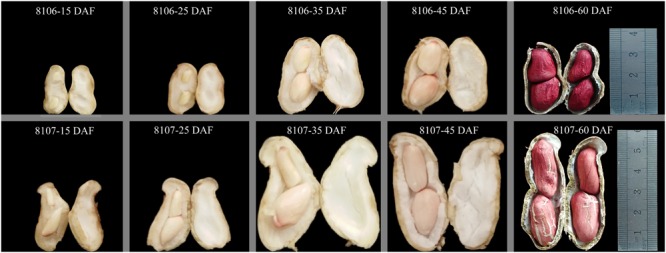
FIGURE 1
FIGURE 1
Morphological changes in two peanut lines during seed development. 8106 and 8107 lines indicate the two peanut recombinant inbred lines (RILs). 15 DAF, 25 DAF, 35 DAF, 45 DAF, and 60 DAF indicate 15, 25, 35, 45, and 60 days after flowering, respectively.
FIGURE 2
FIGURE 2
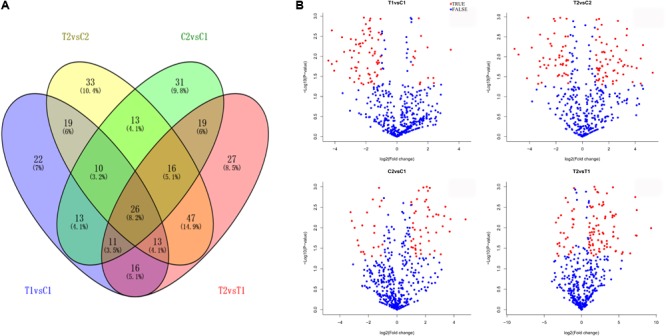
Differentially expressed miRNAs in two peanut RILs. Venn diagrams showing the number of common and specific miRNAs in comparisons of the four libraries (A). Volcanic diagrams showing the number of differentially expressed miRNAs in each comparison (B). The red dots indicate miRNAs with significant differences, and the blue dots indicate that the difference was not significant for miRNA expression. C1, RIL 8106 at 15 DAF; T1, RIL 8106 at 35 DAF; C2, RIL 8107 at 15 DAF; T2, RIL 8107 at 35 DAF.
FIGURE 3
FIGURE 3
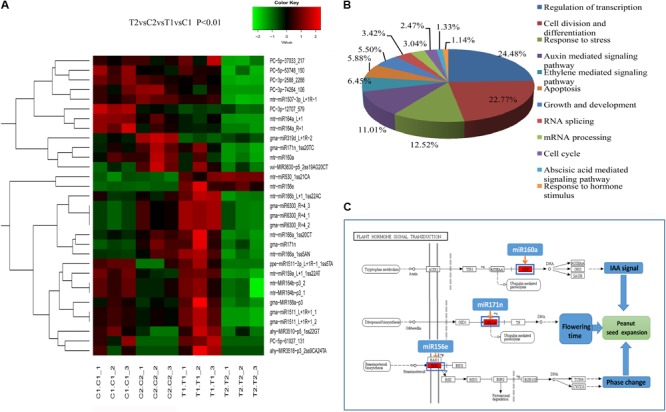
Clustering of partially differentially expressed miRNAs in the two peanut RILs (A). Biological Process GO categories of the predicted target genes of the differentially expressed miRNAs (B). KEGG pathways related to plant hormone signal transduction targeted by differentially expressed miRNAs (C).
FIGURE 4
FIGURE 4
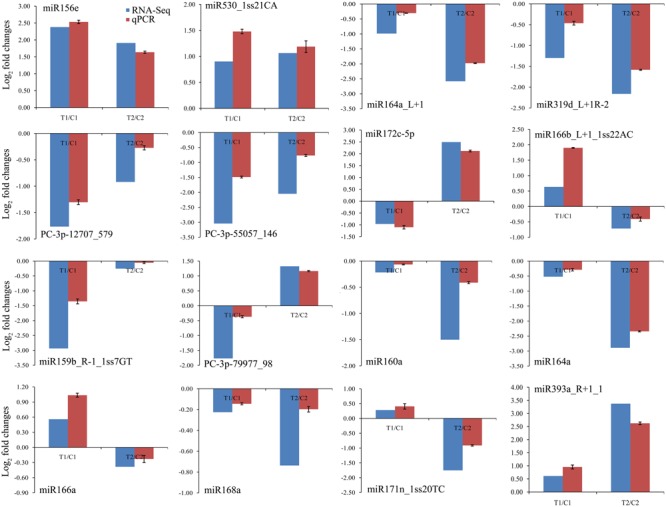
Comparisons of the expression levels of 16 miRNAs in seeds of two peanut RILs. The expression levels were normalized to the expression of Actin in qPCR. Red indicates the fold-changes of miRNA expression levels determined by qPCR. Blue indicates the miRNA expression fold-changes generated from the deep sequencing. The experiments were repeated three times, and vertical bars indicate the standard errors.
FIGURE 5
FIGURE 5
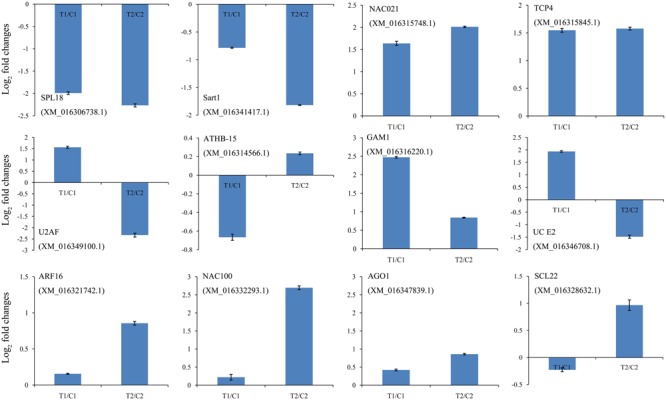
Comparison of the relative expression levels of 12 target genes in two peanut RILs. The expression levels were normalized to the expression of Actin in qPCR. The log2 fold-changes in target gene expression as determined by qPCR are shown in blue. The experiments were repeated three times and vertical bars indicate the standard errors.
FIGURE 6
FIGURE 6
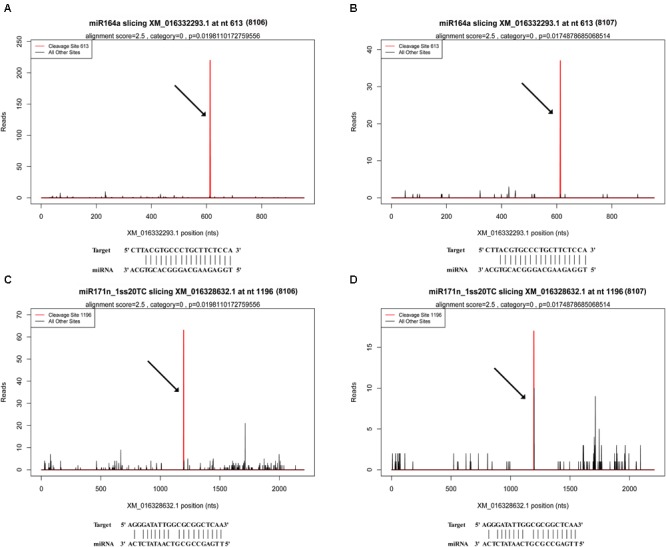
Examples of T-plots of miRNA targets in two peanut RILs confirmed by degradome sequencing. The T-plots show the distribution of the degradome tags along the full length of the target mRNA sequence. The vertical red line indicates the cleavage site of each transcript and is also shown by an arrow. (A,B) The cleavage features in NAC domain-containing protein 100-like (XM_016332293.1) mRNA by miR164a in the two peanut RILs, 8106 and 8107, respectively. (C,D) The cleavage features in scarecrow-like protein 22 (XM_016328632.1) mRNA by miR171n_1ss20TC in RILs 8106 and 8107, respectively.
FIGURE 7
FIGURE 7
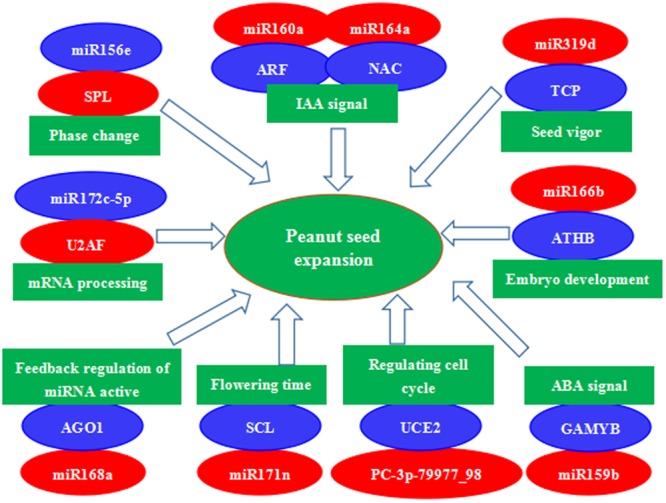
A proposed regulatory mechanism involving differentially expressed miRNAs and their target genes during peanut seed expansion. Red indicates down-regulation and blue indicates up-regulation of gene expression.

References

    1. Achard P., Herr A., Baulcombe D., Harberd N. (2004). Modulation of floral development by a gibberellin-regulated microRNA. Development 131 3357–3365. 10.1242/dev.01206 - DOI - PubMed
    1. Addo-Quaye C., Eshoo T. W., Bartel D. P., Axtell M. J. (2008). Endogenous siRNA and miRNA targets identified by sequencing of the Arabidopsis degradome. Curr. Biol. 18 758–762. 10.1016/j.cub.2008.04.042 - DOI - PMC - PubMed
    1. Addo-Quaye C., Miller W., Axtell M. J. (2009a). CleaveLand: a pipeline for using degradome data to find cleaved small RNA targets. Bioinformatics 25 130–131. 10.1093/bioinformatics/btn604 - DOI - PMC - PubMed
    1. Addo-Quaye C., Snyder J. A., Park Y. B., Li Y. F., Sunkar R., Axtell M. J. (2009b). Sliced microRNA targets and precise loop-first processing of MIR319 hairpins revealed by analysis of the Physcomitrella patens degradome. RNA 15 2112–2121. 10.1261/rna.1774909 - DOI - PMC - PubMed
    1. Aldana A. B., Fites R. C., Pattee H. E. (1972). Changes in nucleic acids, protein and ribonuclease activity during maturation of peanut seeds. Plant Cell Physiol. 13 515–521. 10.1093/oxfordjournals.pcp.a074764 - DOI

LinkOut - more resources