Comment
. 2018 May 1;128(5):1727-1730.
doi: 10.1172/JCI120388. Epub 2018 Apr 16.

The evolving landscape of predictive biomarkers of response to PARP inhibitors

Comment

The evolving landscape of predictive biomarkers of response to PARP inhibitors

Anish Thomas et al. J Clin Invest. .

Abstract

Poly(ADP-ribose) polymerase inhibitors (PARPis) are DNA-damaging agents that trap PARP-DNA complexes and interfere with DNA replication. Three PARPis - olaparib, niraparib, and rucaparib - were recently approved by the FDA for the treatment of breast and ovarian cancers. These PARPis, along with 2 others (talazoparib and veliparib), are being evaluated for their potential to treat additional malignancies, including prostate cancers. While lack of PARP-1 confers high resistance to PARPis, it has not been established whether or not the levels of PARP-1 directly correlate with tumor response. In this issue of the JCI, Makvandi and coworkers describe an approach to address this question using [18F]FluorThanatrace, an [18F]-labeled PARP-1 inhibitor, for PET. The tracer was taken up by patient tumor tissue and appeared to differentiate levels of PARP-1 expression; however, future studies should be aimed at determining if this tracer can be used to stratify patient response to PARPi therapy.


Conflict of interest statement

Conflict of interest: The authors have declared that no conflict of interest exists.

Figures

Figure 1
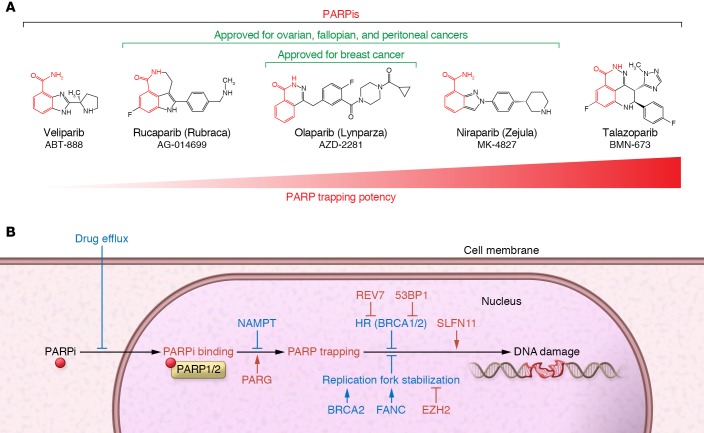
Figure 1. Clinical PARP inhibitors (PARPis) and determinants of response and resistance to PARPis.
(A) Three PARPis are approved for ovarian and/or breast cancers. All PARPis comprise a nicotinamide moiety (red), which binds the β-NAD+ acceptor site in PARP-1 and PARP-2. PARPis differ by their PARP-trapping potency. (B) PARPis are potential substrates for the drug efflux pumps (PgP/ABCB1), which limit cellular accumulation. Binding of the PARPis to the NAD+ site of PARP-1 and PARP-2 (red circle) results both in catalytic inhibition by competitive inhibition of β-NAD+ binding and in PARP trapping by a proposed reverse allosteric mechanism (5). Trapping can be mitigated by increased PARP-1 and PARP-2 auto-PARylation due to high NAD+ synthesis by nicotinamide phosphoribosyltransferase (NAMPT) or enhanced by PAR removal by poly(ADP-ribose) glycohydrolase (PARG). Trapping of PARP-1 and PARP-2 damages replicating cells. Cells can alleviate this effect by stabilizing replication forks through BRCA2 and other factors of the Fanconi anemia pathway (FANC) or suppression of the polycomb complex (EZH2). Damaged cells can also repair the broken forks by homologous recombination (HR) involving BRCA1 or BRCA2 or commit themselves to death through Schlafen 11 (SLFN11). Inactivation of 53BP1 and REV7 reactivates HR. Red symbols define determinants of response to the PARPis. Blue symbols signify resistance to PARPis. Synthetic lethality (4) occurs in cancer cells deficient for the resistance factors highlighted in blue. BRCA1 and BRCA2 were the first resistance factors identified and led to the approval of PARPis as monotherapy.

Comment on

  • A PET imaging agent for evaluating PARP-1 expression in ovarian cancer.
    Makvandi M, Pantel A, Schwartz L, Schubert E, Xu K, Hsieh CJ, Hou C, Kim H, Weng CC, Winters H, Doot R, Farwell MD, Pryma DA, Greenberg RA, Mankoff DA, Simpkins F, Mach RH, Lin LL. Makvandi M, et al. J Clin Invest. 2018 May 1;128(5):2116-2126. doi: 10.1172/JCI97992. Epub 2018 Apr 16. J Clin Invest. 2018. PMID: 29509546 Free PMC article. Clinical Trial.

References

    1. Leidecker O, et al. Serine is a new target residue for endogenous ADP-ribosylation on histones. Nat Chem Biol. 2016;12(12):998–1000. doi: 10.1038/nchembio.2180. - DOI - PMC - PubMed
    1. Daniels CM, Ong SE, Leung AK. The promise of proteomics for the study of ADP-ribosylation. Mol Cell. 2015;58(6):911–924. doi: 10.1016/j.molcel.2015.06.012. - DOI - PMC - PubMed
    1. Pommier Y, O’Connor MJ, de Bono J. Laying a trap to kill cancer cells: PARP inhibitors and their mechanisms of action. Sci Transl Med. 2016;8(362):362ps17. doi: 10.1126/scitranslmed.aaf9246. - DOI - PubMed
    1. Lord CJ, Ashworth A. PARP inhibitors: synthetic lethality in the clinic. Science. 2017;355(6330):1152–1158. doi: 10.1126/science.aam7344. - DOI - PMC - PubMed
    1. Murai J, et al. Trapping of PARP1 and PARP2 by clinical PARP inhibitors. Cancer Res. 2012;72(21):5588–5599. doi: 10.1158/0008-5472.CAN-12-2753. - DOI - PMC - PubMed

Publication types

Substances