. 2018 May;24(5):852-859.
doi: 10.3201/eid2405.171700.

Epidemic Dynamics of Vibrio parahaemolyticus Illness in a Hotspot of Disease Emergence, Galicia, Spain

Epidemic Dynamics of Vibrio parahaemolyticus Illness in a Hotspot of Disease Emergence, Galicia, Spain

Jaime Martinez-Urtaza et al. Emerg Infect Dis. 2018 May.

Abstract

Galicia in northwestern Spain has been considered a hotspot for Vibrio parahaemolyticus infections. Infections abruptly emerged in 1998 and, over the next 15 years, were associated with large outbreaks caused by strains belonging to a single clone. We report a recent transition in the epidemiologic pattern in which cases throughout the region have been linked to different and unrelated strains. Global genome-wide phylogenetic analysis revealed that most of the pathogenic strains isolated from infections were associated with globally diverse isolates, indicating frequent episodic introductions from disparate and remote sources. Moreover, we identified that the 2 major switches in the epidemic dynamics of V. parahaemolyticus in the regions, the emergence of cases and an epidemiologic shift in 2015-2016, were associated with the rise of sea surface temperature in coastal areas of Galicia. This association may represent a fundamental contributing factor in the emergence of illness linked to these introduced pathogenic strains.

Keywords: Galicia; Spain; Vibrio parahaemolyticus; bacteria; climate change; enteric infections; epidemiology; food safety; gastroenteritis; global phylogeny; seafood safety; warming; whole-genome sequencing.


Figures

Figure 1
Figure 1
Phylogenetic reconstruction of Vibrio parahaemolyticus based on 738 available genomes. Red dots indicate isolates from Spain collected over the past 20 years from clinical settings and environmental sources. Colors represent sequence types, and areas without color correspond to undetermined sequence types. Scale bars represent nucleotide substitutions per site.
Figure 2
Figure 2
Phylogeny of Vibrio parahaemolyticus isolates from Galicia, Spain. A) Phylogenetic inference of the 42 genomes from Spain identified in this study (red text) along with all other genomes identified in the same clusters by the global phylogeny with their corresponding sequence types (STs). B) Phylogenetic tree of genomes belonging to ST3 (pandemic clone). C) Phylogenetic tree of genomes included in ST36 in the global phylogeny. Gray dots indicate bootstrap values supporting the nodes; dot sizes indicate 80% (smallest) to 100% (largest). Values <80% are not shown. Scale bars represent nucleotide substitutions per site. ND, not determined.
Figure 3
Figure 3
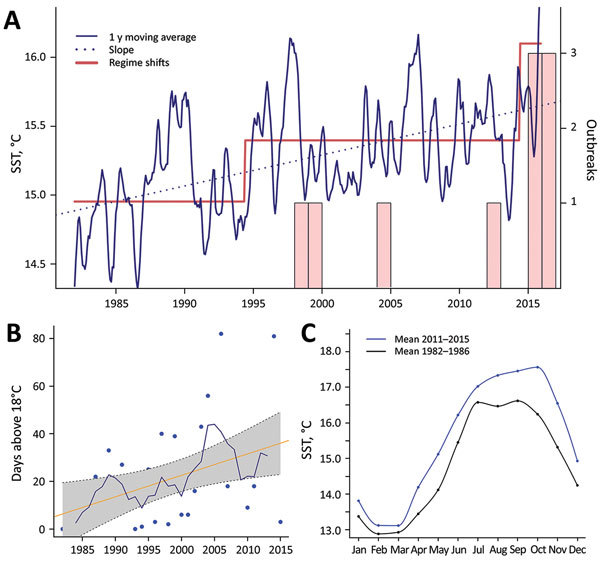
Recent environmental warming trends in Galicia, Spain, 1982–2016. Trends in the mean values of SST were estimated using daily SST data from a coastal area defined by the coordinates 42°–43°N and 8.5°–9.5°W. A) Mean SST records show stepwise changes rather than a linear pattern. Two regime shifts occurred in June 1994 (0.4°C warming) and June 2014 (0.7°C), which correspond with the first emergence of Vibrio parahaemolyticus cases and the epidemiologic shifts observed for 2015 and 2016. B) Number of days with SST >18°C (blue dot), 5-year moving average (blue line), and regression line (yellow line); slope is of ≈1 d/y (e.g., gaining 1 d/y). C) Mean SST data for Galicia for 2 periods, demonstrating the generalized warming and expansion of season with favorable conditions for sustaining Vibrio organisms in the environment and hence increasing risk of infection. SST, sea surface temperature.

References

    1. Vezzulli L, Grande C, Reid PC, Hélaouët P, Edwards M, Höfle MG, et al. Climate influence on Vibrio and associated human diseases during the past half-century in the coastal North Atlantic. Proc Natl Acad Sci U S A. 2016;113:E5062–71. 10.1073/pnas.1609157113 - DOI - PMC - PubMed
    1. Baker-Austin CL, Trinanes JA, Taylor NGH, Hartnell R, Siitonen A, Martinez-Urtaza J. Emerging Vibrio risk at high latitudes in response to ocean warming. Nat Clim Chang. 2012;3:73–7. 10.1038/nclimate1628 - DOI
    1. Martinez-Urtaza J, Bowers JC, Trinanes J, DePaola A. Climate anomalies and the increasing risk of Vibrio parahaemolyticus and Vibrio vulnificus illnesses. Food Res Int. 2010;43:1780–90. 10.1016/j.foodres.2010.04.001 - DOI
    1. Martinez-Urtaza J, Lozano-Leon A, Varela-Pet J, Trinanes J, Pazos Y, Garcia-Martin O. Environmental determinants of the occurrence and distribution of Vibrio parahaemolyticus in the rias of Galicia, Spain. Appl Environ Microbiol. 2008;74:265–74. 10.1128/AEM.01307-07 - DOI - PMC - PubMed
    1. Martinez-Urtaza J, Powell A, Jansa J, Rey JL, Montero OP, Campello MG, et al. Epidemiological investigation of a foodborne outbreak in Spain associated with U.S. West Coast genotypes of Vibrio parahaemolyticus. Springerplus. 2016;5:87. 10.1186/s40064-016-1728-1 - DOI - PMC - PubMed

Publication types

MeSH terms

LinkOut - more resources