


Atrial fibrillation symptom profiles associated with healthcare utilization: A latent class regression analysis
- PMID: 29665065
- PMCID: PMC6192872
- DOI: 10.1111/pace.13356
Atrial fibrillation symptom profiles associated with healthcare utilization: A latent class regression analysis
Abstract
Background: Symptoms drive healthcare use among adults with atrial fibrillation, but limited data are available regarding which symptoms are most problematic and which patients are most at-risk. The purpose of this study was to: (1) identify clusters of patients with similar symptom profiles, (2) characterize the individuals within each cluster, and (3) determine whether specific symptom profiles are associated with healthcare utilization.
Methods: We conducted a cross-sectional secondary data analysis of 1,501 adults from the Vanderbilt Atrial Fibrillation Registry. Participants were recruited from Vanderbilt cardiology clinics, emergency department, and in-patient services. Subjects included in our analysis had clinically verified atrial fibrillation and a completed symptom survey. Symptom and healthcare utilization data were collected with the University of Toronto Atrial Fibrillation Severity Scale. Latent class regression analysis was used to identify symptom clusters, with clinical and demographic variables included as covariates. We used Poisson regression to examine the association between latent class membership and healthcare utilization.
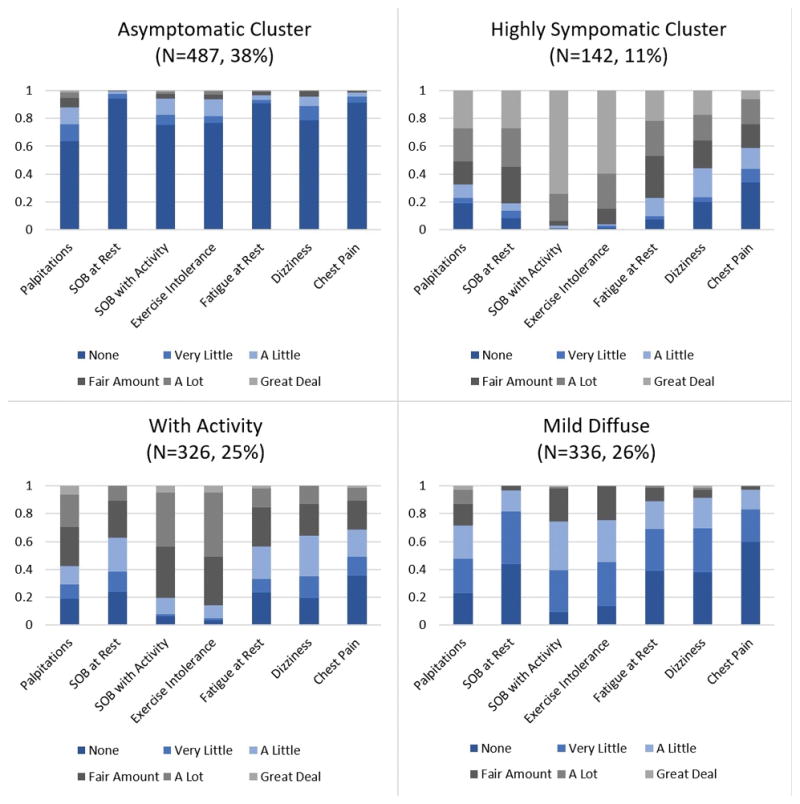
Results: Participants were predominantly male (67%) with a mean age of 58.4 years (±11.9). Four latent classes were evident, including an Asymptomatic cluster (N = 487, 38%), Highly Symptomatic cluster (N = 142, 11%), With Activity cluster (N = 326, 25%), and Mild Diffuse cluster (N = 336, 26%). Highly Symptomatic membership was associated with the greatest rate of emergency department visits and hospitalizations (incident rate ratio 2.4, P < 0.001).
Conclusions: Clinically meaningful atrial fibrillation symptom profiles were identified that were associated with increased rates of emergency department visits and hospitalizations.
Keywords: atrial fibrillation; emergency service; hospitalization; symptom cluster.
© 2018 Wiley Periodicals, Inc.
Conflict of interest statement
No conflicts of interest to report.
Figures
References
-
- van Wijk CM, Kolk AM. Sex differences in physical symptoms: the contribution of symptom perception theory. Soc Sci Med. 1997 - PubMed
-
- Armstrong TS. Symptoms experience: a concept analysis. Oncol Nurs Forum. 2003 - PubMed
-
- Posey AD. Symptom perception: a concept exploration. Nurs Forum. 2006 - PubMed
-
- Teel CS, Meek P, McNamara AM, et al. Perspectives unifying symptom interpretation. Image J Nurs Sch. 1997 - PubMed
-
- McCabe PJ, Rhudy LM, DeVon HA. Patients’ experiences from symptom onset to initial treatment for atrial fibrillation. J Clin Nurs. 2015 - PubMed
Publication types
MeSH terms
Grants and funding
LinkOut - more resources
Full Text Sources
Other Literature Sources
Medical
