. 2018 Apr 17;15(1):33.
doi: 10.1186/s12977-018-0415-4.

The HTLV-1 oncoprotein Tax is modified by the ubiquitin related modifier 1 (Urm1)

Affiliations

The HTLV-1 oncoprotein Tax is modified by the ubiquitin related modifier 1 (Urm1)

Rita Hleihel et al. Retrovirology. .

Abstract

Background: Adult T-cell leukemia/lymphoma (ATL) is an aggressive malignancy secondary to chronic human T-cell lymphotropic virus 1 infection, triggered by the virally encoded oncoprotein Tax. The transforming activity and subcellular localization of Tax is strongly influenced by posttranslational modifications, among which ubiquitylation and SUMOylation have been identified as key regulators of the nuclear/cytoplasmic shuttling of Tax, as well as its ability to activate NF-κB signaling.

Results: Adding to the complex posttranslational modification landscape of Tax, we here demonstrate that Tax also interacts with the ubiquitin-related modifier 1 (Urm1). Conjugation of Urm1 to Tax results in a redistribution of Tax to the cytoplasm and major increase in the transcription of the NF-ĸB targets Rantes and interleukin-6. Utilizing a tax-transgenic Drosophila model, we show that the Urm1-dependent subcellular targeting of Tax is evolutionary conserved, and that the presence of Urm1 is strongly correlated with the transcriptional output of Diptericin, an antimicrobial peptide and established downstream target of NF-κB in flies.

Conclusions: These data put forward Urm1 as a novel Tax modifier that modulates its oncogenic activity and hence represents a potential novel target for developing new strategies for treating ATL.

Keywords: ATL; HTLV-1; NF-κB; Oncogenesis; Tax; Urm1.


Figures
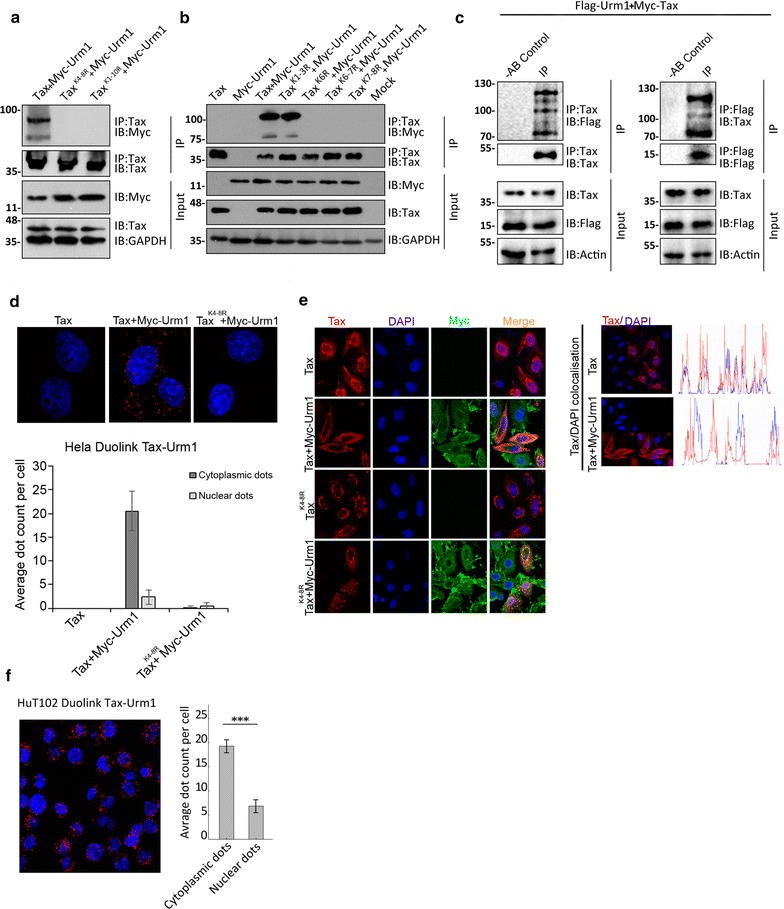
Fig. 1
Fig. 1
Urmylation of the HTLV-1 oncoprotein Tax strongly influences the subcellular localization of Tax. a Tax is targeted by urmylation upon co-expression of wild-type Tax and Myc-tagged Urm1 in HeLa cells. Mutagenesis of Tax, replacing all lysine residues (TaxK1-10R) or lysine 4-8 (TaxK4-8R) for arginines, completely abolished Urm1 conjugation to Tax. b Mutational analysis of the indicated lysine residues in Tax, expressed in HeLa cells, indicates that Urm1 targets the same lysine residues as ubiquitin and SUMO for conjugation, lysine residues 4-8. c Tax is urmylated in protein lysates derived from Drosophila melanogaster adult eyes expressing Myc-Tax and Flag-Urm1 under control of the GAL4/UAS system, using GMR-GAL4 as driver. – AB control represents a negative control, in which no antibody was added to the immunoprecipitation. d Duolink® in situ proximity ligation assay performed in HeLa cells expressing Tax and Myc-tagged Urm1, depicting that Tax-Urm1 protein complexes are primarily localized in the cytoplasmic compartment n = 25, P < 0.0001. e Co-expression of Myc-Urm1 (green) and Tax (red) in HeLa cells causes a shift in the subcellular localization of Tax, with a clear increase of cytoplasmic Tax, as compared to cells expressing Tax alone (two upper panels). The Urm1-dependent nuclear exclusion of Tax is abrogated in cells expressing the TaxK4-8R mutant, indicating that lysine 4-8 is required for Urm1-mediated regulation of Tax (two lower panels). f Also in ATL-derived HuT102 cells, interaction between endogenous Tax and endogenous Urm1 proteins is primarily encountered in the cytoplasm, n = 42, P < 0.0001. Representative images for the Duolink® experiments and immunohistochemical analysis in HeLa cells were acquired by confocal microscopy using either a Zeiss LSM 510 META confocal laser microscope or a Zeiss LSM 710 confocal microscope (Zeiss, Oberkochen, Germany) with a Plan Apochromat 63/1.4 numeric aperture oil-immersion objective using Zen 2009 (Carl Zeiss). High-resolution images were obtained with a deconvolution program (Autodeblur; Image Quant), using blind iterative algorithms
Fig. 2
Fig. 2
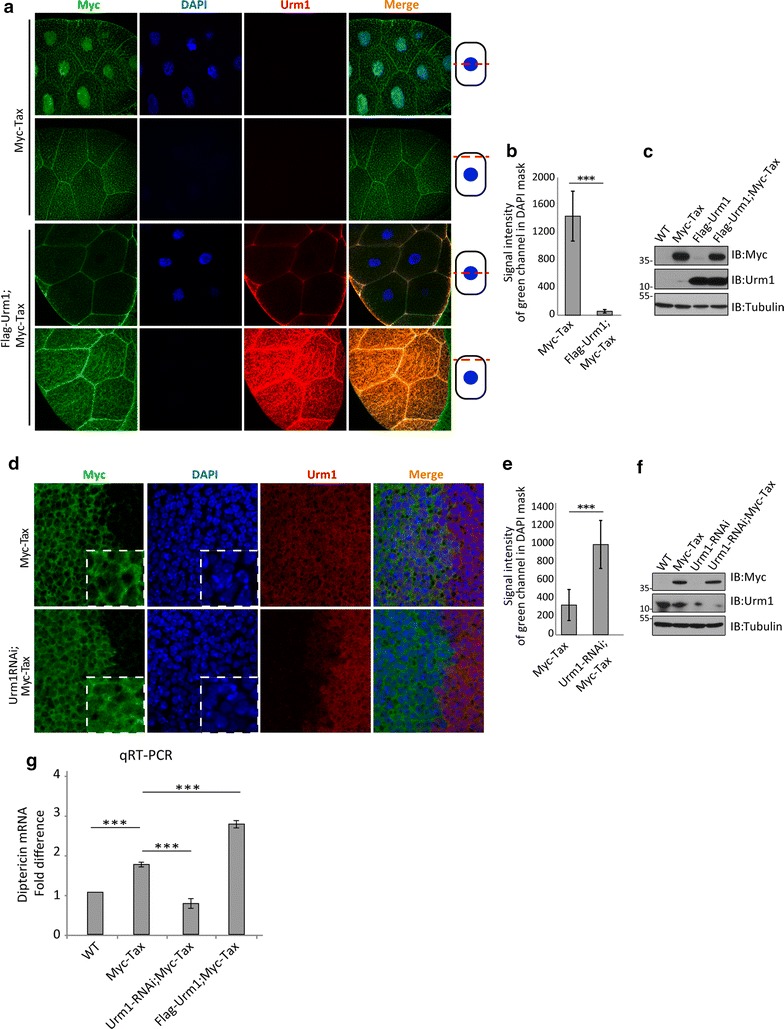
Posttranslational modification of Tax by urmylation regulates the nuclear-cytoplasmic shuttling of Tax, and in extension its ability to activate NF-κB signaling. a Co-expression of Flag-Urm1 (red) and Myc-Tax (green) in 3rd instar larval Drosophila salivary glands (employing Sgs-GAL4 as driver) results in a complete blockage of the nuclear Myc-Tax accumulation, which is observed upon expression of Myc-Tax alone. Quantification is shown in (b), n = 12, P < 0.0001. c Verification of the expression levels of Myc-Tax and Flag-Urm1, induced by the UAS/GAL4 system in Drosophila, by Western Blot. d RNAi-mediated knockdown of Urm1 promotes a significant increase in the amount of nuclear Tax, analyzed in the 3rd instar larval wing disc of flies with the indicated genotypes. Engrailed-GAL4 was used to drive expression of Myc-Tax (green) alone (top) and together with Urm1-RNAi (red) (bottom) specifically in the posterior half of the wing disc (left side of each image), while preserving wild-type tissue in the anterior part (right side of each image). The images are taken at the border between the anterior and posterior side, thus displaying the control wild-type tissue as well as the genetically modified area expressing Myc-Tax and/or Urm1-RNAi in the same view. Quantification of Tax/DAPI colocalization is shown in (e), n = 14, P < 0.0001. f Verification of the GAL4/UAS-mediated induction of Myc-Tax expression and the efficiency of RNAi-mediated knockdown of Urm1 in Drosophila, visualized by Western Blot. g The ability of Tax to induce activation of the NF-κB pathway is strongly correlated with the expression levels of Urm1, as indicated by qRT-PCR analysis of Diptericin, an established transcriptional target of NF-κB in the adult Drosophila fat body. Expression of Myc-Tax, Urm1-RNAi and Flag-Urm1 was induced by the UAS/GAL4 system, utilizing FB-GAL4 as driver, and the qRT-PCR was performed in triplicates on two biological replicates (P < 0.001). Images depicting Drosophila salivary glands in (a) and wing imaginal discs in (d) were acquired using a Nikon C1 confocal microscope, magnifications, ×60 Plan Apo VC NA 1,40 oil and ×100 Plan Apo VC NA 1,40 oil and EZ-C1 software. The Duolink® images were acquired as described in Fig. 1
Fig. 3
Fig. 3
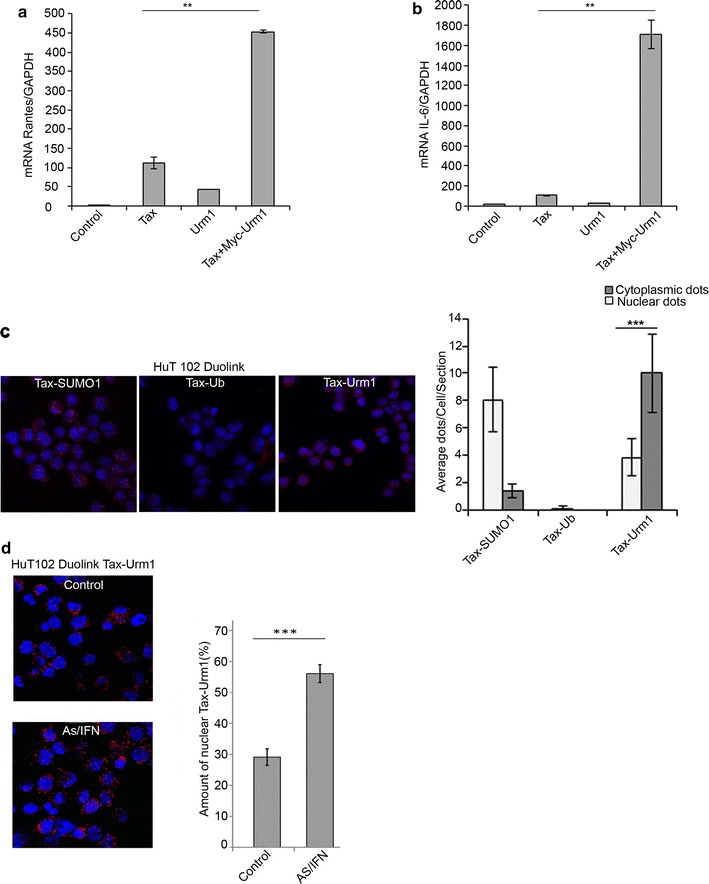
Urm1 augments Tax-induced transcriptional upregulation of NF-ĸB target genes. a, b The mRNA levels of Rantes and IL-6, both known as transcriptional targets of NF-ĸB, are dramatically increased in HeLa cells expressing Tax together with Urm1, as compared with cells expressing Tax alone. Quantitative RT-PCR, where the levels of Rantes (a) and IL-6 (b) mRNA are normalized against the housekeeping gene GAPDH, P < 0.001. c Comparison of the subcellular localization of interaction events between Urm1 and Tax, in relation to complex formation involving Tax and ubiquitin, versus Tax and SUMO-1, visualized using proximity ligation assay in HuT102 cells. d Treatment of HuT102 cells with arsenic/IFN counteracts the Urm1-depentent cytoplasmic shuttling of Tax, resulting in an increased accumulation of Tax1-Urm protein complexes in the nucleus, n = 42, P <  0.001

References

    1. Hasegawa H, Sawa H, Lewis MJ, Orba Y, Sheehy N, Yamamoto Y, Ichinohe T, Tsunetsugu-Yokota Y, Katano H, Takahashi H, et al. Thymus-derived leukemia-lymphoma in mice transgenic for the Tax gene of human T-lymphotropic virus type I. Nat Med. 2006;12(4):466–472. doi: 10.1038/nm1389. - DOI - PubMed
    1. Matsuoka M, Jeang KT. Human T-cell leukaemia virus type 1 (HTLV-1) infectivity and cellular transformation. Nat Rev Cancer. 2007;7(4):270–280. doi: 10.1038/nrc2111. - DOI - PubMed
    1. Bangham CR, Ratner L. How does HTLV-1 cause adult T-cell leukaemia/lymphoma (ATL)? Curr Opin Virol. 2015;14:93–100. doi: 10.1016/j.coviro.2015.09.004. - DOI - PMC - PubMed
    1. Hermine O, Wattel E, Gessain A, Bazarbachi A. Adult T cell leukaemia: a review of established and new treatments. BioDrugs. 1998;10(6):447–462. doi: 10.2165/00063030-199810060-00003. - DOI - PubMed
    1. Kfoury Y, Nasr R, Hermine O, de The H, Bazarbachi A. Proapoptotic regimes for HTLV-I-transformed cells: targeting Tax and the NF-kappaB pathway. Cell Death Differ. 2005;12(Suppl 1):871–877. doi: 10.1038/sj.cdd.4401624. - DOI - PubMed

Publication types

MeSH terms

LinkOut - more resources