. 2018 May 1;115(18):E4304-E4311.
doi: 10.1073/pnas.1803294115. Epub 2018 Apr 16.

Deep learning improves prediction of drug-drug and drug-food interactions

Affiliations

Deep learning improves prediction of drug-drug and drug-food interactions

Jae Yong Ryu et al. Proc Natl Acad Sci U S A. .

Abstract

Drug interactions, including drug-drug interactions (DDIs) and drug-food constituent interactions (DFIs), can trigger unexpected pharmacological effects, including adverse drug events (ADEs), with causal mechanisms often unknown. Several computational methods have been developed to better understand drug interactions, especially for DDIs. However, these methods do not provide sufficient details beyond the chance of DDI occurrence, or require detailed drug information often unavailable for DDI prediction. Here, we report development of a computational framework DeepDDI that uses names of drug-drug or drug-food constituent pairs and their structural information as inputs to accurately generate 86 important DDI types as outputs of human-readable sentences. DeepDDI uses deep neural network with its optimized prediction performance and predicts 86 DDI types with a mean accuracy of 92.4% using the DrugBank gold standard DDI dataset covering 192,284 DDIs contributed by 191,878 drug pairs. DeepDDI is used to suggest potential causal mechanisms for the reported ADEs of 9,284 drug pairs, and also predict alternative drug candidates for 62,707 drug pairs having negative health effects. Furthermore, DeepDDI is applied to 3,288,157 drug-food constituent pairs (2,159 approved drugs and 1,523 well-characterized food constituents) to predict DFIs. The effects of 256 food constituents on pharmacological effects of interacting drugs and bioactivities of 149 food constituents are predicted. These results suggest that DeepDDI can provide important information on drug prescription and even dietary suggestions while taking certain drugs and also guidelines during drug development.

Keywords: DeepDDI; deep learning; drug–drug interactions; drug–food interactions; structural similarity profile.


Conflict of interest statement

Conflict of interest statement: The authors and sponsor declare the technology described here is patent filed (KR-10-2017-0164115) for potential commercialization.

Figures
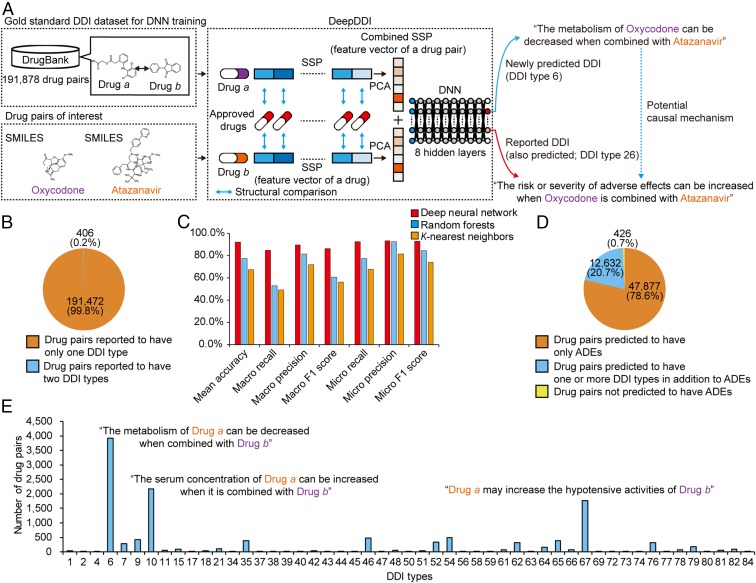
Fig. 1.
Fig. 1.
Overall scheme, performance evaluation, and application of DeepDDI. (A) DeepDDI consists of the structural similarity profile (SSP) generation pipeline and deep neural network (DNN). DeepDDI accepts chemical structures (in SMILES describing the structure of a chemical compound) and names of drugs in pairs as inputs, and predicts their potential drug–drug interaction (DDI) types as outputs in human-readable sentences having the input drug names. DNN of DeepDDI is a multilabel classification model that can predict multiple DDI types at the same time for a given drug pair. To develop DeepDDI, a gold standard DDI dataset covering 191,878 drug pairs was obtained from DrugBank, and used to train the DNN of DeepDDI. A single, combined SSP (feature vector of a drug pair) is generated for each input drug pair (SI Appendix, Materials and Methods). DeepDDI has many implications such as prediction of potential causal mechanism for the adverse drug evens (ADEs) of a drug pair of interest (blue dotted arrow) using the output sentences. It should be noted that the use of input data on the same drug pairs, but with different drug orders, results in different DeepDDI output sentences. For example, the use of input data in the order of atazanavir and oxycodone generated a DeepDDI output sentence corresponding to the DDI type 26 with atazanavir appearing before oxycodone; and the output sentence for DDI type 6 was not generated in this case. (B) Number (percentage) of drug pairs in the gold standard DDI dataset having a single DDI type or two. The dataset does not have drug pairs having more than two DDI types. (C) Prediction performance of DeepDDI for classifying DDI types for drug pairs in the gold standard DDI dataset using three different machine learning algorithms (SI Appendix, Materials and Methods). (D) DeepDDI prediction results for the drug pairs reported to have ADEs in the gold standard DDI dataset. (E) Number of drug pairs having additionally predicted DDI types using DeepDDI in addition to the reported ADEs.
Fig. 2.
Fig. 2.
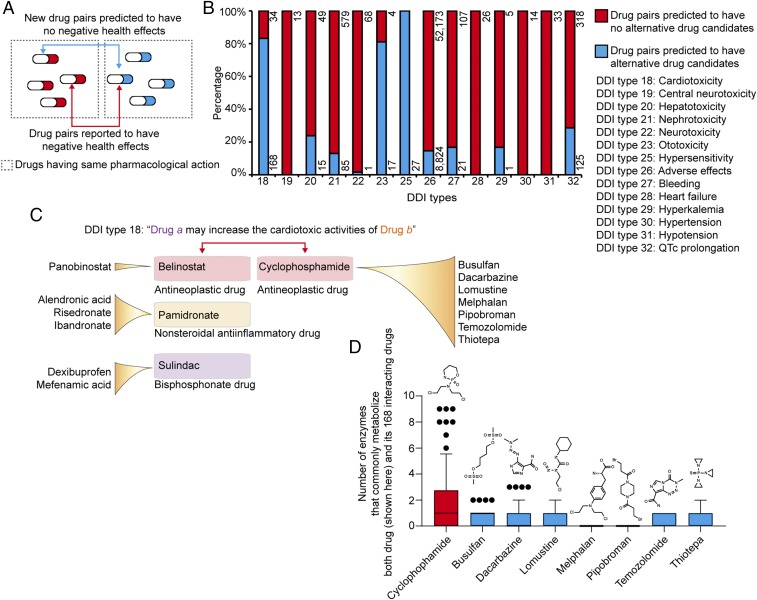
Prediction of new drug members for a drug pair to avoid the reported negative health effects. (A) For a drug pair with DDI reported to have negative health effects (bidirectional red arrow, see Fig. 2B and Dataset S1 for the 14 relevant DDI types), new drug pairs (bidirectional blue arrow) having alternative drug members were predicted using DeepDDI. (B) Percentage (number) of the reported drug pairs that were predicted to have new drug members that would lower the chance of each DDI type having negative health effects. Key toxicity terms are listed for each DDI type next to the graph. (C) Alternative drug members predicted for cyclophosphamide and its three interacting drugs (among the 168 interacting drugs), which could lower the chance of cardiotoxic activity (DDI type 18). If cyclophosphamide has to be used to treat a cancer despite its cardiotoxicity, its interacting drugs (i.e., belinostat, pamidronate, and sulindac) can be replaced with alternative drugs having the same pharmacological effects to minimize the chance of cardiotoxicity. (D) Number of enzymes that commonly metabolize cyclophosphamide and each of its 168 interacting drugs (red box), and seven new drug members predicted in place of cyclophosphamide and each of its 168 interacting drug (blue box). Boxes represent the 25th–75th percentiles, while whiskers represent the 5th–95th percentiles. Drug pairs with new drug members were predicted to have lower chance of cardiotoxic activity, while achieving the intended anticancer efficacy.
Fig. 3.
Fig. 3.
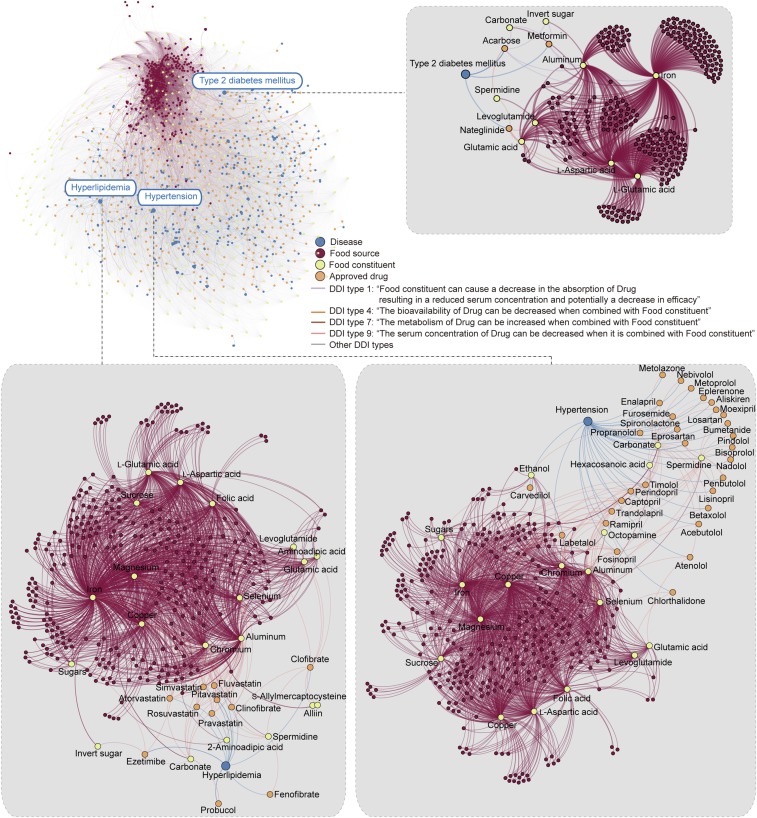
Prediction of food constituents that reduce the in vivo concentration of approved drugs. A network showing relationships among 357 diseases, 430 approved drugs, 274 food constituents, and 356 food sources was created using the DeepDDI output sentences obtained from 358,995 drug-food constituent pairs (Datasets S5 and S6). As representative examples, local networks for hypertension, hyperlipidemia, and type 2 diabetes mellitus are presented in gray boxes. In vivo concentration of drugs was predicted to be reduced by the decreased absorption (DDI type 1), decreased bioavailability (DDI type 4), increased metabolism (DDI type 7), and decreased serum concentration (DDI type 9) through drug–food constituent interactions (DFIs). Networks were drawn using Gephi (33).
Fig. 4.
Fig. 4.
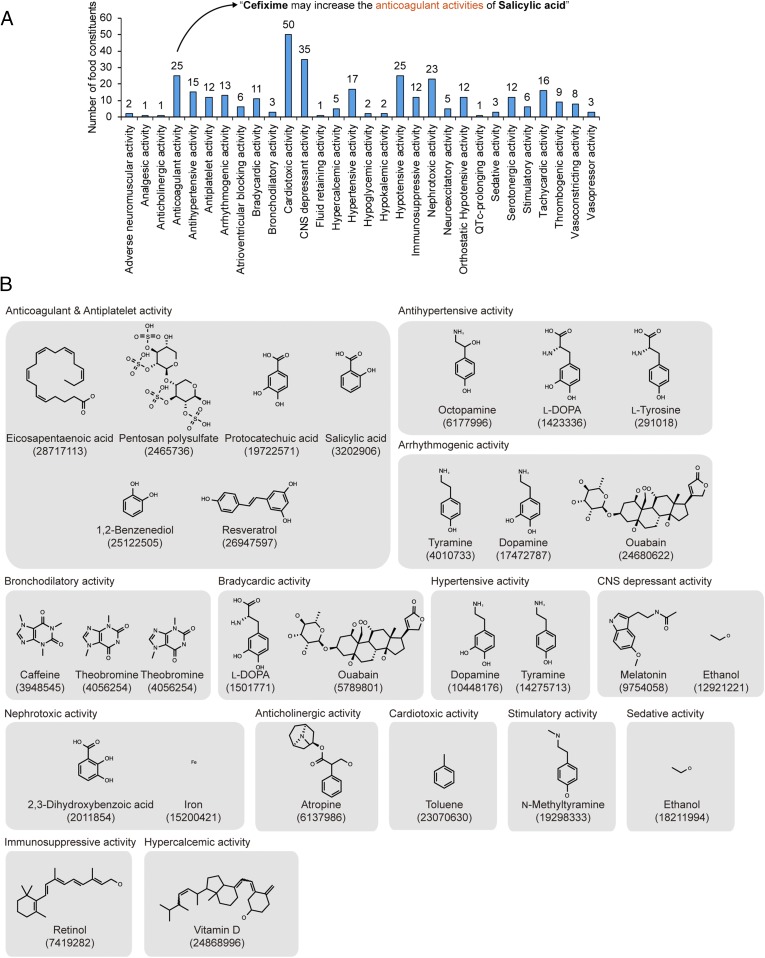
Bioactivity prediction of food constituents. (A) Number of food constituents predicted to have each bioactivity based on the DeepDDI output sentences (SI Appendix, Fig. S10B). A unique set of 149 unique food constituents were predicted to have at least one of the 30 bioactivities. (B) Twenty-three food constituents grouped in gray boxes based on their predicted bioactivities among the 149 food constituents. These food constituents have reported evidences. Number below each chemical name refers to PubMed identifier (PMID) of relevant literature (see Dataset S7 for details).

References

    1. Edwards IR, Aronson JK. Adverse drug reactions: Definitions, diagnosis, and management. Lancet. 2000;356:1255–1259. - PubMed
    1. Kantor ED, Rehm CD, Haas JS, Chan AT, Giovannucci EL. Trends in prescription drug use among adults in the United States from 1999-2012. JAMA. 2015;314:1818–1831. - PMC - PubMed
    1. Qato DM, Wilder J, Schumm LP, Gillet V, Alexander GC. Changes in prescription and over-the-counter medication and dietary supplement use among older adults in the United States, 2005 vs 2011. JAMA Intern Med. 2016;176:473–482. - PMC - PubMed
    1. Pirmohamed M, Orme M. Drug Interactions of Clinical Importance. Chapman & Hall; London: 1998. pp. 888–912.
    1. Onakpoya IJ, Heneghan CJ, Aronson JK. Post-marketing withdrawal of 462 medicinal products because of adverse drug reactions: A systematic review of the world literature. BMC Med. 2016;14:10. - PMC - PubMed

Publication types