. 2018 Apr 17;8(1):6076.
doi: 10.1038/s41598-018-24306-1.

Mutation status and prognostic values of KRAS, NRAS, BRAF and PIK3CA in 353 Chinese colorectal cancer patients

Affiliations

Mutation status and prognostic values of KRAS, NRAS, BRAF and PIK3CA in 353 Chinese colorectal cancer patients

Fang Guo et al. Sci Rep. .

Abstract

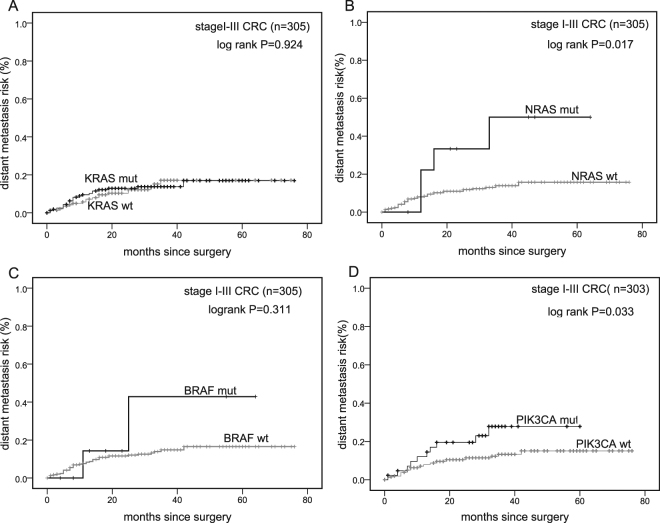
Mutations in KRAS exon 2, BRAF and PIK3CA are commonly present in colorectal cancer (CRC) worldwide, but few data about RAS mutations outside KRAS exon 2 are available for Chinese CRCs. We, therefore, determined the mutation frequencies and prognostic values of KRAS exon 2, 3 and 4, NRAS exon 2 and 3, PIK3CA exon 9 and 20, and BRAF exon 15 by PCR and direct sequencing in 353 CRC patients from two Chinese clinical centers. KRAS exon 2, BRAF, PIK3CA mutations were identified in 42.2%, 4.5%, 12.3% of the cases, respectively. We found "rare mutations" in RAS genes in nearly 14% of CRCs-i.e., in almost a quarter (24.0%) of KRAS exon 2 wild type CRCs, including 2.3% in KRAS exon 3, 8.2% in KRAS exon 4 and 3.4% in NRAS. Stage I-III patients with PIK3CA or NRAS mutations developed more distant metastases (3-year risk in PIK3CA mutated and wild type patients: 23.3% vs 11.5%, P = 0.03; multivariate Hazard ratio (HR) = 3.129, P = 0.003; 3-year risk in NRAS mutated and wild type patients: 40.0% vs 12.2%, P = 0.012; multivariate HR = 5.152, P = 0.003). Our data emphasizes the importance of these novel molecular features in CRCs.


Conflict of interest statement

The authors declare no competing interests.

Figures
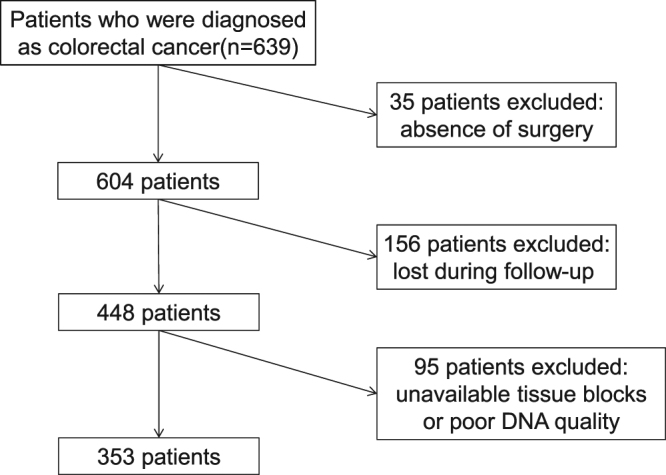
Figure 1
Figure 1
Selection of study population.
Figure 2
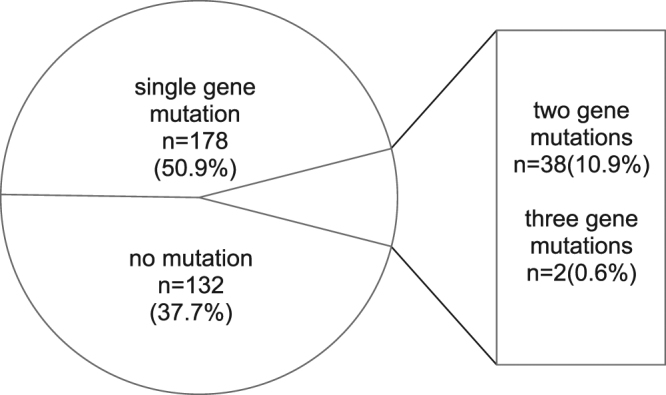
Figure 2
The distribution of mutations is illustrated in a pie chart of 350 colorectal cancer samples.
Figure 3
Figure 3
Kaplan-Meier curves. OS since surgery for patients with (black) and without (gray) mutations in 353 CRC patients. Panel D: DNA of three samples was not available for PIK3CA mutation analysis. wt: Wild-type; mut: Mutant.
Figure 4
Figure 4
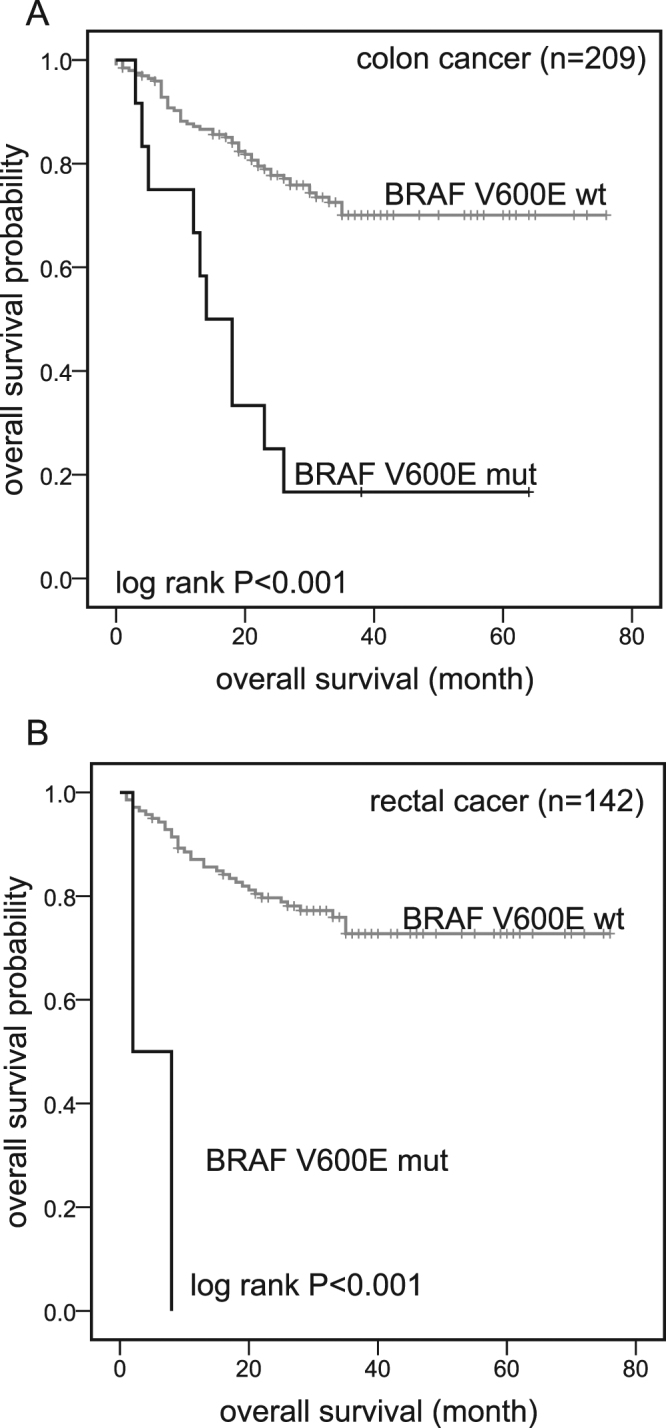
Kaplan-Meier curves. OS since surgery for patients with (black) and without (gray) BRAF V600E mutations in colon or rectal cancer. (A) 3-year OS in BRAF V600E mut versus BRAF wt colon cancer patients: 16.7% versus 74.1%; log-rank P < 0.001. One colon cancer patient harboring a BRAF K601E mutation was excluded in this analysis. (B) 3-year OS in BRAF V600E mut versus BRAF wt rectal cancer patients: 0% versus 75.7%; log-rank P < 0.001. One rectal cancer patient harboring a BRAF K601N mutation was excluded in this analysis. wt: Wild-type; mut: Mutant.
Figure 5
Figure 5
Kaplan-Meier curves. Distant metastasis rates since surgery for 305 stage I to III patients with (black) and without (gray) mutations. Panel (D) DNA of two samples were not available for PIK3CA mutation analysis. wt: Wild-type; mut: Mutant.

References

    1. Chen W, et al. Report of cancer incidence and mortality in China, 2010. Annals of translational medicine. 2014;2:61. - PMC - PubMed
    1. Scaltriti M, Baselga J. The epidermal growth factor receptor pathway: a model for targeted therapy. Clinical cancer research: an official journal of the American Association for Cancer Research. 2006;12:5268–5272. doi: 10.1158/1078-0432.CCR-05-1554. - DOI - PubMed
    1. Edkins S, et al. Recurrent KRAS codon 146 mutations in human colorectal cancer. Cancer biology & therapy. 2006;5:928–932. doi: 10.4161/cbt.5.8.3251. - DOI - PMC - PubMed
    1. Irahara N, et al. NRAS mutations are rare in colorectal cancer. Diagnostic molecular pathology: the American journal of surgical pathology, part B. 2010;19:157–163. doi: 10.1097/PDM.0b013e3181c93fd1. - DOI - PMC - PubMed
    1. Bos JL. Ras oncogenes in human cancer: a review. Cancer research. 1989;49:4682–4689. - PubMed