Review
. 2018 Mar;6(5):95.
doi: 10.21037/atm.2018.01.25.

The role of positron emission tomography in the diagnosis, staging and response assessment of non-small cell lung cancer

Affiliations
Review

The role of positron emission tomography in the diagnosis, staging and response assessment of non-small cell lung cancer

Sara Volpi et al. Ann Transl Med. 2018 Mar.

Abstract

Lung cancer is a common disease and the leading cause of cancer-related mortality, with non-small cell lung cancer (NSCLC) accounting for the majority of cases. Following diagnosis of lung cancer, accurate staging is essential to guide clinical management and inform prognosis. Positron emission tomography (PET) in conjunction with computed tomography (CT)-as PET-CT has developed as an important tool in the multi-disciplinary management of lung cancer. This article will review the current evidence for the role of 18F-fluorodeoxyglucose (FDG) PET-CT in NSCLC diagnosis, staging, response assessment and follow up.

Keywords: Positron emission tomography (PET); diagnosis; follow up; non-small cell lung cancer (NSCLC); response assessment; staging.


Conflict of interest statement

Conflicts of Interest: The authors have no conflicts of interest to declare.

Figures
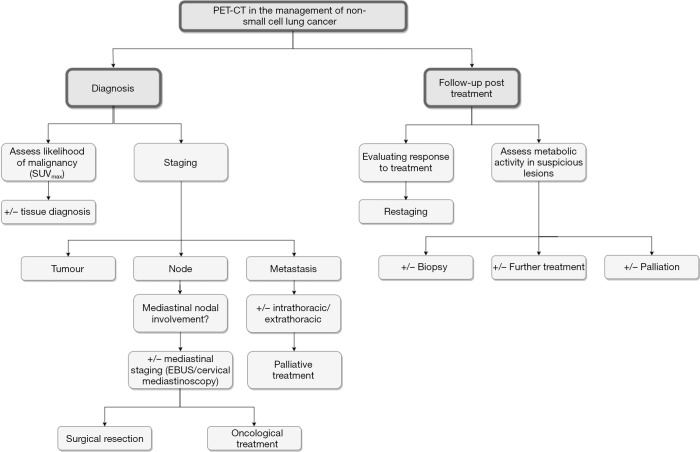
Figure 1
Figure 1
The roles of PET-CT in the management of non-small cell lung carcinoma. PET-CT, positron emission tomography-computed tomography.
Figure 2
Figure 2
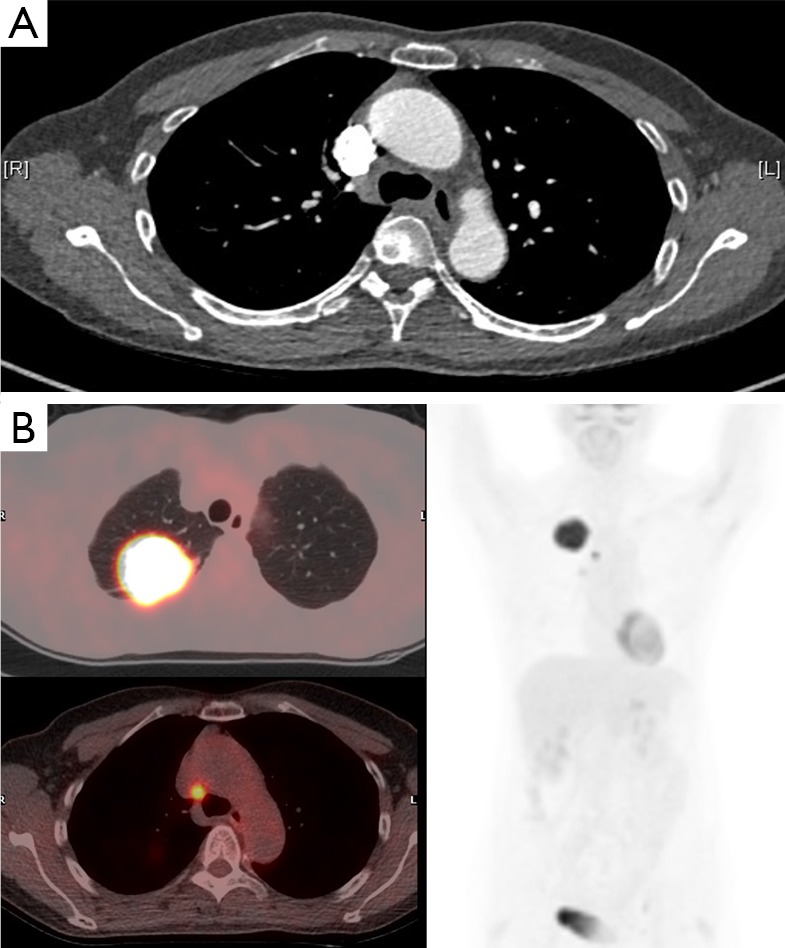
The value of PET-CT to staging. Patient with non-small cell lung carcinoma. The tumour in the right upper lobe shows avid tracer uptake (SUVmax =19.4). There is a 5 mm station 4R node adjacent to the azygos vein and superior vena cava on the staging CT scan. This shows tracer uptake on the PET-CT (SUVmax =9.7) and was shown to contain tumour cells on endo-bronchial ultrasound guided sampling. If PET-CT had not been performed this N2 node would have been missed. PET-CT, positron emission tomography-computed tomography.

References

    1. Siegel R, Naishadham D, Jemal A. Cancer statistics, 2012. CA Cancer J Clin 2012;62:10-29. 10.3322/caac.20138 - DOI - PubMed
    1. Tyczynski JE, Bray F, Parkin DM. Lung cancer in Europe in 2000: epidemiology, prevention, and early detection. Lancet Oncol 2003;4:45-55. 10.1016/S1470-2045(03)00960-4 - DOI - PubMed
    1. Gould MK, Maclean CC, Kuschner WG, et al. Accuracy of positron emission tomography for diagnosis of pulmonary nodules and mass lesions: a meta-analysis. JAMA 2001;285:914-24. 10.1001/jama.285.7.914 - DOI - PubMed
    1. Sharma P, Singh H, Basu S, et al. Positron emission tomography-computed tomography in the management of lung cancer: An update. South Asian J Cancer 2013;2:171-8. 10.4103/2278-330X.114148 - DOI - PMC - PubMed
    1. Ambrosini V, Nicolini S, Caroli P, et al. PET/CT imaging in different types of lung cancer: an overview. Eur J Radiol 2012;81:988-1001. 10.1016/j.ejrad.2011.03.020 - DOI - PubMed

LinkOut - more resources