


Underestimated prevalence of heart failure in hospital inpatients: a comparison of ICD codes and discharge letter information
- PMID: 29667017
- PMCID: PMC6105250
- DOI: 10.1007/s00392-018-1245-z
Underestimated prevalence of heart failure in hospital inpatients: a comparison of ICD codes and discharge letter information
Abstract
Background: Heart failure is the predominant cause of hospitalization and amongst the leading causes of death in Germany. However, accurate estimates of prevalence and incidence are lacking. Reported figures originating from different information sources are compromised by factors like economic reasons or documentation quality.
Methods: We implemented a clinical data warehouse that integrates various information sources (structured parameters, plain text, data extracted by natural language processing) and enables reliable approximations to the real number of heart failure patients. Performance of ICD-based diagnosis in detecting heart failure was compared across the years 2000-2015 with (a) advanced definitions based on algorithms that integrate various sources of the hospital information system, and (b) a physician-based reference standard.
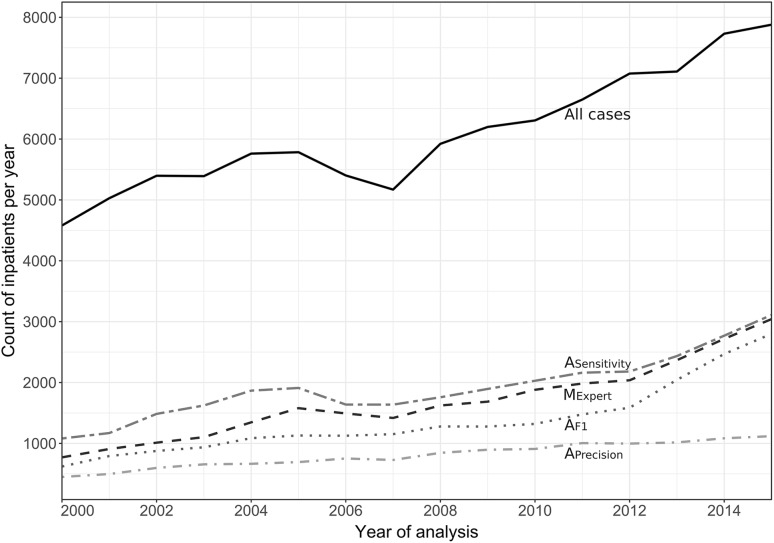
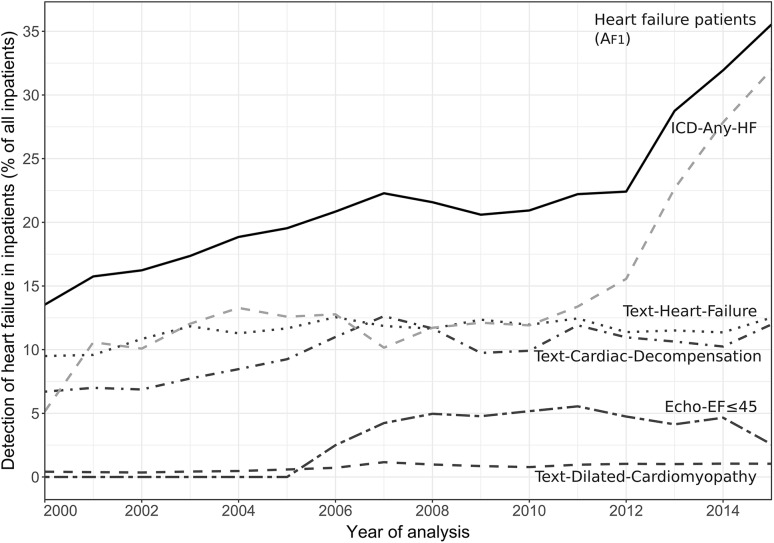
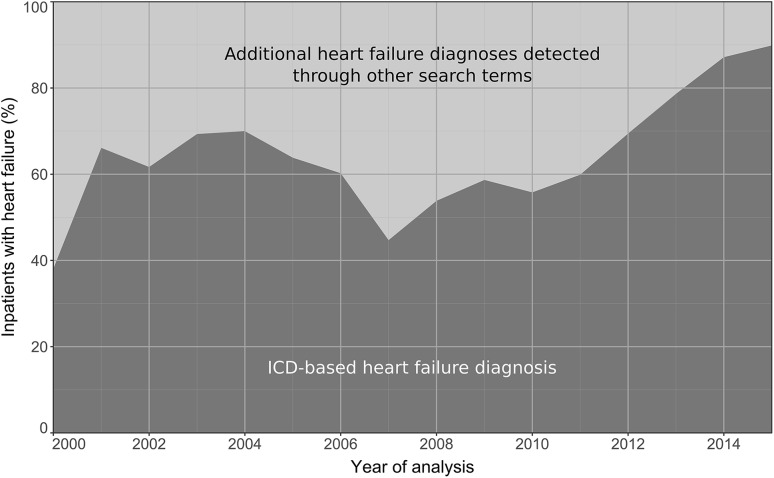
Results: Applying these methods for detecting heart failure in inpatients revealed that relying on ICD codes resulted in a marked underestimation of the true prevalence of heart failure, ranging from 44% in the validation dataset to 55% (single year) and 31% (all years) in the overall analysis. Percentages changed over the years, indicating secular changes in coding practice and efficiency. Performance was markedly improved using search and permutation algorithms from the initial expert-specified query (F1 score of 81%) to the computer-optimized query (F1 score of 86%) or, alternatively, optimizing precision or sensitivity depending on the search objective.
Conclusions: Estimating prevalence of heart failure using ICD codes as the sole data source yielded unreliable results. Diagnostic accuracy was markedly improved using dedicated search algorithms. Our approach may be transferred to other hospital information systems.
Keywords: Data warehouse; Electronic health records; Heart failure; ICD coding; Information extraction.
Conflict of interest statement
On behalf of all authors, the corresponding author states that there is no conflict of interest.
Figures
References
-
- Federal Statistical Office. http://www.gbe.de. Accessed Mar 2017
-
- Asakura K, Ordal E. Is your clinical documentation improvement program compliant? Health Financ Manag. 2012;66(10):96–100. - PubMed
-
- Pourasghar F, Malekafzali H, Koch S, Fors U. Factors influencing the quality of medical documentation when a paper-based medical records system is replaced with an electronic medical records system: an Iranian case study. Int J Technol Assess Health Care. 2008;24(4):445–451. doi: 10.1017/S0266462308080586. - DOI - PubMed
-
- Hall MJ, Levant S, DeFrances CJ (2012) Hospitalization for congestive heart failure: United States, 2000–2010, NCHS Data Brief (108), pp 1–8 - PubMed
-
- Schellenbaum GD, Heckbert SR, Smith NL, Rea TD, Lumley T, Kitzman DW, Roger VL, Taylor HA, Psaty BM. Congestive heart failure incidence and prognosis: case identification using central adjudication versus hospital discharge diagnoses. Ann Epidemiol. 2006;16(2):115–122. doi: 10.1016/j.annepidem.2005.02.012. - DOI - PubMed
Publication types
MeSH terms
Grants and funding
LinkOut - more resources
Full Text Sources
Other Literature Sources
Medical
