. 2018 Jul;21(4):447-456.
doi: 10.1007/s10071-018-1180-4. Epub 2018 Apr 17.

Sex, skull length, breed, and age predict how dogs look at faces of humans and conspecifics

Affiliations

Sex, skull length, breed, and age predict how dogs look at faces of humans and conspecifics

Zsófia Bognár et al. Anim Cogn. 2018 Jul.

Abstract

The gaze of other dogs and humans is informative for dogs, but it has not been explored which factors predict face-directed attention. We used image presentations of unfamiliar human and dog heads, facing the observer (portrait) or facing away (profile), and measured looking time responses. We expected dog portraits to be aversive, human portraits to attract interest, and tested dogs of different sex, skull length and breed function, which in previous work had predicted human-directed attention. Dog portraits attracted longer looking times than human profiles. Mesocephalic dogs looked at portraits longer than at profiles, independent of the species in the image. Overall, brachycephalic dogs and dogs of unspecified breed function (such as mixed breeds) displayed the longest looking times. Among the latter, females observed the images for longer than males, which is in line with human findings on sex differences in processing faces. In a subsequent experiment, we tested whether dog portraits functioned as threatening stimuli. We hypothesized that dogs will avoid food rewards or approach them more slowly in the presence of a dog portrait, but found no effect of image type. In general, older dogs took longer to approach food placed in front of the images and mesocephalic dogs were faster than dogs of other skull length types. The results suggest that short-headed dogs are more attentive to faces, while sex and breed function predict looking times through complex interactions.

Keywords: Breed differences; Dog cognition; Gaze following; Perception.


Conflict of interest statement

Conflict of Interest: The authors declare that they have no conflict of interest.

Figures
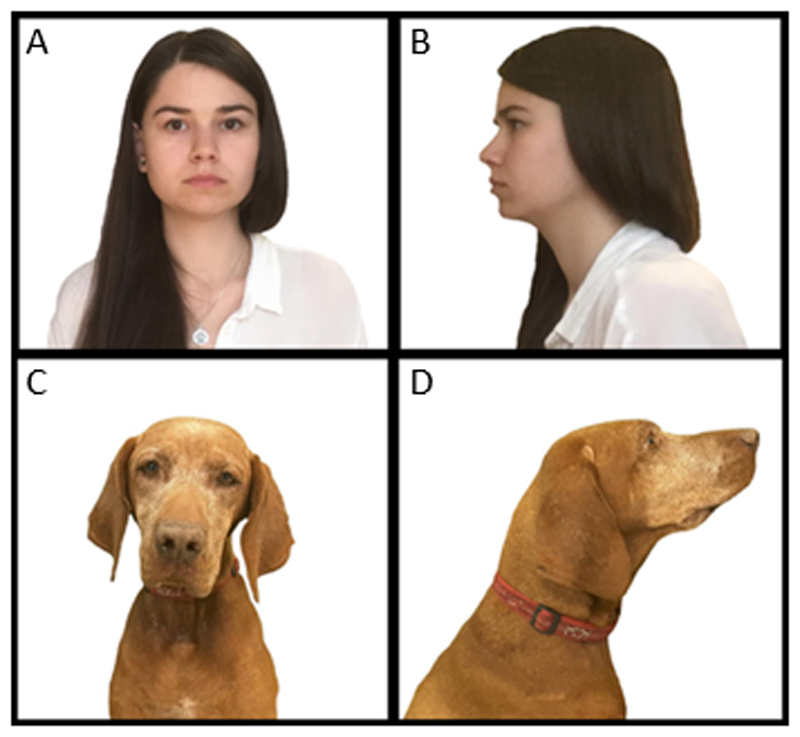
Figure 1
Figure 1
Four types of image were used as test-stimuli. Human portrait (A), human profile (B), dog portrait (C) and dog profile (D).
Figure 2
Figure 2
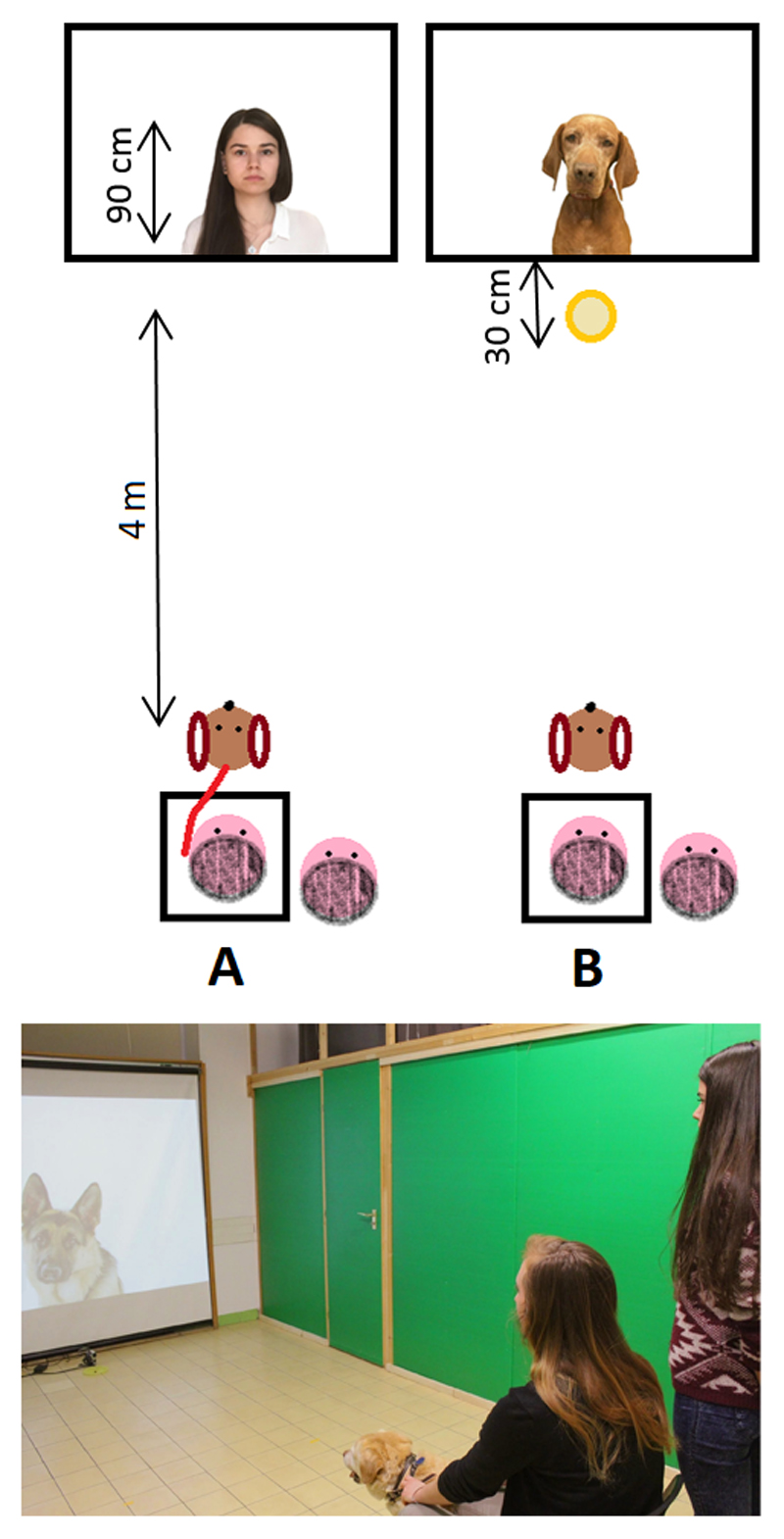
In the Spontaneous Looking Condition dog and owner (seated on a chair, depicted here as a rectangular box) were positioned 4 meters away from the center of a canvas, facing it. A bouncing ball was projected to capture the dog‘s attention and once it looked in the direction of the wall a new image, 90 cm tall, was projected, starting a new trial (A). In the Foraging Situation Condition a bowl of food was placed 30 cm in front of the center of the canvas and the dog was allowed to approach when a new image was projected (B), defining a new trial.
Figure 3
Figure 3
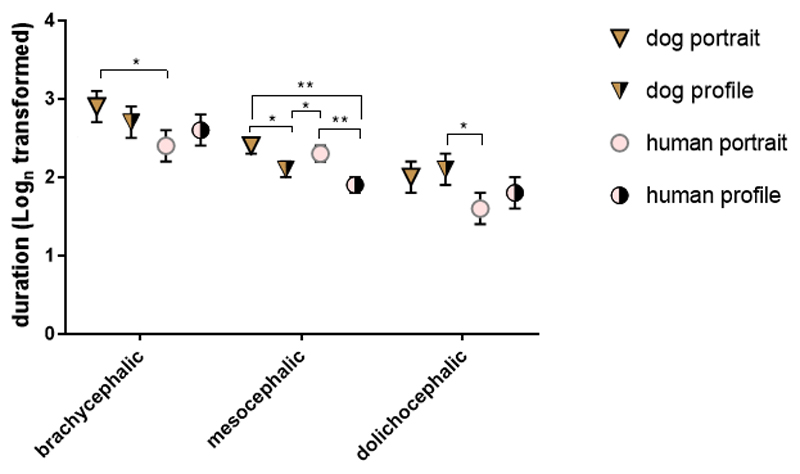
Means and standard errors of log-transformed looking times in the Spontaneous Looking Condition for the picture type x skull length interaction.
Figure 4
Figure 4
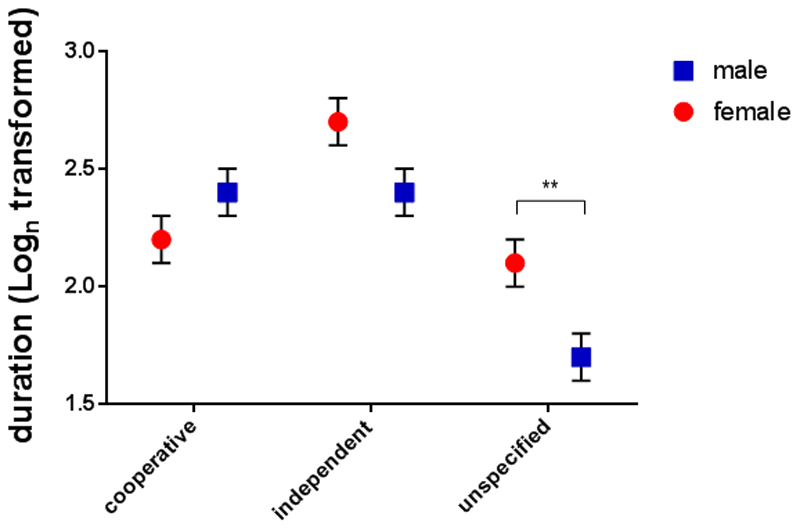
Means and standard errors of log-transformed looking times in the Spontaneous Looking Condition for the sex x breed function interaction.
Figure 5
Figure 5
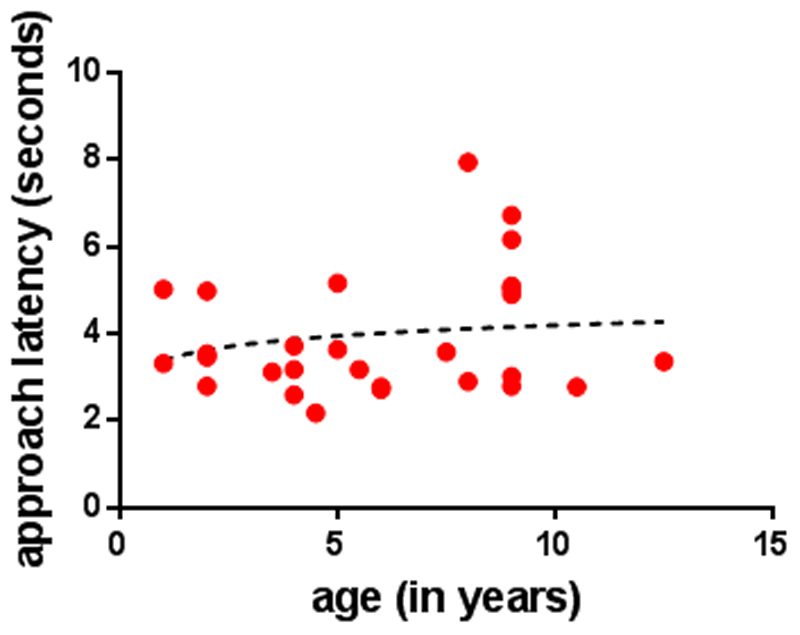
Scatter plot of the average approach latency (seconds) and age of the dogs (in years), in the Foraging Situation Condition.
Figure 6
Figure 6
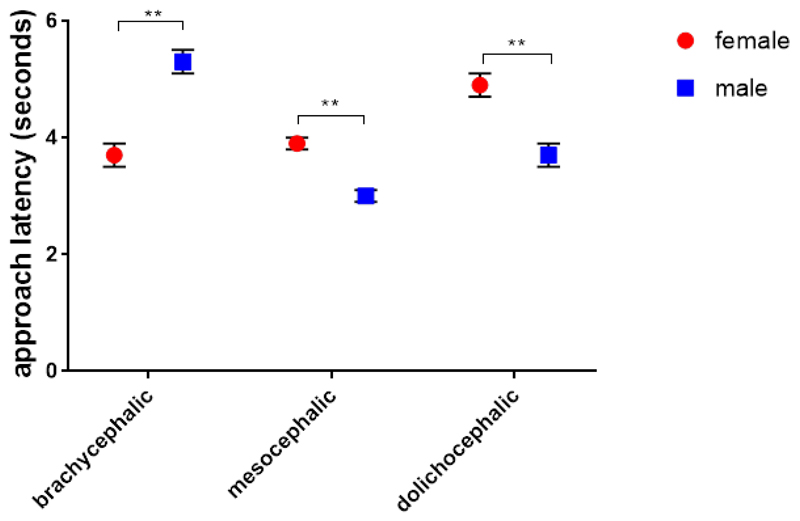
Means and standard errors of approach latency (seconds) in the Foraging Situation Condition for the sex x skull length interaction.

References

    1. Adams B, Chan A, Callahan H, Milgram NW. The canine as a model of human cognitive aging: recent developments. Prog Neuropsychopharmacol Biol Psychiatry. 2000;24:675–692. doi: 10.1016/S0278-5846(00)00101-9. - DOI - PubMed
    1. Armony JL, Dolan RJ. Modulation of spatial attention by fear-conditioned stimuli: an event-related fMRI study. Neuropsychologia. 2002;40:817–26. doi: 10.1016/S0028-3932(01)00178-6. - DOI - PubMed
    1. Bálint A, Faragó T, Miklósi Á, Pongrácz P. Threat-level-dependent manipulation of signaled body size: dog growls’ indexical cues depend on the different levels of potential danger. Anim Cogn. 2016:1–17. doi: 10.1007/s10071-016-1019-9. - DOI - PubMed
    1. Bartal IB-a, Decety J, Mason P, et al. Empathy and Pro-Social Behavior in Rats. Science (80- ) 2011;334:1427–1430. doi: 10.1126/science.1210789. - DOI - PMC - PubMed
    1. Bayliss AP, di Pellegrino G, Tipper SP. Sex differences in eye gaze and symbolic cueing of attention. Q J Exp Psychol. 2005;58:631–650. doi: 10.1080/02724980443000124. - DOI - PubMed

LinkOut - more resources