


Phase II Randomized Controlled Trial of Constraint-Induced Movement Therapy in Multiple Sclerosis. Part 2: Effect on White Matter Integrity
- PMID: 29668401
- PMCID: PMC5912693
- DOI: 10.1177/1545968317753073
Phase II Randomized Controlled Trial of Constraint-Induced Movement Therapy in Multiple Sclerosis. Part 2: Effect on White Matter Integrity
Abstract
Background: Constraint-induced movement therapy (CIMT) is a method of physical rehabilitation that has demonstrated clinical efficacy in patients with chronic stroke, cerebral palsy, and multiple sclerosis (MS).
Objective: This pilot randomized controlled trial tested whether CIMT can also induce increases in white matter integrity in patients with MS.
Methods: Twenty adults with chronic hemiparetic MS were randomized to receive either CIMT or complementary and alternative medicine (CAM) treatment (reported in the first article of this pair). Structural white matter change was assessed by tract-based spatial statistics (TBSS); measures included fractional anisotropy (FA), mean diffusivity (MD), axial diffusivity (AD), and radial diffusivity (RD).
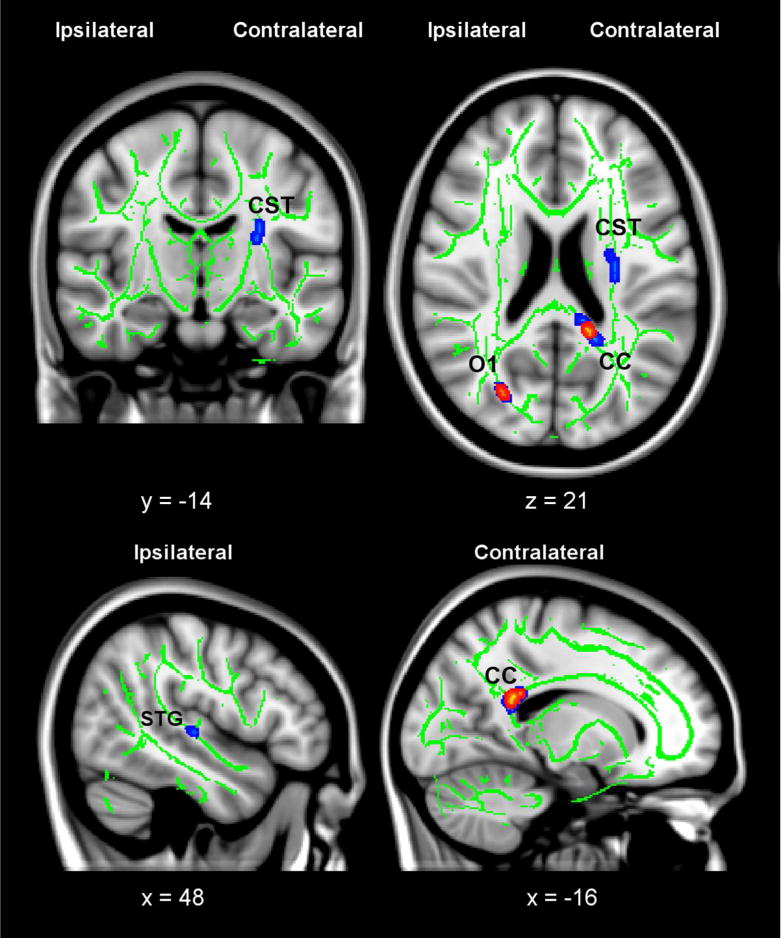
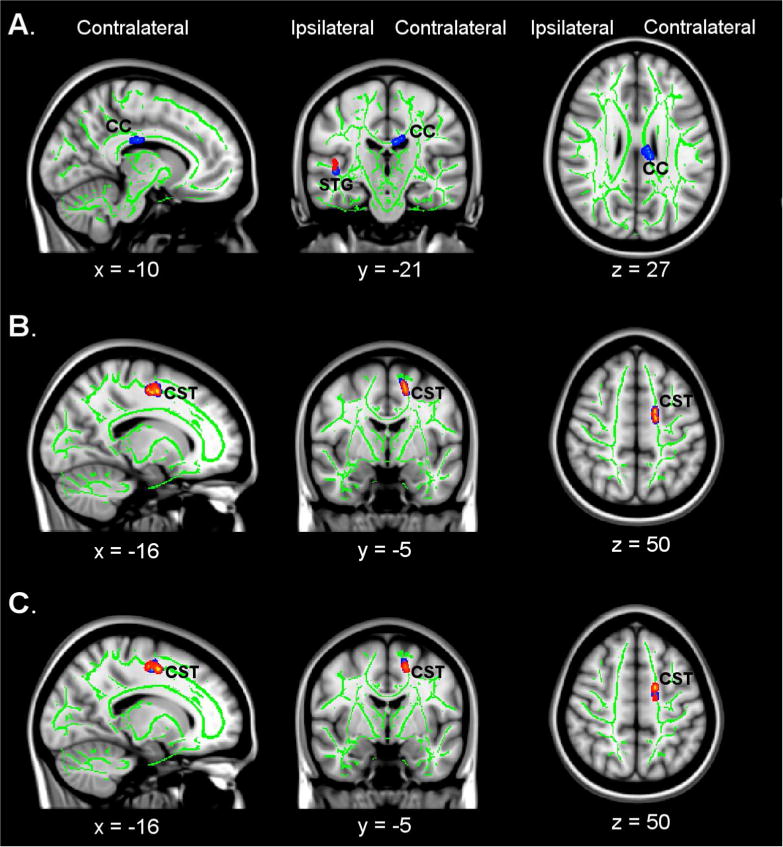
Results: CIMT and CAM groups did not differ in pretreatment disability or expectancy to benefit. As noted in the companion paper, the motor activity log (MAL) improved more after CIMT than CAM ( P < .001); the within-group effect size for CIMT was 3.7 (large d' = 0.57), while for CAM it was just 0.7. Improvements in white matter integrity followed CIMT and were observed in the contralateral corpus callosum (FA, P < .05), ipsilateral superior occipital gyrus (AD, P < .05), ipsilateral superior temporal gyrus (FA, P < .05), and contralateral corticospinal tract (MD and RD, P < .05).
Conclusion: CIMT produced a very large improvement in real-world limb use and induced white matter changes in patients with hemiparetic MS when compared with CAM. The findings suggest in preliminary fashion that the adverse changes in white matter integrity induced by MS might be reversed by CIMT.
Clinical trial registration number: ClinicalTrials.gov (NCT01081275).
Keywords: complementary and alternative medicine; constraint-induced movement therapy; magnetic resonance imaging; multiple sclerosis; rehabilitation; white matter.
Conflict of interest statement
Figures
References
-
- Bertoni R, Lamers I, Chen CC, Feys P, Cattaneo D. Unilateral and bilateral upper limb dysfunction at body functions, activity and participation levels in people with multiple sclerosis. Mult Scler. 2015;21:1566–1574. - PubMed
-
- Tallantyre EC, Bø L, Al-Rawashdeh O, et al. Clinico-pathological evidence that axonal loss underlies disability in progressive multiple sclerosis. Mult Scler. 2010;16:406–411. - PubMed
-
- Ciccarelli O, Werring DJ, Barker GJ, et al. A study of the mechanisms of normalappearing white matter damage in multiple sclerosis using diffusion tensor imaging-evidence of Wallerian degeneration. J Neurol. 2003;250:287–292. - PubMed
Publication types
MeSH terms
Associated data
Grants and funding
LinkOut - more resources
Full Text Sources
Other Literature Sources
Medical
Research Materials
Miscellaneous
