


Comparison of mental health screening tools for detecting antenatal depression and anxiety disorders in South African women
- PMID: 29668725
- PMCID: PMC5906008
- DOI: 10.1371/journal.pone.0193697
Comparison of mental health screening tools for detecting antenatal depression and anxiety disorders in South African women
Abstract
Background: Antenatal depression and anxiety disorders are highly prevalent in low and middle-income countries. Screening of pregnant women in primary care antenatal settings provides an opportunity for entry to care, but data are needed on the performance of different screening tools. We compared five widely-used questionnaires in a sample of pregnant women in urban South Africa.
Method: Pregnant women attending a primary care antenatal clinic were administered five tools by trained research assistants: the Edinburgh Postnatal Depression Scale (EPDS), the Patient Health Questionnaire (PHQ-9), the Kessler Psychological Distress scale (K10) and a shortened 6-item version (K6), the Whooley questions and the two-item Generalised Anxiety Disorder scale (GAD-2). Following this, a registered mental health counsellor administered the MINI Plus, a structured clinical diagnostic interview. The Area Under the Curve (AUC) from Receiver Operator Characteristic curve analysis was used to summarise screening test performance and Cronbach's α used to assess internal consistency.
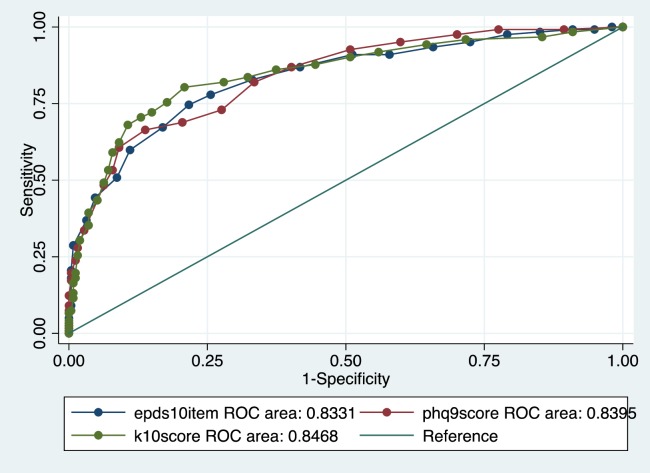
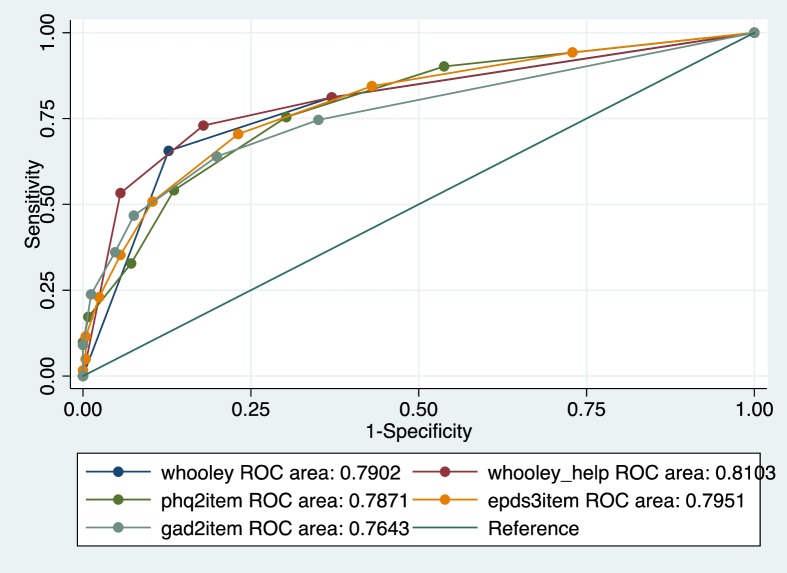
Results: Of 376 participants, 32% were diagnosed with either MDE and/or anxiety disorders. All five questionnaires demonstrated moderate to high performance (AUC = 0.78-0.85). The EPDS was the best performing instrument for detecting MDE and the K10 and K6 for anxiety disorder. For MDE and/or anxiety disorders, the EPDS had the highest AUC (0.83). Of the short instruments, the K10 (AUC = 0.85) and the K6 (AUC = 0.85) performed the best, with the K6 showing good balance between sensitivity (74%) and specificity (85%) and a good positive predictive value (70%). The Whooley questions (AUC = 0.81) were the best performing ultra-short instrument. Internal consistency ranged from good to acceptable (α = 0.89-0.71). However, the PPV of the questionnaires compared with the diagnostic interview, ranged from 54% to 71% at the optimal cut-off scores.
Conclusions: Universal screening for case identification of antenatal depression and anxiety disorders in low-resource settings can be conducted with a number of commonly used screening instruments. Short and ultra-short screening instruments such as the K6 and the Whooley questions may be feasible and acceptable for use in these settings.
Conflict of interest statement
Figures
References
-
- Fisher J, Mello C De, Patel V, Rahman A, Tran T, Holmes W. Prevalence and determinants of common perinatal mental disorders in women in low- and lower-middle-income countries: a systematic review. Bull World Health Organ. 2012;90: 139–149. doi: 10.2471/BLT.11.091850 - DOI - PMC - PubMed
-
- Sawyer A, Ayers S, Smith H. Pre- and postnatal psychological wellbeing in Africa: a systematic review. J Affect Disord. Elsevier B.V.; 2010;123: 17–29. doi: 10.1016/j.jad.2009.06.027 - DOI - PubMed
-
- Gelaye B, Rondon MB, Araya R, Williams MA. Epidemiology of maternal depression, risk factors, and child outcomes in low-income and middle-income countries. The Lancet Psychiatry. Elsevier Ltd; 2016;3: 973–982. doi: 10.1016/S2215-0366(16)30284-X - DOI - PMC - PubMed
-
- Biaggi A, Conroy S, Pawlby S, Pariante CM. Identifying the women at risk of antenatal anxiety and depression: A systematic review. J Affect Disord. Elsevier; 2016;191: 62–77. doi: 10.1016/j.jad.2015.11.014 - DOI - PMC - PubMed
-
- Meltzer-Brody S, Brandon A. It is time to focus on maternal mental health: optimising maternal and child health outcomes. BJOG an Int J Obstet Gynaecol. 2015;122: 321–321. doi: 10.1111/1471-0528.12839 - DOI - PubMed
Publication types
MeSH terms
LinkOut - more resources
Full Text Sources
Other Literature Sources
Medical
Research Materials
