


The Validity and Reliability of Screening Measures for Depression and Anxiety Disorders in Inflammatory Bowel Disease
- PMID: 29668911
- PMCID: PMC6124738
- DOI: 10.1093/ibd/izy068
The Validity and Reliability of Screening Measures for Depression and Anxiety Disorders in Inflammatory Bowel Disease
Abstract
Background: We evaluated the validity and reliability of multiple symptom scales for depression and anxiety for persons with inflammatory bowel disease (IBD).
Methods: IBD participants in a cohort study completed a Structured Clinical Interview for DSM-IV-TR Axis I Disorders (SCID) and completed the Patient Health Questionnaire (PHQ-9), Hospital Anxiety and Depression Scale (HADS), Kessler-6 Distress Scale, PROMIS Emotional Distress Depression Short-Form 8a (PROMIS Depression) and Anxiety Short-Form 8a (PROMIS Anxiety), Generalized Anxiety Disorder 7-item Scale, and Overall Anxiety and Severity Impairment Scale. We computed sensitivity, specificity, and positive and negative predictive values for the screening measures with the SCID diagnoses as the reference standard, conducted receiver operating curve (ROC) analysis, and assessed internal consistency and test-retest reliability.
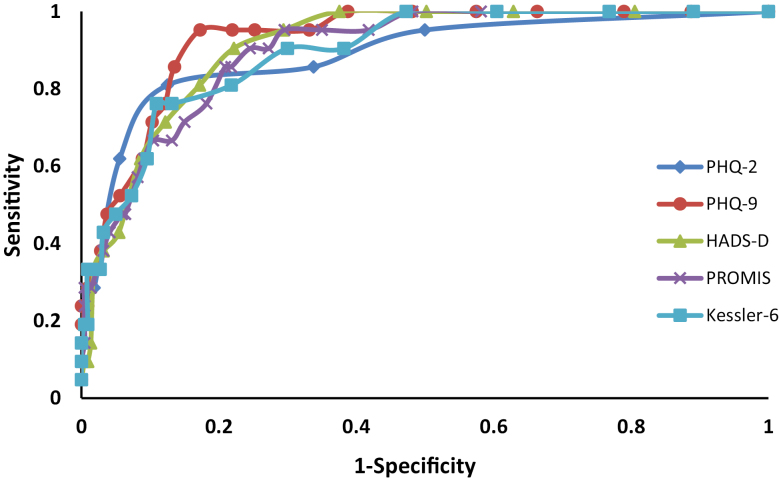
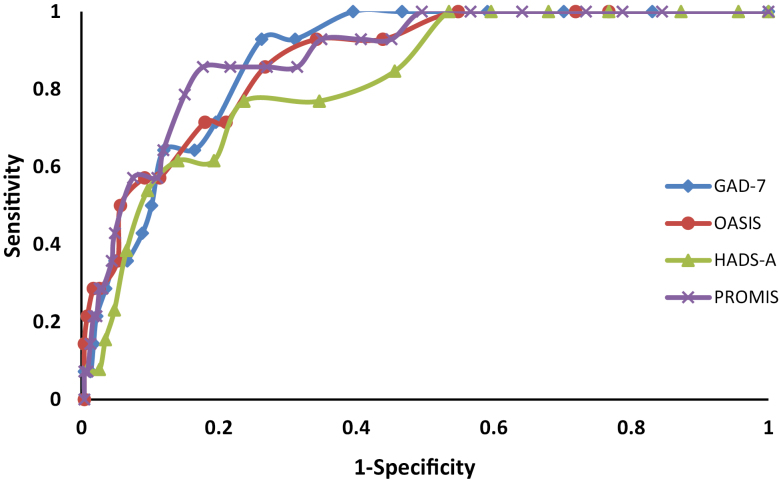
Results: Of 242 participants, the SCID classified 8.7% as having major depression and 17.8% as having anxiety disorders. Among the depression scales, the PHQ-9 had the highest sensitivity (95%). Specificity was generally higher than sensitivity and was highest for the HADS-D (cut-point of 11; 97%). The area under the ROC curve (AUC) did not differ significantly among depression scales. Among the anxiety scales, sensitivity was highest for the PROMIS (79%). Specificity ranged from 82% to 88% for all tools except the HADS-A (cut-point of 8; 65%). The AUC did not differ between depression and anxiety tools.
Conclusions: Overall, the symptom scales for depression and anxiety were similar in their psychometric properties. The anxiety scales did not perform as well as the depression scales. Alternate cut-points may be more relevant when these scales are used in an IBD sample.
Keywords: anxiety; depression; inflammatory bowel disease; psychometric properties.
© 2018 Crohn’s & Colitis Foundation. Published by Oxford University Press. All rights reserved. For permissions, please e-mail: journals.permissions@oup.com.
Figures
References
-
- Singh S, Blanchard A, Walker JR et al. Common symptoms and stressors among individuals with inflammatory bowel diseases. Clin Gastroenterol Hepatol. 2011;9:769–75. - PubMed
-
- Walker JR, Ediger JP, Graff LA et al. The Manitoba IBD Cohort Study: a population-based study of the prevalence of lifetime and 12-month anxiety and mood disorders. Am J Gastroenterol. 2008;103:1989–97. - PubMed
-
- Marrie RA, Walld R, Bolton JM et al. ; CIHR Team in Defining the Burden and Managing the Effects of Psychiatric Comorbidity in Chronic Immunoinflammatory Disease Increased incidence of psychiatric disorders in immune-mediated inflammatory disease. J Psychosom Res. 2017;101:17–23. - PubMed
Publication types
MeSH terms
LinkOut - more resources
Full Text Sources
Other Literature Sources
Medical
