


Apa-I polymorphism in VDR gene is related to metabolic syndrome in polycystic ovary syndrome: a cross-sectional study
- PMID: 29669566
- PMCID: PMC5907412
- DOI: 10.1186/s12958-018-0355-9
Apa-I polymorphism in VDR gene is related to metabolic syndrome in polycystic ovary syndrome: a cross-sectional study
Abstract
Background: Polycystic ovary syndrome (PCOS) is a common endocrine disorder determined by polygenic traits as well as environmental factors. Lower vitamin D levels have been detected in PCOS women and related to hormone and metabolic disturbances. Vitamin D acts in tissues through the vitamin D receptor (VDR). VDR gene variants have been associated with worse metabolic profile in the general population. We investigated the genotype and haplotype distribution of the Bsm-I (rs1544410), Apa-I (rs7975232), and Taq-I (rs731236) VDR gene polymorphisms in PCOS and non-hirsute women from southern Brazil. We further investigated the associations of these gene variants and their haplotypes with PCOS, vitamin D levels, and metabolic abnormalities, including the metabolic syndrome (MetS).
Methods: A group of 191 women with PCOS (Rotterdam criteria) and 100 non-hirsute controls with regular ovulatory cycles were genotyped for all polymorphisms by real-time PCR, with allelic discrimination assays. MetS and the cutoffs for its isolated components were defined in accordance with the Joint Scientific Statement.
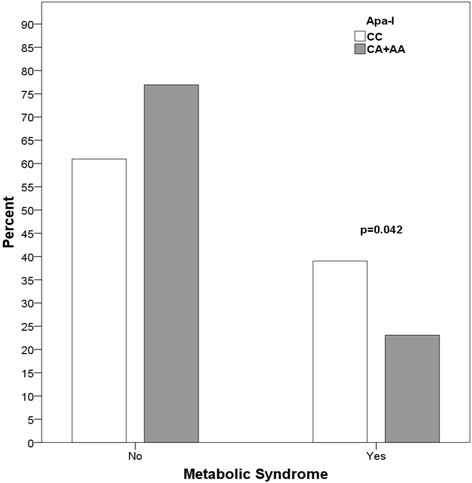
Results: Women with PCOS were younger and had significantly higher BMI and total testosterone levels than controls (p < 0.05). The frequency of MetS in PCOS and controls was 26.5% and 4.8% respectively. The CC genotype of Apa-I entailed higher risk of MetS in PCOS (OR: 2.133; 95% CI 1.020-4.464, p = 0.042), and was associated with higher systolic blood pressure (p = 0.009), total cholesterol (p = 0.040), and LDL-cholesterol (p = 0.038) in both PCOS and control groups (two-way ANOVA). The frequencies of VDR haplotypes were similar in PCOS and control women.
Conclusions: The present results suggest that the Apa-I variant in VDR gene may be associated with MetS in southern Brazilian women with PCOS, and with blood pressure, total cholesterol, and LDL-c in women with and without PCOS.
Keywords: Gene polymorphisms; Metabolic syndrome; PCOS; Vitamin D receptor.
Conflict of interest statement
Ethics approval and consent to participate
The study was approved by the Institutional Review Board and the local Ethics Committee at Hospital de Clínicas de Porto Alegre (FIPE-HCPA 340/2004). Written informed consent was obtained from every subject.
Competing interests
The authors declare that they have no competing interests.
Publisher’s Note
Springer Nature remains neutral with regard to jurisdictional claims in published maps and institutional affiliations.
Figures
References
-
- Asuncion M, Calvo RM, San Millan JL, Sancho J, Avila S, Escobar-Morreale HF. A prospective study of the prevalence of the polycystic ovary syndrome in unselected Caucasian women from Spain. J Clin Endocrinol Metab. 2000;85:2434–2438. - PubMed
MeSH terms
Substances
Grants and funding
LinkOut - more resources
Full Text Sources
Other Literature Sources
Medical
