. 2018 Apr 19;6(1):72.
doi: 10.1186/s40168-018-0450-3.

Similarity of the dog and human gut microbiomes in gene content and response to diet

Affiliations

Similarity of the dog and human gut microbiomes in gene content and response to diet

Luis Pedro Coelho et al. Microbiome. .

Abstract

Background: Gut microbes influence their hosts in many ways, in particular by modulating the impact of diet. These effects have been studied most extensively in humans and mice. In this work, we used whole genome metagenomics to investigate the relationship between the gut metagenomes of dogs, humans, mice, and pigs.

Results: We present a dog gut microbiome gene catalog containing 1,247,405 genes (based on 129 metagenomes and a total of 1.9 terabasepairs of sequencing data). Based on this catalog and taxonomic abundance profiling, we show that the dog microbiome is closer to the human microbiome than the microbiome of either pigs or mice. To investigate this similarity in terms of response to dietary changes, we report on a randomized intervention with two diets (high-protein/low-carbohydrate vs. lower protein/higher carbohydrate). We show that diet has a large and reproducible effect on the dog microbiome, independent of breed or sex. Moreover, the responses were in agreement with those observed in previous human studies.

Conclusions: We conclude that findings in dogs may be predictive of human microbiome results. In particular, a novel finding is that overweight or obese dogs experience larger compositional shifts than lean dogs in response to a high-protein diet.

Keywords: Diet; Dog microbiome; Human microbiome; Metagenomics; Microbiome; Mouse microbiome; Pig microbiome.


Conflict of interest statement

Ethics approval

The animal study protocol was reviewed and approved by the Animal Care and Use Committee of the Nestlé Purina PetCare Company.

Consent for publication

Not applicable.

Competing interests

Nestlé Purina PetCare Company partially funded this research. The following authors are employees of the company: Coralie Fournier, Yuanlong Pan, Gail Czarnecki-Maulden, Patrick Descombes, Janet R. Jackson, and Qinghong Li.

Publisher’s Note

Springer Nature remains neutral with regard to jurisdictional claims in published maps and institutional affiliations.

Figures
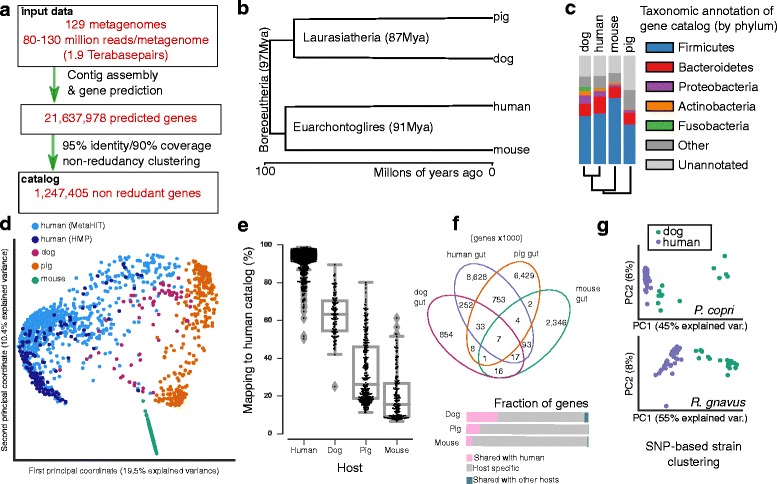
Fig. 1
Fig. 1
Dog gut microbiome gene catalog in comparison to human, mouse and pig. a Overview of gene catalog generation pipeline. b Phylogenetic relationship of the four hosts considered in this study, obtained by whole genome alignments, as reported by Murphy et al. [10]. c Distribution by phylum of the genes in the dog, human, mouse, and pig gut gene catalogs. d Principal coordinate analysis of genus-level taxonomic distribution in four mammal hosts (including two human cohorts), based on abundance-weighted Jaccard distance. e Mapping rates of reads from each of the four hosts when recruited against the human gene catalog. f Overlap of gene catalogs at 95% identity between the catalogs of the four species considered (in thousands of genes). g Principal coordinate analysis of SNP-based differentiation of strains from human and dog for the two most abundant species in dogs
Fig. 2
Fig. 2
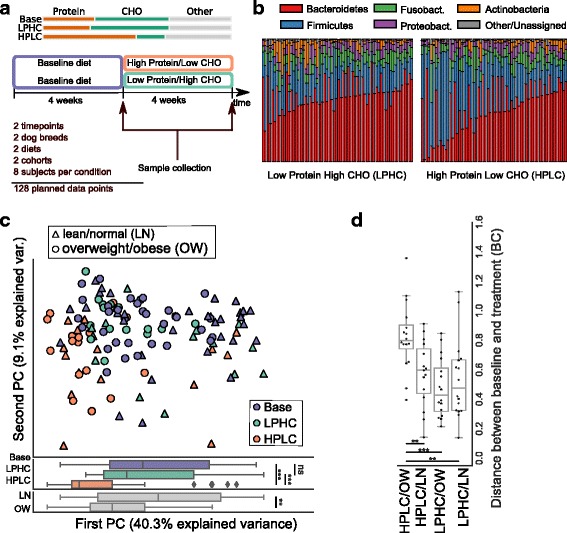
Effects of diet on the dog gut microbiome. a Study design (CHO carbohydrates, LPHC lower protein higher carbohydrates, HPLC high-protein low-carbohydrates). b Phylum-level relative abundances in the three diets; data is paired so that adjacent bars represent data from the same dog (before and after dietary intervention). c Principal coordinate analysis (using Bray-Curtis on log-transformed data as the underlying distance measure) based on taxonomic composition at the genus level (top panel) and the distributions of samples along the first principal component by diet and phenotype (bottom panel), *p < 0.05, **p < 0.01, ***p < 0.001; testing using Mann-Whitney-Wilcoxon test, after multiple hypothesis using the two-step Benjamini-Hochberg method; n.s. non-significant. d Shifts in microbiome composition vary for different diets and phenotype. The differences in relative abundance between the baseline and the post-treatment sample from the same dog, measured as Bray-Curtis (BC) distance after log-transformation (*p < 0.05, **p < 0.01, ***p < 0.001)
Fig. 3
Fig. 3
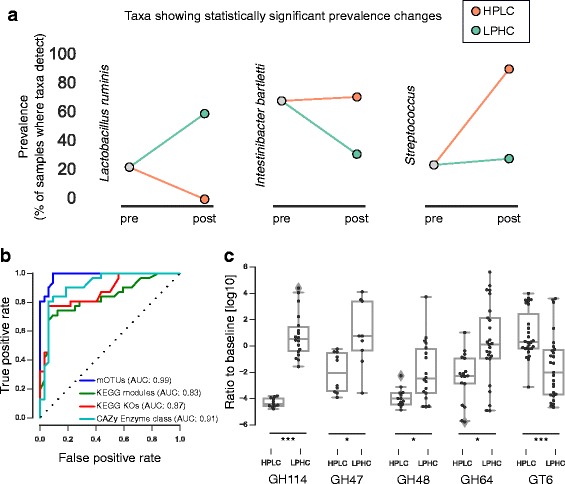
a Prevalence changes for three taxa showing statistically significant effects (p < 0.05 after multiple hypothesis testing). b Predictability of diet based on fecal samples at the end of the study. Receiver operating curves for diet classification (estimated by leave-one-out cross-validation). mOTUs refer to metagenomics OTUs [66]. c CAZy enzyme classes which show a differential response to the diet change (HPLC vs. LPHC). Shown is the ratio between pre-intervention and post-intervention samples (subjects where both samples were below the detection limit were removed from the analysis) (*p < 0.05, **p < 0.01, ***p < 0.001; Gehan’s two-sided test after multiple hypothesis correction)
Fig. 4
Fig. 4
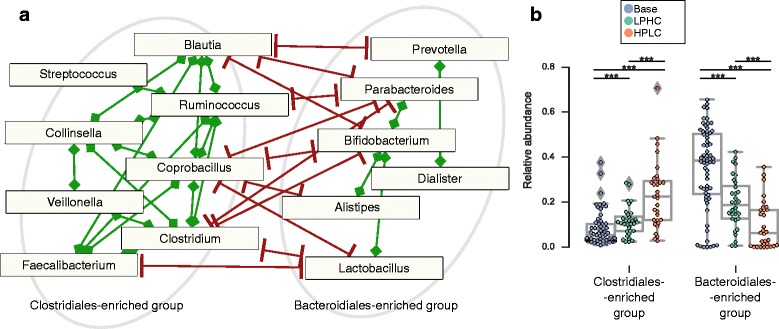
Analysis of co-abundance of genera. a Network of co-abundant genera (FDR of 5%, evaluated with sparCC; Spearman r > 0.5 or < − 0.5). Highlighted are two groups, one composed mainly of Clostridiales, the second of Bacteroideales. Green lines denote positive correlations, red lines negative ones. b Relative abundance of the Clostridiales-enriched and the Bacteroideales-enriched groups in each of the three diets studied (Base, HPLC, LPHC)

References

    1. Turnbaugh PJ, et al. An obesity-associated gut microbiome with increased capacity for energy harvest. Nature. 2006;444:1027–1131. doi: 10.1038/nature05414. - DOI - PubMed
    1. David LA, et al. Diet rapidly and reproducibly alters the human gut microbiome. Nature. 2014;505:559–563. doi: 10.1038/nature12820. - DOI - PMC - PubMed
    1. Zeevi D, et al. Personalized nutrition by prediction of glycemic responses. Cell. 2015;163:1079–1094. doi: 10.1016/j.cell.2015.11.001. - DOI - PubMed
    1. Nguyen T, Vieira-Silva S, Liston A, Raes J. How informative is the mouse for human gut microbiota research? Dis Model Mech. 2015;8:1–16. doi: 10.1242/dmm.017400. - DOI - PMC - PubMed
    1. Hugenholtz F, de Vos WM. Mouse models for human intestinal microbiota research: a critical evaluation. Cell Mol Life Sci. 2018;75:149–160. doi: 10.1007/s00018-017-2693-8. - DOI - PMC - PubMed

Publication types