Patterns of care and outcomes in adolescent and young adult acute lymphoblastic leukemia: a population-based study
- PMID: 29669756
- PMCID: PMC5916002
- DOI: 10.1182/bloodadvances.2017014944
Patterns of care and outcomes in adolescent and young adult acute lymphoblastic leukemia: a population-based study
Abstract
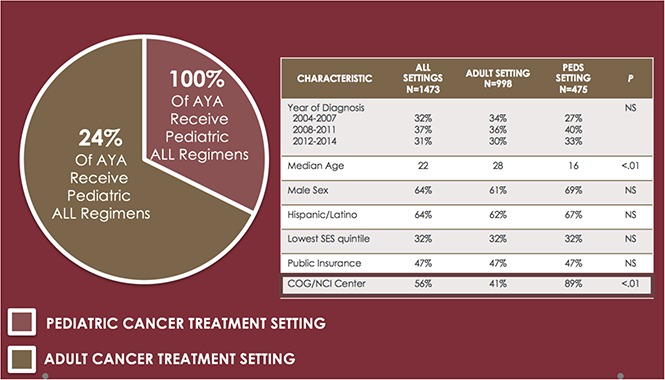
Adolescents and young adults (AYAs, 15-39 years) with acute lymphoblastic leukemia (ALL) represent a heterogeneous population who receive care in pediatric or adult cancer settings. Using the California Cancer Registry, we describe AYA ALL patterns of care and outcomes over the past decade. Sociodemographics, treatment location, and front-line therapies administered to AYAs diagnosed with ALL between 2004 and 2014 were obtained. Cox regression models evaluated associations between ALL setting and regimen and overall survival (OS) and leukemia-specific survival (LSS) for the entire cohort, younger AYA (<25 years), and AYAs treated in the adult cancer setting only. Of 1473 cases, 67.7% were treated in an adult setting; of these, 24.8% received a pediatric ALL regimen and 40.7% were treated at a National Cancer Institute (NCI)-designated center. In multivariable analyses, front-line treatment in a pediatric (vs adult) setting (OS HR = 0.53, 95% confidence interval [CI], 0.37-0.76; LSS HR = 0.51, 95% CI, 0.35-0.74) and at an NCI/Children's Oncology Group (COG) center (OS HR = 0.80, 95% CI, 0.66-0.96; LSS HR = 0.80, 95% CI, 0.65-0.97) were associated with significantly superior survival. Results were similar when analyses were limited to younger AYAs. Outcomes for AYAs treated in an adult setting did not differ following front-line pediatric or adult ALL regimens. Our population-level findings demonstrate that two-thirds of AYAs with newly diagnosed ALL are treated in an adult cancer setting, with the majority receiving care in community settings. Given the potential survival benefits, front-line treatment of AYA ALL at pediatric and/or NCI/COG-designated cancer centers should be considered.
© 2018 by The American Society of Hematology.
Conflict of interest statement
Conflict-of-interest disclosure: The authors declare no competing financial interests.
References
-
- Stock W, La M, Sanford B, et al. ; Cancer and Leukemia Group B studies. What determines the outcomes for adolescents and young adults with acute lymphoblastic leukemia treated on cooperative group protocols? A comparison of Children’s Cancer Group and Cancer and Leukemia Group B studies. Blood. 2008;112(5):1646-1654. - PMC - PubMed
-
- Boissel N, Auclerc MF, Lhéritier V, et al. Should adolescents with acute lymphoblastic leukemia be treated as old children or young adults? Comparison of the French FRALLE-93 and LALA-94 trials. J Clin Oncol. 2003;21(5):774-780. - PubMed
-
- de Bont JM, van der Holt B, Dekker AW, van der Does-van den Berg A, Sonneveld P, Pieters R. Adolescents with acute lymphatic leukaemia achieve significantly better results when treated following Dutch paediatric oncology protocols than with adult protocols [in Dutch]. Ned Tijdschr Geneeskd. 2005;149(8):400-406. - PubMed
-
- Hallböök H, Gustafsson G, Smedmyr B, Söderhäll S, Heyman M;. Swedish Adult Acute Lymphocytic Leukemia Group; Swedish Childhood Leukemia Group. Treatment outcome in young adults and children >10 years of age with acute lymphoblastic leukemia in Sweden: a comparison between a pediatric protocol and an adult protocol. Cancer. 2006;107(7):1551-1561. - PubMed
-
- Ramanujachar R, Richards S, Hann I, et al. Adolescents with acute lymphoblastic leukaemia: outcome on UK national paediatric (ALL97) and adult (UKALLXII/E2993) trials. Pediatr Blood Cancer. 2007;48(3):254-261. - PubMed
Publication types
MeSH terms
Grants and funding
LinkOut - more resources
Full Text Sources
Other Literature Sources
Medical
Miscellaneous