. 2018 Apr 18;8(1):6229.
doi: 10.1038/s41598-018-24528-3.

Overcoming Bias: Cognitive Control Reduces Susceptibility to Framing Effects in Evaluating Musical Performance

Affiliations

Overcoming Bias: Cognitive Control Reduces Susceptibility to Framing Effects in Evaluating Musical Performance

Gökhan Aydogan et al. Sci Rep. .

Erratum in

Abstract

Prior expectations can bias evaluative judgments of sensory information. We show that information about a performer's status can bias the evaluation of musical stimuli, reflected by differential activity of the ventromedial prefrontal cortex (vmPFC). Moreover, we demonstrate that decreased susceptibility to this confirmation bias is (a) accompanied by the recruitment of and (b) correlated with the white-matter structure of the executive control network, particularly related to the dorsolateral prefrontal cortex (dlPFC). By using long-duration musical stimuli, we were able to track the initial biasing, subsequent perception, and ultimate evaluation of the stimuli, examining the full evolution of these biases over time. Our findings confirm the persistence of confirmation bias effects even when ample opportunity exists to gather information about true stimulus quality, and underline the importance of executive control in reducing bias.


Conflict of interest statement

The authors declare no competing interests.

Figures

Figure 1
Figure 1
(A) Participants listened to pairs of performances of musical excerpts. For each pair, they were told that one was played by a professional and one by a student. They rated ‘enjoyment’ on a 1–7 scale. (B) Trial instructions biased enjoyment ratings (Wilcoxon signed-rank test, z = 2.750, p = 0.006, paired two-sided test).
Figure 2
Figure 2
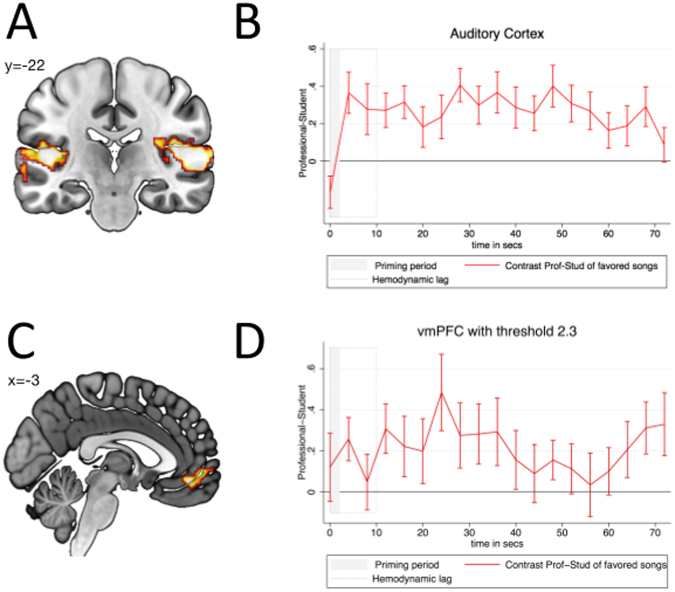
We computed a whole brain contrast between trials in which a professionally framed performance was preferred and trials when a student-framed performance was preferred. (A,B) Provided an excerpt was preferred, the professional pianist frame induced significantly more activity in the primary auditory cortex relative to the student pianist frame. (C,D) Greater activation was also found in the vmPFC following the professional frame relative to the student frame.
Figure 3
Figure 3
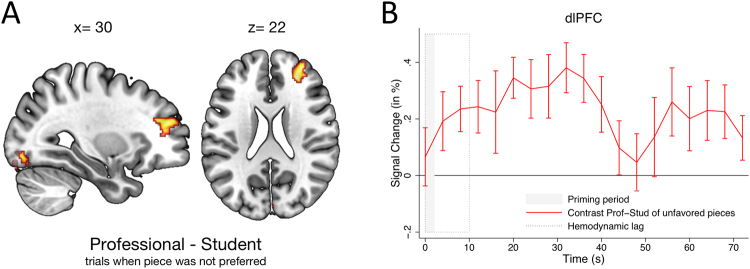
(A,B) We computed a whole brain contrast between trials in which a professionally framed performance was not preferred and trials when a student-framed performance was not preferred. This contrast identified a region of the dlPFC, indicating that dlPFC activity correlated with instances when the professionally framed performance was perceived as less impressive compared to cases when the student-framed performance was not preferred.
Figure 4
Figure 4
The results of probabilistic tractography were plotted against the magnitude of the behavioral framing effect. Specifically, based on our results from the fMRI analysis, we computed the likelihoods of two cortico-striatal tracts, the dlPFC-caudate and vmPFC-caudate, separately for each participant. We then plotted the averaged cortico-striatal tract likelihoods against the magnitude of the behavioral bias. A non-parametric test revealed a significant correlation between the magnitude of the framing effect and the averaged likelihood of both cortico-striatal tracts (Spearman’s rho = −0.4917, P = 0.0277, two-sided).

References

    1. Kirk U, Skov M, Hulme O, Christensen MS, Zeki S. Modulation of aesthetic value by semantic context: An fMRI study. NeuroImage. 2009;44:1125–1132. doi: 10.1016/j.neuroimage.2008.10.009. - DOI - PubMed
    1. Plassmann H, O’Doherty J, Shiv B, Rangel A. Marketing actions can modulate neural representations of experienced pleasantness. P. Natl. Acad. Sci. 2008;105:1050–1054. doi: 10.1073/pnas.0706929105. - DOI - PMC - PubMed
    1. Schmidt L, Skvortsova V, Kullen C, Weber B, Plassmann H. How context alters value: The brain’s valuation and affective regulation system link price cues to experienced taste pleasantness. Sci. Rep. 2017;7:8098. doi: 10.1038/s41598-017-08080-0. - DOI - PMC - PubMed
    1. Kahneman D. Maps of bounded rationality: Psychology for behavioral economics. Am. Econ. Rev. 2003;93:1449–1475. doi: 10.1257/000282803322655392. - DOI
    1. Kroger C, Margulis EH. “But they told me it was professional”: Extrinsic factors in the evaluation of musical performance. Psychol. Mus. 2017;45:49–64. doi: 10.1177/0305735616642543. - DOI

LinkOut - more resources