


Apathy and depressive symptoms in older people and incident myocardial infarction, stroke, and mortality: a systematic review and meta-analysis of individual participant data
- PMID: 29670402
- PMCID: PMC5894652
- DOI: 10.2147/CLEP.S150915
Apathy and depressive symptoms in older people and incident myocardial infarction, stroke, and mortality: a systematic review and meta-analysis of individual participant data
Erratum in
-
Erratum: Apathy and depressive symptoms in older people and incident myocardial infarction, stroke, and mortality: a systematic review and meta-analysis of individual participant data [Erratum].Clin Epidemiol. 2019 Mar 15;11:229. doi: 10.2147/CLEP.S206812. eCollection 2019. Clin Epidemiol. 2019. PMID: 30992683 Free PMC article.
Abstract
Background: Previous findings suggest that apathy symptoms independently of depressive symptoms measured using the Geriatric Depression Scale (GDS) are associated with cardiovascular disease (CVD) in older individuals.
Aims: To study whether apathy and depressive symptoms in older people are associated with future CVD, stroke, and mortality using individual patient-data meta-analysis.
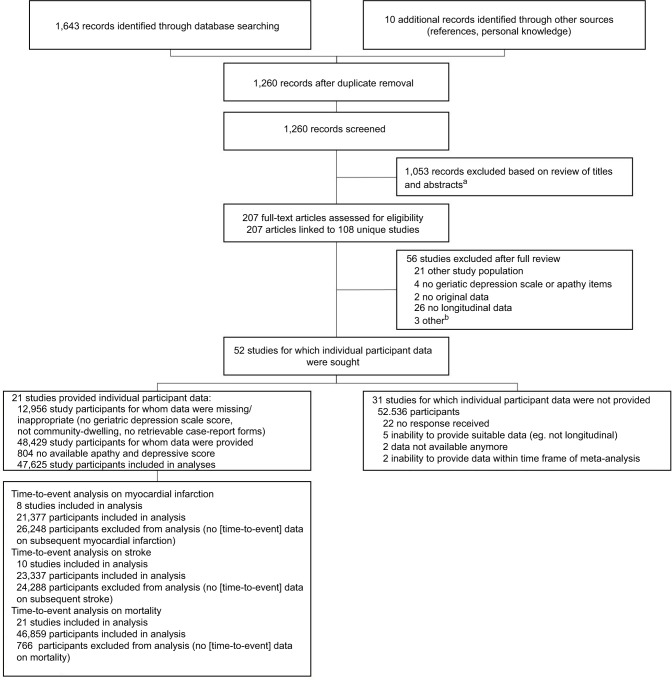
Methods: Medline, Embase, and PsycInfo databases up to September 3, 2013, were systematically searched without language restrictions. We sought prospective studies with older (mean age ≥65 years) community-dwelling populations in which the GDS was employed and subsequent stroke and/or CVD were recorded to provide individual participant data. Apathy symptoms were defined as the three apathy-related subitems of the GDS, with depressive symptoms the remaining items. We used myocardial infarction (MI), stroke, and all-cause mortality as main outcomes. Analyses were adjusted for age, sex, and MI/stroke history. An adaptation of the Newcastle-Ottawa scale was used to evaluate bias. Hazard ratios were calculated using one-stage random-effect Cox regression models.
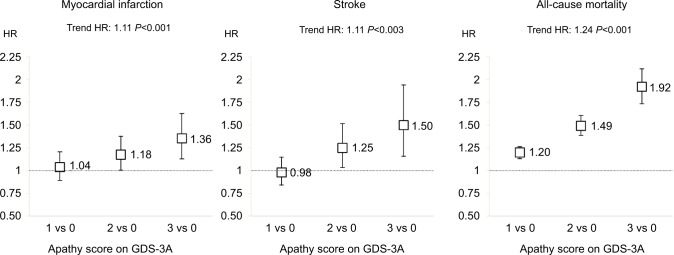
Results: Of the 52 eligible studies, 21 (40.4%) were included, comprising 47,625 older people (mean age [standard deviation] 74 [7.4] years), over a median follow-up of 8.8 years. Participants with apathy symptoms had a 21% higher risk of MI (95% confidence interval [CI] 1.08-1.36), a 37% higher risk of stroke (95% CI 1.18-1.59), and a 47% higher risk of all-cause mortality (95% CI 1.38-1.56). Participants with depressive symptoms had a comparably higher risk of stroke (HR 1.36, 95% CI 1.18-1.56) and all-cause mortality (HR 1.44, 95% CI 1.35-1.53), but not of MI (HR 1.08, 95% CI 0.91-1.29). Associations for isolated apathy and isolated depressive symptoms were comparable. Sensitivity analyses according to risk of bias yielded similar results.
Conclusion: Our findings stress the clinical importance of recognizing apathy independently of depressive symptoms, and could help physicians identify persons at increased risk of vascular disease.
Keywords: apathy; cardiovascular disease; depression; meta-analysis; myocardial infarction; older people; stroke.
Conflict of interest statement
Disclosure The authors report no conflicts of interest in this work.
Figures
References
-
- van der Kooy K, van Hout H, Marwijk H, Marten H, Stehouwer C, Beekman A. Depression and the risk for cardiovascular diseases: systematic review and meta analysis. Int J Geriatr Psychiatry. 2007;22(7):613–626. - PubMed
-
- Rugulies R. Depression as a predictor for coronary heart disease: a review and meta-analysis. Am J Prev Med. 2002;23(1):51–61. - PubMed
-
- Nicholson A, Kuper H, Hemingway H. Depression as an aetiologic and prognostic factor in coronary heart disease: a meta-analysis of 6362 events among 146 538 participants in 54 observational studies. Eur Heart J. 2006;27(23):2763–2774. - PubMed
Publication types
Grants and funding
- R01 HL070848/HL/NHLBI NIH HHS/United States
- R01 HL071194/HL/NHLBI NIH HHS/United States
- R01 HL070847/HL/NHLBI NIH HHS/United States
- R01 AG019181/AG/NIA NIH HHS/United States
- UL1 TR000128/TR/NCATS NIH HHS/United States
- R01 AR035583/AR/NIAMS NIH HHS/United States
- R01 AR035584/AR/NIAMS NIH HHS/United States
- R01 HL070842/HL/NHLBI NIH HHS/United States
- U01 AG042124/AG/NIA NIH HHS/United States
- U01 AG042145/AG/NIA NIH HHS/United States
- R01 AG027576/AG/NIA NIH HHS/United States
- R01 AG005407/AG/NIA NIH HHS/United States
- U01 AG042168/AG/NIA NIH HHS/United States
- R01 HL070841/HL/NHLBI NIH HHS/United States
- U01 AG042140/AG/NIA NIH HHS/United States
- R01 HL070838/HL/NHLBI NIH HHS/United States
- R01 HL070839/HL/NHLBI NIH HHS/United States
- P01 AG003949/AG/NIA NIH HHS/United States
- R01 AR035582/AR/NIAMS NIH HHS/United States
- U01 AG027810/AG/NIA NIH HHS/United States
- R01 AG005394/AG/NIA NIH HHS/United States
- R01 HL070837/HL/NHLBI NIH HHS/United States
- U01 AG042143/AG/NIA NIH HHS/United States
- U01 AG042139/AG/NIA NIH HHS/United States
- R01 AG027574/AG/NIA NIH HHS/United States
- U01 AR066160/AR/NIAMS NIH HHS/United States
LinkOut - more resources
Full Text Sources
Other Literature Sources
