


Sealing effectiveness of fissure sealant bonded with universal adhesive systems on saliva-contaminated and noncontaminated enamel
- PMID: 29670708
- PMCID: PMC5899818
- DOI: 10.4317/jced.54471
Sealing effectiveness of fissure sealant bonded with universal adhesive systems on saliva-contaminated and noncontaminated enamel
Abstract
Background: The effectiveness of sealants is dependent upon their adhesion to enamel surface. The aim of the study was to evaluate the sealing ability of a pit and fissure sealant used with a universal adhesive (etch-and-rinse vs. self-etch modes) when the site is contaminated with saliva. Adhesive properties were evaluated as microleakage and scanning electron microscopic (SEM) characteristics.
Material and methods: A total of 72 mandibular third molars were randomly divided into 6 groups (n=12). Occlusal pits and fissures were sealed with an unfilled resin fissure sealant (FS) material with or without saliva contamination. The groups included: 1) phosphoric acid etching + FS (control), 2) phosphoric acid etching + Scotchbond Universal (etch-and-rinse) + FS, 3) phosphoric acid etching + saliva + Scotchbond Universal (etch-and-rinse) + FS, 4) Scotchbond Universal (self-etching) + FS,5) Scotchbond Universal (self-etching) + saliva + FS, and 6) Scotchbond Universal (self-etching) + saliva + Scotchbond Universal + FS. After thermocycling, the teeth were placed in 0.5% fuchsin, sectioned, and evaluated by digital microscopy. Two samples from each group were also observed by SEM. The data were analyzed with Kruskal-Wallis and Mann-Whitney tests for a significance of p<0.05.
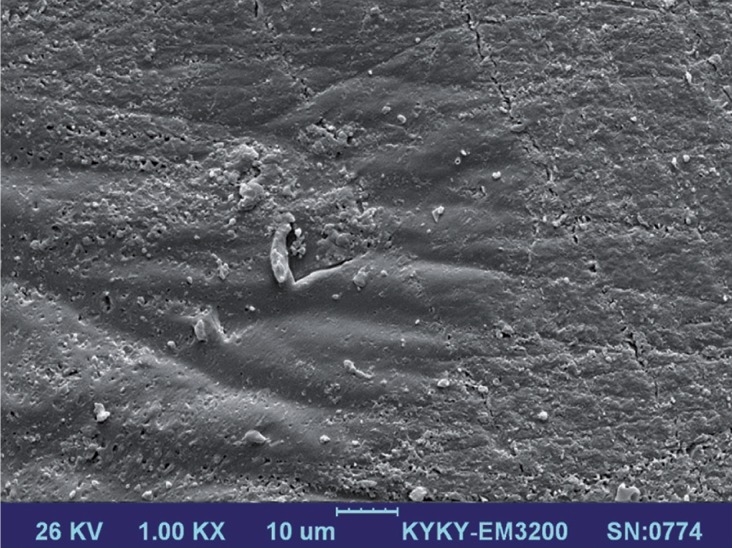
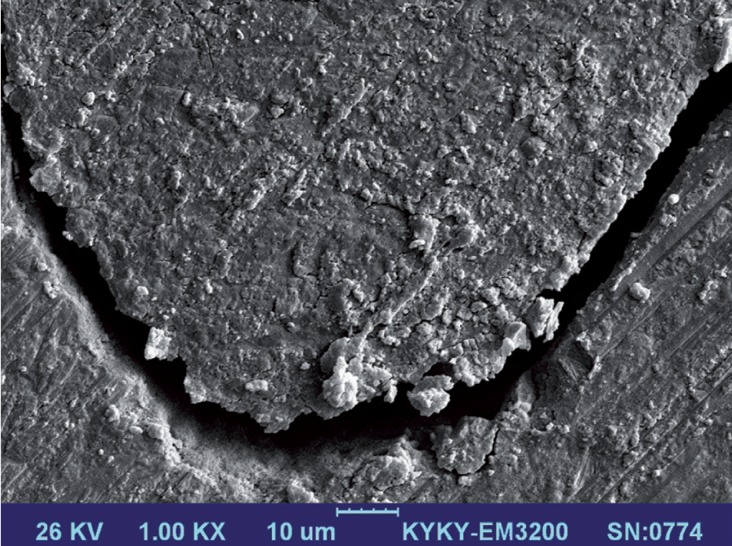
Results: There were significant differences among groups. Groups 1,2 and 4 showed the least microleakage, with no significant differences among groups. Saliva contamination led to increased microleakage and gap formation in SEM images in groups 3, 5 and 6.
Conclusions: The fissure sealing ability of the universal adhesive in etch-and-rinse or self-etch modes was similar to that of conventional acid etching. Saliva contamination had a negative effect on sealant adhesion to pretreated enamel. Key words:Pit and fissure sealant, Universal adhesive, Saliva.
Conflict of interest statement
Conflict of interest statement: The authors state that they have no conflicts of interest.
Figures

References
-
- American Academy of Pediatric Dentistry and American Dental Association. Evidence-based clinical practice guideline for the use of pit-and-fissure sealants. Pediatr Dent. 2016;38:263–79. - PubMed
-
- Memarpour M, Shafiei F, Shokouh P, Shaddel M. Evaluation of a school-based pit and fissure sealant programme in Iranian children. Oral Health Prev Dent. 2011;9:381–6. - PubMed
-
- Simonsen RJ. From prevention to therapy: minimal intervention with sealants and resin restorative materials. J Dent. 2011;39 Suppl 2:S27–33. - PubMed
-
- Erbas Unverdi G, Atac SA, Cehreli ZC. Effectiveness of pit and fissure sealants bonded with different adhesive systems: a prospective randomized controlled trial. Clin Oral Investig. 2017;21:2235–2243. - PubMed
-
- Meller C, Reichenmiller K, Schwahn C, Samietz S, Blunck U. Resin-based pit-and-fissure sealants: microleakage reduction and infiltration enhancement using a bonding agent. J Adhes Dent. 2015;17:59–65. - PubMed
LinkOut - more resources
Full Text Sources
Other Literature Sources
Medical
Miscellaneous