. 2018 Jun;50(3):231-240.
doi: 10.1007/s10863-018-9754-z. Epub 2018 Apr 18.

New use for CETSA: monitoring innate immune receptor stability via post-translational modification by OGT

Affiliations

New use for CETSA: monitoring innate immune receptor stability via post-translational modification by OGT

Walter R Drake et al. J Bioenerg Biomembr. 2018 Jun.

Abstract

O-GlcNAcylation is a dynamic and functionally diverse post-translational modification shown to affect thousands of proteins, including the innate immune receptor nucleotide-binding oligomerization domain-containing protein 2 (Nod2). Mutations of Nod2 (R702W, G908R and 1007 fs) are associated with Crohn's disease and have lower stabilities compared to wild type. Cycloheximide (CHX)-chase half-life assays have been used to show that O-GlcNAcylation increases the stability and response of both wild type and Crohn's variant Nod2, R702W. A more rapid method to assess stability afforded by post-translational modifications is necessary to fully comprehend the correlation between NLR stability and O-GlcNAcylation. Here, a recently developed cellular thermal shift assay (CETSA) that is typically used to demonstrate protein-ligand binding was adapted to detect shifts in protein stabilization upon increasing O-GlcNAcylation levels in Nod2. This assay was used as a method to predict if other Crohn's associated Nod2 variants were O-GlcNAcylated, and also identified the modification on another NLR, Nod1. Classical immunoprecipitations and NF-κB transcriptional assays were used to confirm the presence and effect of this modification on these proteins. The results presented here demonstrate that CETSA is a convenient method that can be used to detect the stability effect of O-GlcNAcylation on O-GlcNAc-transferase (OGT) client proteins and will be a powerful tool in studying post-translational modification.

Keywords: CETSA; Crohn’s disease; NLRs; O-GlcNAcylation; OGT; Peptidoglycan.


Figures
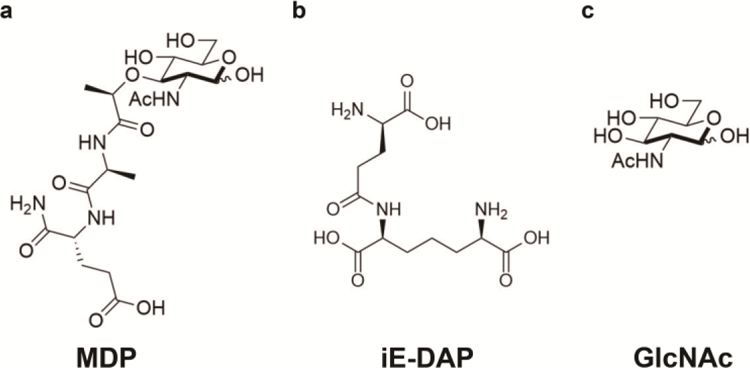
Fig. 1
Fig. 1
NLR Activators (A) MDP consists of N-acetylmuramic acid with an L-Ala D-isoGln dipeptide chain. It is a ligand derived from peptidoglycan detected by Nod2 (B) iE-DAP is a dipeptide derived from peptidoglycan detected by Nod1 (C) GlcNAc, a carbohydrate, leads to inflammasome formation for NLRP3 and is also O-linked to protein serines and threonines by OGT, with UDP-GlcNAc serving as the donor
Fig. 2
Fig. 2
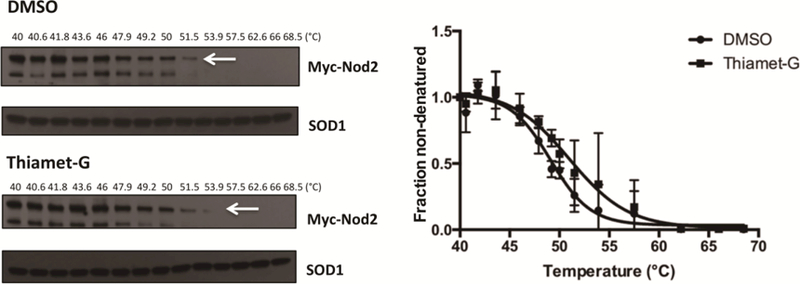
CETSA of wild type Nod2. HEK293T-Nod2-Myc/Tet-op cells were incubated with 1 µM Thiamet-G or DMSO for 8 h, and CETSA and immunoblots were performed (see materials and methods). Relative amounts of Nod2-Myc to SOD1 were plotted from three independent experiments as the means ± S.D. using GraphPad Prism (Boltzmann Sigmoidal model)
Fig. 3
Fig. 3
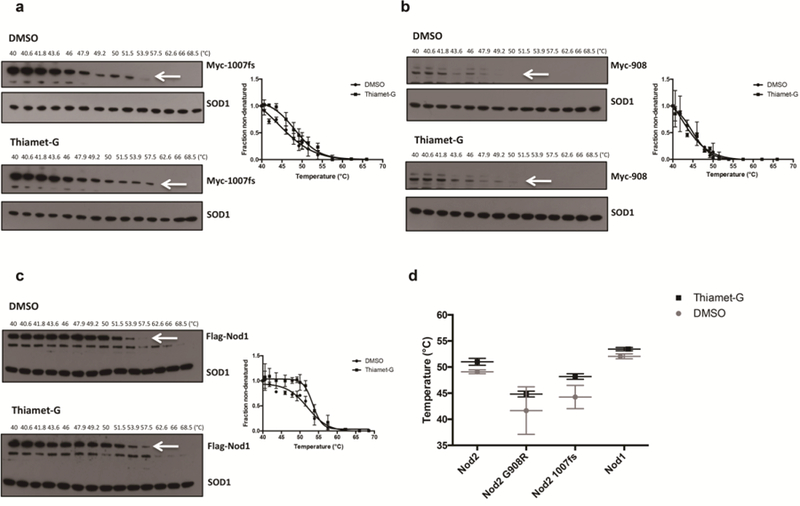
CETSA of Nod2 Crohn’s associated variants and Nod1 (A) HEK293T-Nod2–1007fs-Myc/Tet-op and (B) HEK293T-Nod2-G908R-Myc/Tet-op cells were incubated with 1 µM Thiamet-G or DMSO for 4 h, and CETSA and immunoblots were performed (see materials and methods). (C) HEK293T-Nod1-Flag/Tet-op cells were incubated with 1 µM Thiamet-G or DMSO for 8 h, and CETSA and immunoblots were performed. Relative amounts of Nod2 Myc/Nod1 Flag to SOD1 were plotted from three independent experiments as the means ± S.D. using GraphPad Prism (Boltzmann Sigmoidal model (D) Melting temperature comparison between DMSO and Thiamet-G in Nod1, Nod2 and Nod2 variant cells obtained by CETSA. * indicates significance according to F-test
Fig. 4
Fig. 4
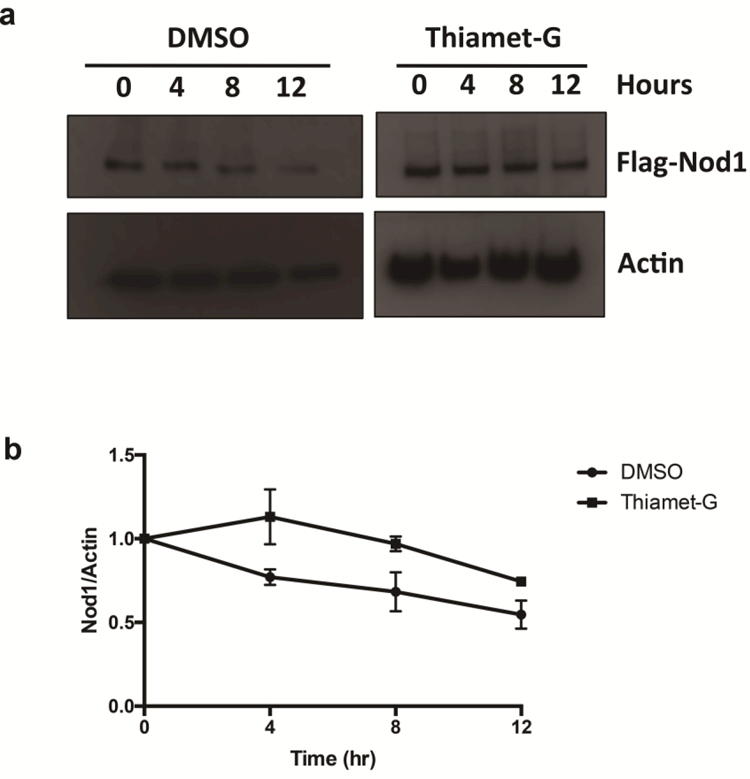
O-GlcNAcylation regulates the half-life of Nod1. (A) HEK293T-Nod1-expressing cells were incubated with 1 μM Thiamet-G or DMSO for 4 h, prior to cycloheximide treatment (50 μg/mL) and cells were collected at the indicated time intervals. Nod1 was detected by anti-Flag western blotting. (B) Half-lives were determined by plotting relative Flag intensities vs. time assuming first order decay, and calculating T1/2 = ln(2)/k
Fig. 5
Fig. 5
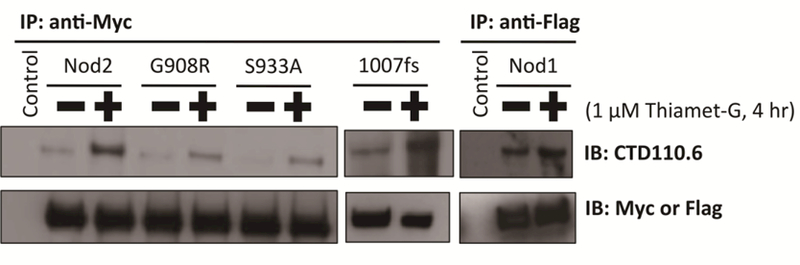
OGT modifies Nod2 mutants and Nod1. HEK293T-Nod2-Myc, HEK293T-Nod2-G908R-Myc, HEK293T-Nod2-S933A-Myc, and HEK293T-Nod2–1007fs-Myc cell lines were immunopurified with Myc antibody and blotted with CTD110.6 and Myc antibodies; control cells do not express Myc-Nod2. HEK293T-Nod1-Flag cell line was immunopurified with Flag antibody and blotted with CTD110.6 and Flag antibodies. Control cells do not express Flag-Nod1. Thiamet-G inhibits OGA, elevating O-GlcNAcylation
Fig. 6
Fig. 6
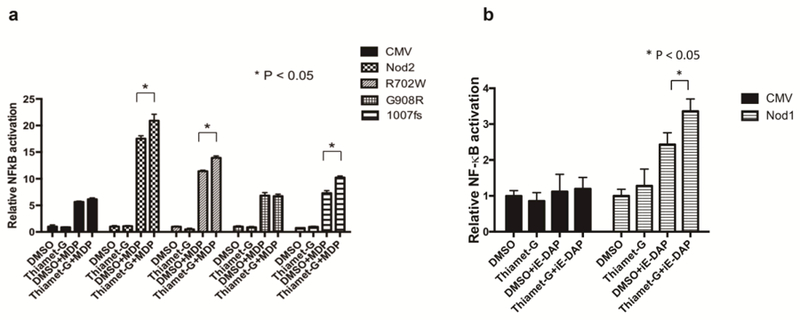
NF-κB assay of Nod2 variants and Nod1. (A) Dual-luciferase assay performed on HEK293T cells transfected with 0.1 ng Nod2, 702, 908 or 1007fs plasmid in the presence of 100 nM Thiamet-G or DMSO for 4 h. After 4 h, cells were incubated with 20 µM MDP for 5h, harvested, and tested for luciferase activity (B) Dual-luciferase assay performed on HEK293T transfected with 0.1 ng Nod1 in the presence of 100 nM Thiamet-G or DMSO for 4 h. After 4 h, cells were incubated with 20 µM iE-DAP for 8h, harvested, and tested for luciferase activity
Fig. 7
Fig. 7
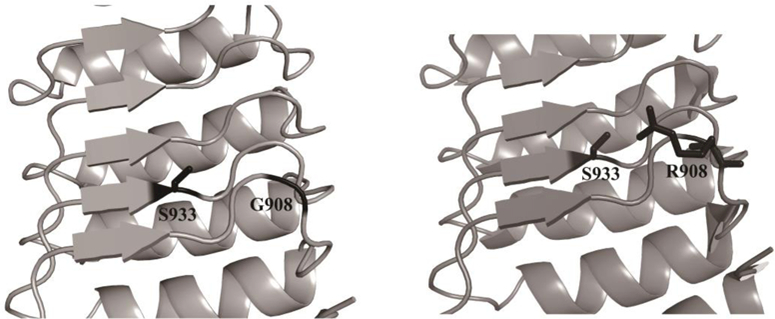
Residue 908 is in close proximity to S933. In the wild type G908 Nod2, S933 is free and solvent exposed. In the Crohn’s associated variant, Nod2-G908R, the bulky arginine side chain can be situated directly nearby S933. Images were created using MacPyMol and PDB 5IRN of crystallized rabbit Nod2

References

    1. Belle A, Tanay A, Bitincka L, Shamir R, O’Shea EK (2006) Quantification of protein half-lives in the budding yeast proteome. PNAS, 103(35):13004–13009. doi: 10.1073/pnas.0605420103 - DOI - PMC - PubMed
    1. Bouskra D, Brezillon C, Berard M, Werts C, Varona R, Boneca IG, Eberl G (2008) Lymphoid tissue genesis induced by commensals through NOD1 regulates intestinal homeostasis. Nature, 456(7221):507–510. doi: 10.1038/nature07450 - DOI - PubMed
    1. Chamaillard M, Hashimoto M, Horie Y, Masumoto J, Qiu S, Saab L, et al. (2003) An essential role for NOD1 in host recognition of bacterial peptidoglycan containing diaminopimelic acid. Nat Immunol, 4(7):702–707, doi: 10.1038/ni945 - DOI - PubMed
    1. Chu CS, Lo PW, Yeh YH, Hsu PH, Peng SH, Teng YC, Kang ML, Wong CH, Juan LJ (2014) O-GlcNAcylation regulates EZH2 protein stability and function. Proc Natl Acad Sci USA, 111(4):1355–1360 - PMC - PubMed
    1. Dai CL, Shi J, Chen Y, Iqbal K, Liu F, Gong CX (2013) Inhibition of protein synthesis alters protein degradation through activation of protein kinase B (AKT). J Biol Chem, 288(33):23875–23883 - PMC - PubMed

Publication types

LinkOut - more resources