


Drinking Patterns of College- and Non-College-Attending Young Adults: Is High-Intensity Drinking Only a College Phenomenon?
- PMID: 29671683
- PMCID: PMC6105386
- DOI: 10.1080/10826084.2018.1461224
Drinking Patterns of College- and Non-College-Attending Young Adults: Is High-Intensity Drinking Only a College Phenomenon?
Abstract
Background: Young adults report the heaviest drinking of any age group, and many are at risk for experiencing an alcohol use disorder. Most research investigating young adult drinking has focused on single indicators of use. Using multiple dimensions of consumption, such as federal guidelines for daily/weekly drinking and engagement in drinking at twice the binge threshold ("high-intensity drinking") to characterize drinking behavior could illuminate drinking patterns linked with harms.
Objectives: We used a person-centered approach to examine latent classes of drinkers from a national sample of young adults. Further, we compared classes on college status.
Methods: We used 2012-2013 data from the National Epidemiologic Survey on Alcohol and Related Conditions (NESARC)-III. We included past-year drinkers aged 18-22 years (n = 2213). Latent classes were estimated based on drinking frequency, daily/weekly drinking, frequency of heavy episodic drinking (4+/5+ drinks for women/men), frequency of high-intensity drinking (8+/10+ drinks), and intoxication frequency.
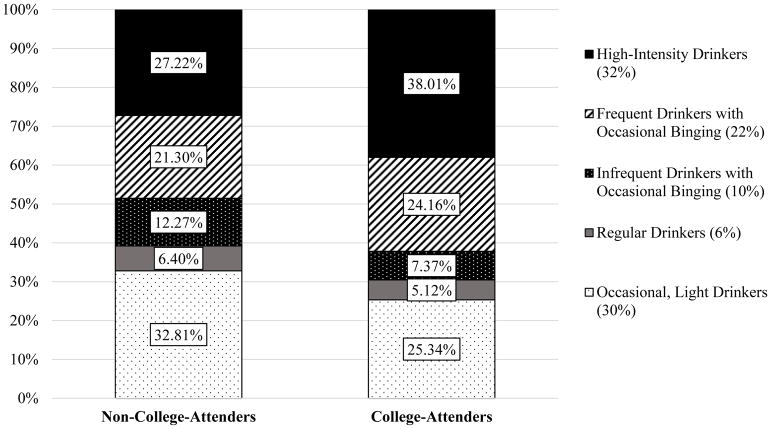
Results: Five latent classes were identified: Occasional, Light Drinkers (30%), Regular Drinkers (6%), Infrequent Drinkers with Occasional Binging (10%), Frequent Drinkers with Occasional Binging (22%), and High-Intensity Drinkers (32%). Although membership in the two riskiest classes were more common among college-attenders, odds of being a High-Intensity Drinker relative to the second riskiest class was not significantly different for college- and non-college-attending young adults. Conclusions/Importance: As high-intensity drinking does not appear to be a drinking pattern unique to college-attenders and non-college-attenders are less likely to mature out of heavy drinking patterns, intervention efforts are needed for this at-risk age group.
Keywords: Young adults; college; drinking patterns; high-intensity drinking; latent class analysis; non-college.
Conflict of interest statement
Conflicts of interest: none.
The authors report no conflicts of interest. The authors alone are responsible for the content and writing of the paper.
Figures
References
-
- Chen CM, Dufour MC, Yi H. Alcohol consumption among young adults ages 18–24 in the United States: Results from the 2001–2002 NESARC Survey. Alcohol Research and Health. 2004;28:269–280.
-
- Cleveland MJ, Lanza ST, Ray AE, Turrisi R, Mallett KA. Transitions in first-year college student drinking behaviors: Does pre-college drinking moderate the effects of parent- and peer-based intervention components? Psychology of Addictive Behaviors. 2012;26:440–450. doi: 10.1037/a0026130. - DOI - PMC - PubMed
MeSH terms
Grants and funding
LinkOut - more resources
Full Text Sources
Other Literature Sources
Medical
Research Materials
Miscellaneous
