Islamophobia, Health, and Public Health: A Systematic Literature Review
- PMID: 29672152
- PMCID: PMC5944883
- DOI: 10.2105/AJPH.2018.304402
Islamophobia, Health, and Public Health: A Systematic Literature Review
Abstract
Background: In 2017, a "Muslim ban" on immigrants to the United States was coupled with a continued rise in Islamophobia and hate crimes toward Muslims. Islamophobia undermines health equity, yet delineating the effects of Islamophobia globally is challenging as it affects a myriad of groups (geographically, racially, and socially). Additionally, stereotypes equate all Muslims with populations from the Middle East and South Asia. To date, health research pays insufficient attention to Islamophobia, Muslims, and those racialized to be Muslim.
Objectives: This literature review advances our understanding of racism and health by examining the racialization of religion, by specifically examining Islamophobia as a form of discrimination.
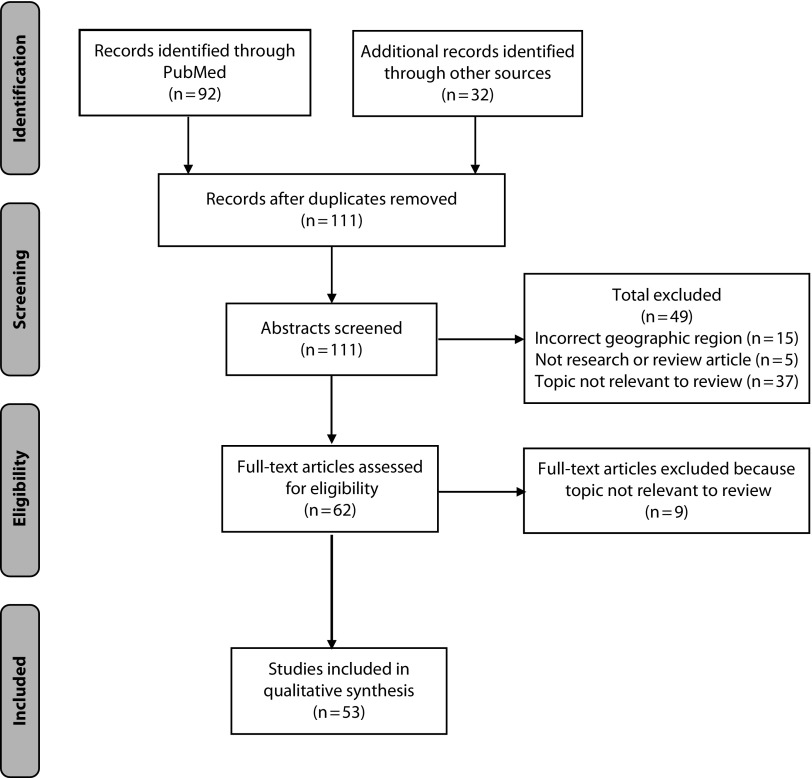
Search methods: Per PRISMA guidelines, we conducted a search in October 2017 using PubMed-MEDLINE and a combination of terms. We identified additional articles using other search engines. For inclusion, articles needed to include a descriptor of discrimination, contain an identifier of Muslim or Muslim-like identity (i.e., groups commonly perceived as Muslim, including Arabs, Middle Easterners, North Africans, and South Asians), include a health outcome, be in English, and be published between 1990 and 2017.
Selection criteria: We identified 111 unique peer-reviewed articles. We excluded articles that did not meet the following criteria: (1) examined Islamophobia, discrimination, or racism among a Muslim or Muslim-like population; (2) included a health outcome or discussion of health disparities; and (3) was conducted in North America, Europe, Australia, or New Zealand. This yielded 53 articles.
Results: The majority of studies (n = 34; 64%) were quantitative. The remaining studies were qualitative (n = 7; 13%), mixed methods (n = 2; 4%), or reviews (n = 10; 19%). Most studies were based in the United States (n = 31; 58%). Nearly half of the reviewed studies examined mental health (n = 24; 45%), and one fourth examined physical health or health behaviors (n = 13; 25%). Others focused on both physical and mental health (n = 10; 19%) or health care seeking (n = 7; 13%). Studies showed associations between Islamophobia and poor mental health, suboptimal health behaviors, and unfavorable health care-seeking behaviors.
Conclusions: This study elucidates the associations between Islamophobia, health, and socioecological determinants of health. Future studies should examine the intersectional nature of Islamophobia and include validated measures, representative samples, subgroup analyses, and comparison groups. More methodologically rigorous studies of Islamophobia and health are needed. Public Health Implications. Addressing the discrimination-related poor health that Muslims and racialized Muslim-like subgroups experience is central to the goals of health equity and assurance of the fundamental right to health.
Comment in
-
Islamophobia and the Public Health Implications of Religious Hatred.Am J Public Health. 2018 Jun;108(6):718-719. doi: 10.2105/AJPH.2018.304419. Am J Public Health. 2018. PMID: 29741951 Free PMC article. No abstract available.
References
-
- Kishi K. Assaults against Muslims in US surpass 2001 level. Pew Research Center. November 15, 2017. Available at: http://www.pewresearch.org/fact-tank/2017/11/15/assaults-against-muslims.... Accessed February 12, 2018.
-
- Federal Bureau of Investigation. Uniform Crime Report: Hate Crime Statistics, 2016. Available at: https://ucr.fbi.gov/hate-crime/2016/resource-pages/hate-crime-2016-_summary. Accessed February 12, 2018.
-
- Levin B, Grisham K. Hate crime in the United States: 20 state compilation of official data. Center for the Study of Hate & Extremism at California State University, San Bernardino. 2016. Available at: https://csbs.csusb.edu/hate-and-extremism-center/data-reports/original-r.... Accessed February 12, 2018.
-
- Lipka M. Muslims and Islam: key findings in the US and around the world. Pew Research Center. 2015. Available at: http://www.pewresearch.org/fact-tank/2017/08/09/muslims-and-islam-key-fi.... Accessed February 12, 2018.
Publication types
MeSH terms
Grants and funding
LinkOut - more resources
Full Text Sources
Other Literature Sources