Comparison of the Predictive Roles of Risk Scores of In-Hospital Major Adverse Cardiovascular Events in Patients with Non-ST Elevation Myocardial Infarction Undergoing Percutaneous Coronary Intervention
- PMID: 29672288
- PMCID: PMC6244032
- DOI: 10.1159/000489399
Comparison of the Predictive Roles of Risk Scores of In-Hospital Major Adverse Cardiovascular Events in Patients with Non-ST Elevation Myocardial Infarction Undergoing Percutaneous Coronary Intervention
Abstract
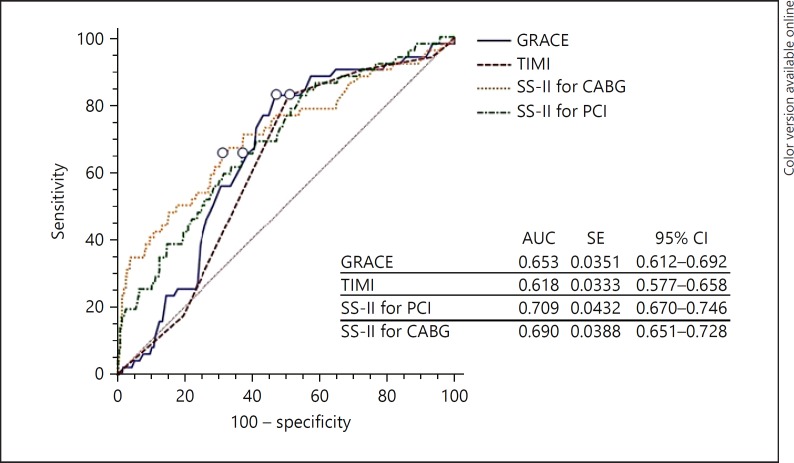
Objective: We evaluated the relationship between various risk scores (SYNTAX score [SS], SYNTAX score-II [SS-II], thrombolysis in myocardial infarction [TIMI] risk scores, and Global Registry of Acute Coronary Events [GRACE] risk scores) and major adverse cardiovascular events (MACE) in non-ST elevation myocardial infarction (NSTEMI) patients undergoing percutaneous coronary intervention (PCI).
Subjects and methods: The study population were selected from among 589 patients who underwent coronary angiography with a diagnosis of NSTEMI. TIMI and GRACE risk scores were calculated. SS and SS-II were calculated in all patients, and points were added according to the predefined algorithm, taking into account the other 6 clinical variables being monitored (age, sex, left ventricular ejection fraction, creatinine clearance, chronic obstructive pulmonary disease, and peripheral artery disease). Patients were classified into tertile 1 (SS < 22), tertile 2 (SS 23-32), and tertile 3 (SS > 32).
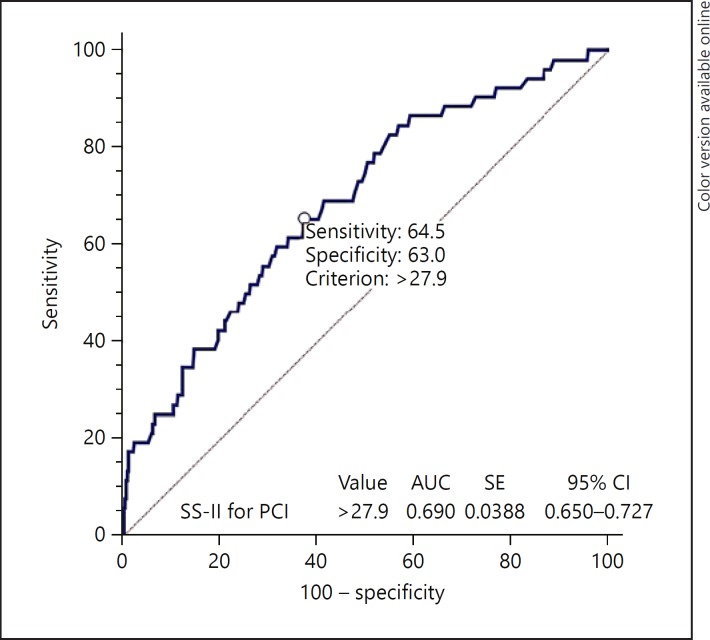
Results: The group with high SS-II for PCI values in the risk scores were observed from tertile 1 to tertile 3 (from 25.0 ± 7.7 to 31.6 ± 9.4, p < 0.001, respectively). The SS-II score in patients with PCI was an independent predictor of MACE, in-hospital mortality, nonfatal myocardial infarction, and stent thrombosis (OR 1.082, 95% CI 1.036-1.131, p < 0.001). The overall MACE, in-hospital mortality, and nonfatal myocardial infarction rates were significantly higher in the high SS-II for PCI group (p < 0.001).
Conclusion: TIMI and GRACE risk scores were able to predict MACE. In addition to these, SS-II was also able to predict in-hospital mortality, nonfatal myocardial infarction, and stent thrombosis.
Keywords: Cardiovascular events; Non-ST elevation myocardial infarction; Risk scores.
© 2018 The Author(s) Published by S. Karger AG, Basel.
Figures
References
-
- Antman EM, Cohen M, Bernink PJ, et al. The TIMI risk score for unstable angina/non-ST elevation MI: a method for prognostication and therapeutic decision making. JAMA. 2000;284:835–842. - PubMed
-
- Kurtul S, Sarli B, Baktir AO, et al. Neutrophil to lymphocyte ratio predicts SYNTAX score in patients with non-ST segment elevation myocardial infarction. Int Heart J. 2015;56:18–21. - PubMed
-
- Yan AT, Yan RT, Tan M, et al. Risk scores for risk stratification in acute coronary syndromes: useful but simpler is not necessarily better. Eur Heart J. 2007;28:1072–1078. - PubMed
-
- Granger CB, Goldberg RJ, Dabbous O, et al. Predictors of hospital mortality in the global registry of acute coronary events. Arch Intern Med. 2003;163:2345–2353. - PubMed
Publication types
MeSH terms
LinkOut - more resources
Full Text Sources
Other Literature Sources
Medical
Miscellaneous