. 2018 Jun 1;141(6):1828-1839.
doi: 10.1093/brain/awy103.

Longitudinal brain imaging in preclinical Alzheimer disease: impact of APOE ε4 genotype

Affiliations

Longitudinal brain imaging in preclinical Alzheimer disease: impact of APOE ε4 genotype

Shruti Mishra et al. Brain. .

Abstract

While prior work reliably demonstrates that the APOE ɛ4 allele has deleterious group level effects on Alzheimer disease pathology, the homogeneity of its influence across the lifespan and spatially in the brain remains unknown. Further it is unclear what combinations of factors at an individual level lead to observed group level effects of APOE genotype. To evaluate the impact of the APOE genotype on disease trajectories, we examined longitudinal MRI and PET imaging in a cohort of 497 cognitively normal middle and older aged participants. A whole-brain regional approach was used to evaluate the spatial effects of genotype on longitudinal change of amyloid-β pathology and cortical atrophy. Carriers of the ɛ4 allele had increased longitudinal accumulation of amyloid-β pathology diffusely through the cortex, but the emergence of this effect across the lifespan differed greatly by region (e.g. age 49 in precuneus, but 65 in the visual cortex) with the detrimental influence already being evident in some regions in middle age. This increased group level effect on accumulation was due to a greater proportion of ɛ4 carriers developing amyloid-β pathology, on average doing so at an earlier age, and having faster amyloid-β accumulation even after accounting for baseline amyloid-β levels. APOE ɛ4 carriers displayed faster rates of structural loss in primarily constrained to the medial temporal lobe structures at around 50 years, although this increase was modest and proportional to the elevated disease severity in APOE ɛ4 carriers. This work indicates that influence of the APOE gene on pathology can be detected starting in middle age.


Figures
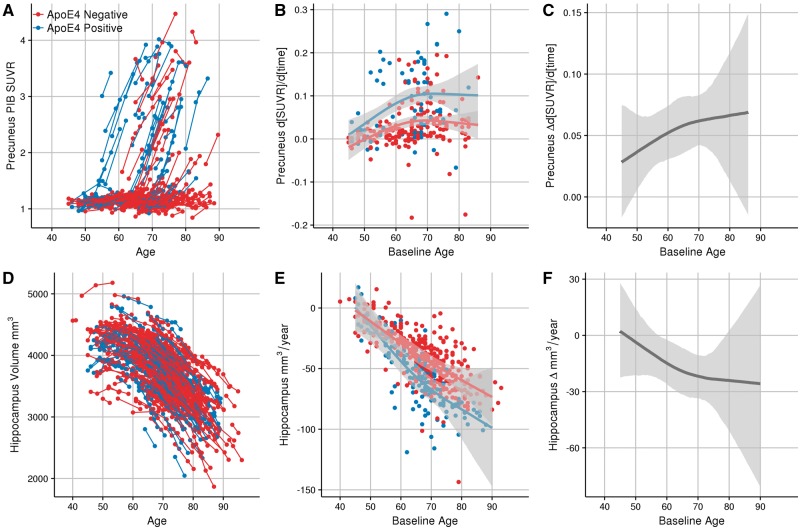
Figure 1
Figure 1
Modelling longitudinal change in precuneus PIB (A–C) and hippocampal volume (D–F). A and D represent spaghetti plots of the model fits for the individual participant SUVR and volume trajectories, respectively. B and E show the longitudinal rates of change between the APOE ɛ4 carriers and non-carriers, along with the 99% credible intervals. For reference, individual random effect slope estimates are also plotted. C and F depict the difference in rate of biomarker change between APOE ɛ4 carriers and non-carriers across the course of the sampled lifespan. Shaded regions represent 99% credible intervals..
Figure 2
Figure 2
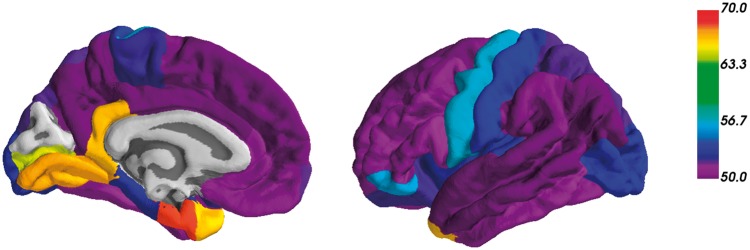
Regional differences in emergence of PIB. The colour scale represents the first age where the rate of amyloid-β accrual in the cortical regions is significantly different between APOE ɛ4 carriers and non-carriers.
Figure 3
Figure 3
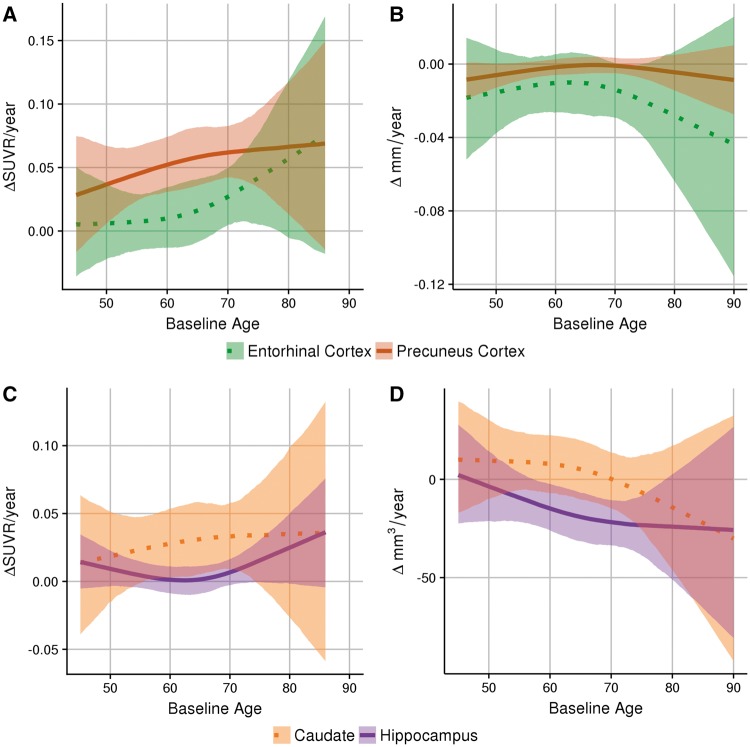
Regional differences in biomarker trajectories. Top: The difference in the longitudinal rates of change of PIB measurements (A) and cortical thickness (B) between APOE ɛ4 carriers and non-carriers in two cortical regions. Bottom: The difference in the longitudinal rates of change of PIB (C) and volume (D) between APOE ɛ4 carriers and non-carriers in two subcortical regions.
Figure 4
Figure 4
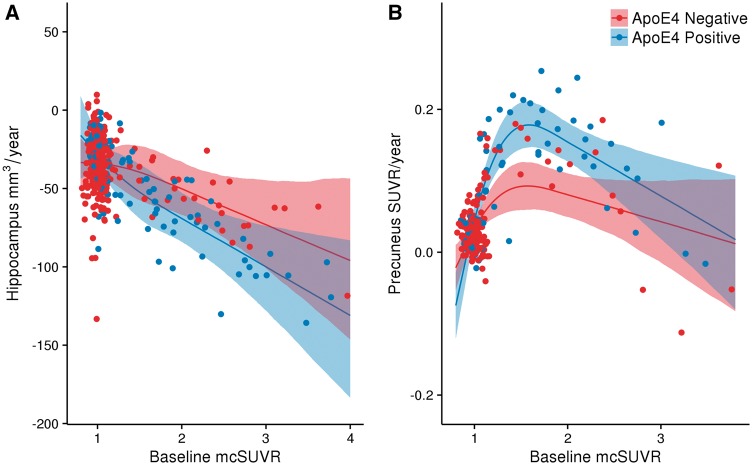
Longitudinal change in PIB as a function of disease status. The longitudinal rates of change of PIB in the hippocampus (A) and the precuneus (B) for both APOE ɛ4 carriers and non-carriers are shown as a function of mean cortical SUVR from the baseline PIB assessment. Shaded areas represent 99% credible intervals.
Figure 5
Figure 5
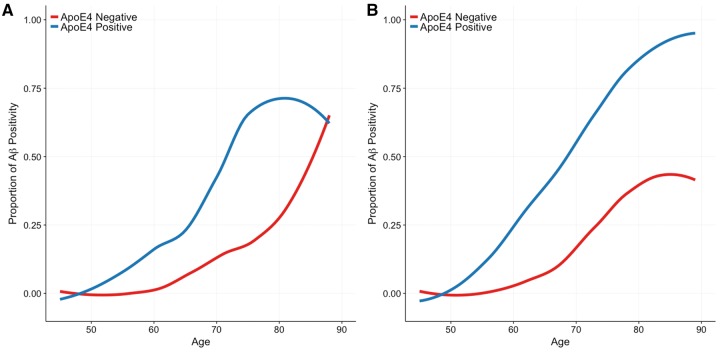
Characterization of abnormal levels of amyloid-β PET across the lifespan. The proportion of APOE ɛ4 carriers and non-carriers who are amyloid-β PET positive is depicted as function of age in (A) non-demented individuals only and (B) the combined sample of non-demented and demented individuals.

References

    1. Bateman RJ, Xiong C, Benzinger TLS, Fagan AM, Goate A, Fox NC, et al. Clinical and biomarker changes in dominantly inherited Alzheimer’s disease. N Engl J Med 2012; 367: 795–804. - PMC - PubMed
    1. Benzinger TLS, Blazey T, Jack CR, Koeppe RA, Su Y, Xiong C, et al. Regional variability of imaging biomarkers in autosomal dominant Alzheimer’s disease. Proc Natl Acad Sci USA 2013; 110: E4502–9. - PMC - PubMed
    1. Bilgel M, An Y, Zhou Y, Wong DF, Prince JL, Ferrucci L, et al. Individual estimates of age at detectable amyloid onset for risk factor assessment. Alzheimers Dement 2016; 12: 373–9. - PMC - PubMed
    1. Braak H, Braak E. Neuropathological stageing of Alzheimer-related changes. Acta Neuropathol 1991; 82: 239–59. - PubMed
    1. Brier M, Gordon B, Friedrichsen K, McCarthy J, Stern A, Christensen J, et al. Tau and AB imaging, CSF measures, and cognition in Alzheimers disease. Sci Transl Med 2016; 40: 135–45. - PMC - PubMed

Publication types