


Incidence of gastric cancer in the USA during 1999 to 2013: a 50-state analysis
- PMID: 29672681
- PMCID: PMC6005108
- DOI: 10.1093/ije/dyy055
Incidence of gastric cancer in the USA during 1999 to 2013: a 50-state analysis
Abstract
Background: The incidence of gastric cancer, while declining in many places worldwide, is characterized by considerable geographical variability. The USA has large racial, ethnic and regional variation; we collected data from all 50 states to better characterize recent changes in gastric cancer incidence nationwide.
Methods: Annual gastric cancer incidence rates from 1999 to 2013 were extracted from the United States Cancer Statistics (USCS) registry. Secular trends of gastric cancer incidence were examined overall and by sociodemographic factors and states. We used Joinpoint regression to compute annual percent change (APC) and average annual percent change (AAPC) and corresponding 95% confidence intervals (CIs). SEER 13 registries data were extracted to examine the secular trends by cardia and non-cardia gastric cancers.
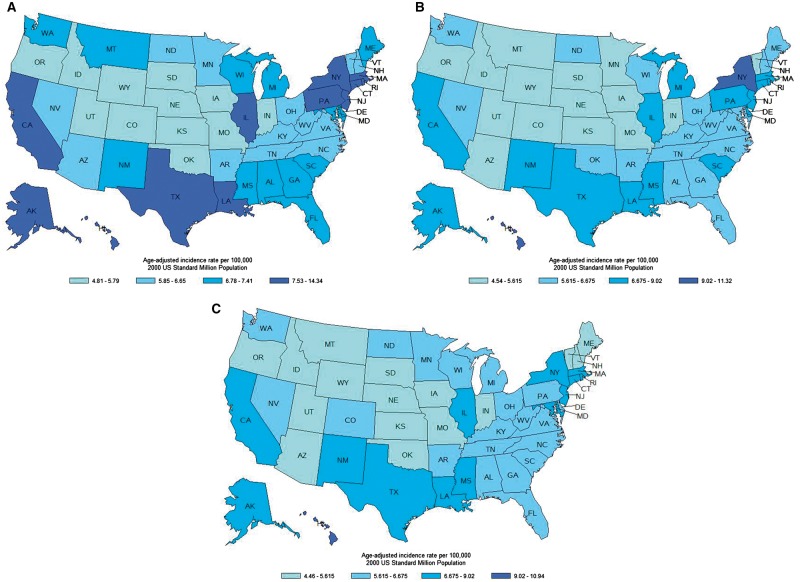
Results: Overall gastric cancer incidence decreased until 2007 (APC = -1.55, 95% CI: -1.88, -1.21), and remained stable thereafter (APC = -0.32, 95% CI: -0.84, 0.20). However, rates increased among persons <50 years of age (AAPC = 0.89, 95% CI: 0.61, 1.16), especially among non-Hispanic white females and Hispanic females. Incidence of non-cardia gastric cancer increased among persons <50 years of age (AAPC = 0.69, 95% CI: -0.06, 1.44), whereas rates of gastric cardia cancer remained unchanged. States with rapid increases in high-risk population groups (e.g. Hispanic females aged <50), including California and Texas, had highest annual increases in gastric cancer incidence.
Conclusions: Divergent trends for gastric cancer incidence were observed in the USA. Incidence rates, particularly for non-cardia gastric cancer, were stable or increasing among persons aged <50 years.
Keywords: Gastric cancer incidence; USA; state analysis.
© The Author(s) 2018; all rights reserved. Published by Oxford University Press on behalf of the International Epidemiological Association.
Figures
References
-
- Ferlay J, Soerjomataram I, Ervik M. et al. GLOBOCAN 2012 v1.0, Cancer Incidence and Mortality Worldwide: IARC CancerBase No. 11 Lyon, France: International Agency for Research on Cancer, 2013.
-
- Surveillance, Epidemiology, and End Results (SEER) Program. SEER*Stat Database: Incidence—SEER 9 Regs Research Data, Nov 2016 Sub (1973–2014) <Katrina/Rita Population Adjustment>—Linked To County Attributes—Total U.S., 1969–2015 Counties, National Cancer Institute, DCCPS, Surveillance Research Program, released April 2017, based on the November 2016 submission. http://www.seer.cancer.gov.
-
- Conteduca V, Sansonno D, Lauletta G, Russi S, Ingravallo G, Dammacco F.. H. pylori infection and gastric cancer: state of the art (review). Int J Oncol 2013;42:5–18. - PubMed
-
- Ladeiras-Lopes R, Pereira AK, Nogueira A. et al. Smoking and gastric cancer: systematic review and meta-analysis of cohort studies. Cancer Causes Control 2008;19:689–701. - PubMed
-
- Tramacere I, Negri E, Pelucchi C. et al. A meta-analysis on alcohol drinking and gastric cancer risk. Ann Oncol 2012;23:28–36. - PubMed
Grants and funding
LinkOut - more resources
Full Text Sources
Other Literature Sources
