


Total hip arthroplasty to treat acetabular protrusions secondary to rheumatoid arthritis
- PMID: 29673377
- PMCID: PMC5907719
- DOI: 10.1186/s13018-018-0809-y
Total hip arthroplasty to treat acetabular protrusions secondary to rheumatoid arthritis
Abstract
Background: The treatment of acetabular protrusions during total hip arthroplasty of patients with rheumatoid arthritis is difficult. A lack of bone stock, deficient medial cup support, and medialization of the joint center in those with protrusio acetabuli must be addressed during acetabular reconstruction. The purpose of this study was to assess the short-term clinical results of total hip arthroplasty in patients with severe acetabular protrusions secondary to rheumatoid arthritis.
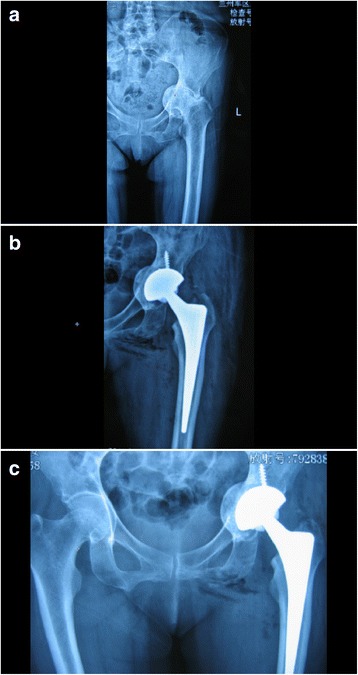
Methods: From January 2011 to November 2014, 18 patients (20 hips) with severe acetabular protrusions secondary to rheumatoid arthritis underwent total hip arthroplasties using a non-cement impaction and auto-bone-grafting method with resection of the femoral head to treat the acetabular protrusion. The Harris hip scoring system was used to evaluate hip function during follow-up; X-rays were taken to assess the extent of prosthesis loosening and bone graft healing.
Results: The operation time ranged from 55 to 131 min, averaging 89.5 ± 8.1 min. The blood loss was 165-480 mL (295 ± 10.9 mL). No blood vessel or nerve damage and no acetabular or femoral fracture occurred. The follow-up duration was 4.5 ± 1.7 years. Postoperative X-rays revealed autologous bone graft/acetabular fusion at 4.5 months post-surgery. The Harris hip scores increased significantly, from 55.3 ± 9.5 to 92.2 ± 12.7, after the operation (P < 0.01). The distance from the center of the femoral head to Kohler's line increased from 19.87 ± 3.9 mm to 21.5 ± 3.5 mm after the operation (P < 0.01). During follow-up, no hip acetabular prosthesis loosening was evident.
Conclusions: For patients with protrusio acetabuli secondary to rheumatoid arthritis, the use of a cementless, trabecular, metal modular cup allowing peripheral press fitting and restoration of bone stock via impacted autologous bone grafting are both technically straightforward and appear to yield satisfactory short-term results.
Keywords: Acetabular protrusion; Autogenous bone transplantation; Hip arthroplasty; Reconstruction; Rheumatoid arthritis.
Conflict of interest statement
Ethics approval and consent to participate
This study was approved by the Medical Ethics Committee of the Lanzhou General Hospital of the People’s Liberation Army. Informed consent was obtained from all patients. The study adhered to all relevant tenets of the Declaration of Helsinki, as revised in 2008, and was authorized by the ethics committee of our institution. All participants gave written informed consent.
Competing interests
The authors declare that they have no competing interests.
Publisher’s Note
Springer Nature remains neutral with regard to jurisdictional claims in published maps and institutional affiliations.
Figures

References
-
- Rosenberg WW, Schreurs BW, de Waal Malefijt MC, Veth RP, Slooff TJ. Impacted morsellized bone grafting and cemented primary total hip arthroplasty for acetabular protrusion in patients with rheumatoid arthritis: an 8- to 18-year follow-up study of 36 hips. Acta Orthop Scand. 2000;71:143–146. doi: 10.1080/000164700317413102. - DOI - PubMed
-
- Lu N, Yang Y, Chen H, Li WQ, Pu B, Liu LP. Health-type total hip arthroplasty combined with compression bone grafting for rheumatoid arthritis with acetabular retraction. Chinese Journal of Reconstructive Surgery. 2015;29:160–162. - PubMed
MeSH terms
Grants and funding
LinkOut - more resources
Full Text Sources
Other Literature Sources
Medical
