


Long-term scar quality after hydrosurgical versus conventional debridement of deep dermal burns (HyCon trial): study protocol for a randomized controlled trial
- PMID: 29673408
- PMCID: PMC5909227
- DOI: 10.1186/s13063-018-2599-2
Long-term scar quality after hydrosurgical versus conventional debridement of deep dermal burns (HyCon trial): study protocol for a randomized controlled trial
Abstract
Background: Deep dermal burns require tangential excision of non-viable tissue and skin grafting to improve wound healing and burn-scar quality. Tangential excision is conventionally performed with a knife, but during the last decade hydrosurgery has become popular as a new tool for tangential excision. Hydrosurgery is generally thought to be a more precise and controlled manner of burn debridement leading to preservation of viable tissue and, therefore, better scar quality. Although scar quality is considered to be one of the most important outcomes in burn surgery today, no randomized controlled study has compared the effect of these two common treatment modalities with scar quality as a primary outcome. The aim of this study is, therefore, to compare long-term scar quality after hydrosurgical versus conventional tangential excision in deep dermal burns.
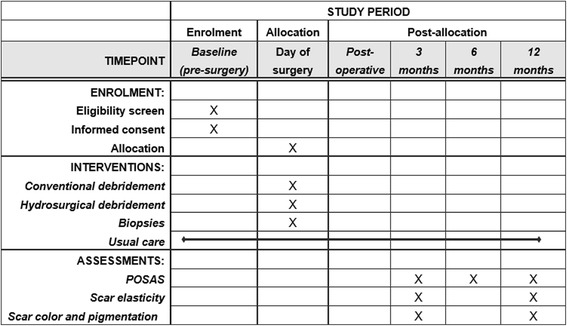
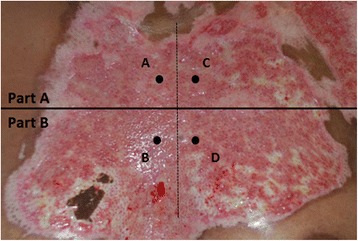
Methods/design: A multicenter, randomized, intra-patient, controlled trial will be conducted in the Dutch burn centers of Rotterdam, Beverwijk, and Groningen. All patients with deep dermal burns that require excision and grafting are eligible. Exclusion criteria are: a burn wound < 50 cm2, total body surface area (TBSA) burned > 30%, full-thickness burns, chemical or electrical burns, infected wounds (clinical symptoms in combination with positive wound swabs), insufficient knowledge of the Dutch or English language, patients that are unlikely to comply with requirements of the study protocol and follow-up, and patients who are (temporarily) incompetent because of sedation and/or intubation. A total of 137 patients will be included. Comparable wound areas A and B will be appointed, randomized and either excised conventionally with a knife or with the hydrosurgery system. The primary outcome is scar quality measured by the observer score of the Patient and Observer Scar Assessment Scale (POSAS); a subjective scar-assessment instrument, consisting of two separate six-item scales (observer and patient) that are both scored on a 10-point rating scale.
Discussion: This study will contribute to the optimal surgical treatment of patients with deep dermal burn wounds.
Trial registration: Dutch Trial Register, NTR6232 . Registered on 23 January 2017.
Keywords: Burns; Conventional debridement; Hydrosurgery; Scar quality; Tangential excision; Versajet.
Conflict of interest statement
Ethics approval and consent to participate
This study has been approved by the Medical Research Ethics Committee of Rotterdam (NL58875.101.16).
Competing interests
The authors declare that they have no competing interests.
Publisher’s Note
Springer Nature remains neutral with regard to jurisdictional claims in published maps and institutional affiliations.
Figures
References
Publication types
MeSH terms
Grants and funding
LinkOut - more resources
Full Text Sources
Other Literature Sources
Medical
