


Retrospective observational study of emergency department syndromic surveillance data during air pollution episodes across London and Paris in 2014
- PMID: 29674360
- PMCID: PMC5914706
- DOI: 10.1136/bmjopen-2017-018732
Retrospective observational study of emergency department syndromic surveillance data during air pollution episodes across London and Paris in 2014
Abstract
Introduction: Poor air quality (AQ) is a global public health issue and AQ events can span across countries. Using emergency department (ED) syndromic surveillance from England and France, we describe changes in human health indicators during periods of particularly poor AQ in London and Paris during 2014.
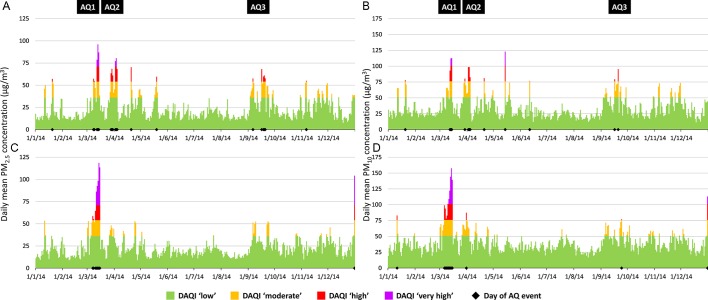
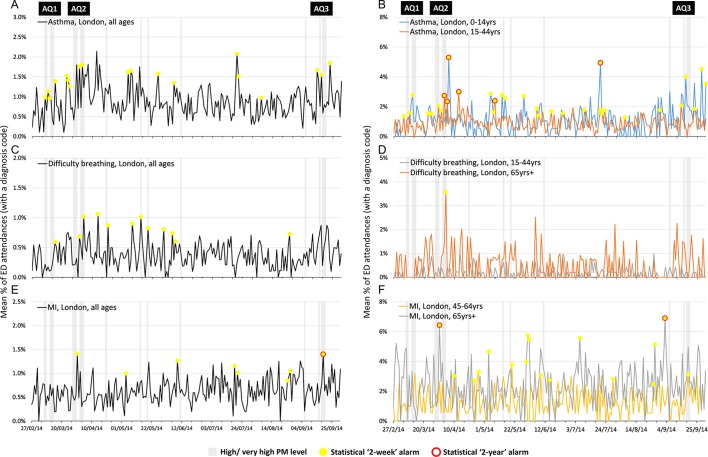
Methods: Using daily AQ data for 2014, we identified three periods of poor AQ affecting both London and Paris. Anonymised near real-time ED attendance syndromic surveillance data from EDs across England and France were used to monitor the health impact of poor AQ.Using the routine English syndromic surveillance detection methods, increases in selected ED syndromic indicators (asthma, difficulty breathing and myocardial ischaemia), in total and by age, were identified and compared with periods of poor AQ in each city. Retrospective Wilcoxon-Mann-Whitney tests were used to identify significant increases in ED attendance data on days with (and up to 3 days following) poor AQ.
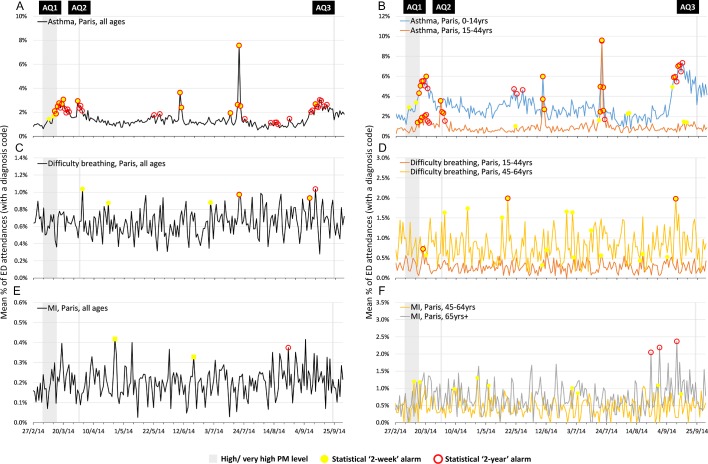
Results: Almost 1.5 million ED attendances were recorded during the study period (27 February 2014 to 1 October 2014). Significant increases in ED attendances for asthma were identified around periods of poor AQ in both cities, especially in children (aged 0-14 years). Some variation was seen in Paris with a rapid increase during the first AQ period in asthma attendances among children (aged 0-14 years), whereas during the second period the increase was greater in adults.
Discussion: This work demonstrates the public health value of syndromic surveillance during air pollution incidents. There is potential for further cross-border harmonisation to provide Europe-wide early alerting to health impacts and improve future public health messaging to healthcare services to provide warning of increases in demand.
Keywords: air quality; asthma; emergency department; particulate matter; syndromic surveillance.
© Crown copyright 2018. Reproduced with the permission of the Controller of Her Majesty’s Stationery Office/Queen’s Printer for Scotland and Public Health England.
Conflict of interest statement
Competing interests: None declared.
Figures
References
-
- World Health Organisation. Air quality guidelines global update 2005. Particulate matter, ozone, nitrogen dioxide and sulfur dioxide: WHO, 2006. - PubMed
-
- Public Health England. Public health outcomes framework: 3.01 - fraction of mortality attributable to particulate air pollution. 2017. http://www.phoutcomes.info/public-health-outcomes-framework#page/6/gid/1... (accessed 30 Mar 2017).
-
- European Environment Agency. Directive 2008/50/EC of the European Parliament and of the Council of 21 May 2008 on ambient air quality and cleaner air for Europe, 2008/50/EC. 2008.
-
- World Air Quality Index project. Air pollution in the world: real time air quality map. 2016. http://waqi.info/ (accessed 1 Mar 2016).
Publication types
MeSH terms
LinkOut - more resources
Full Text Sources
Other Literature Sources
Medical
