


FSPP: A Tool for Genome-Wide Prediction of smORF-Encoded Peptides and Their Functions
- PMID: 29675032
- PMCID: PMC5896265
- DOI: 10.3389/fgene.2018.00096
FSPP: A Tool for Genome-Wide Prediction of smORF-Encoded Peptides and Their Functions
Abstract
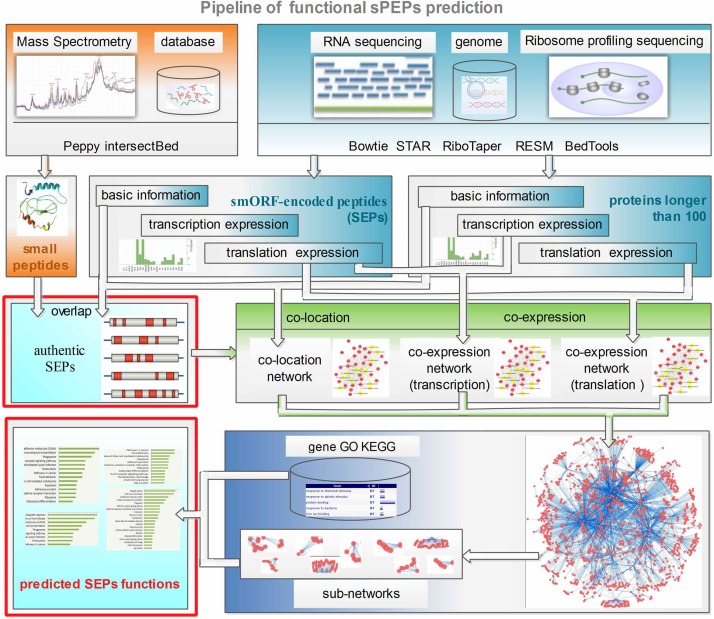
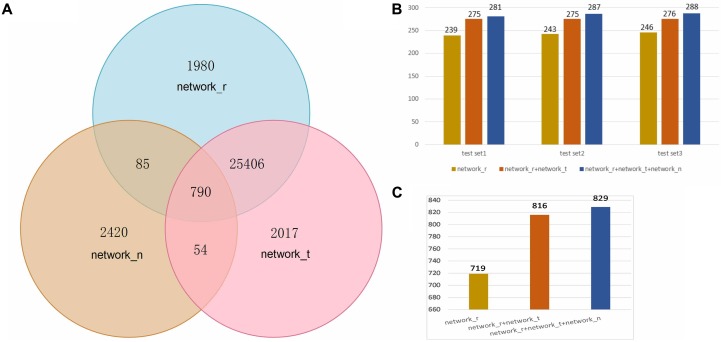
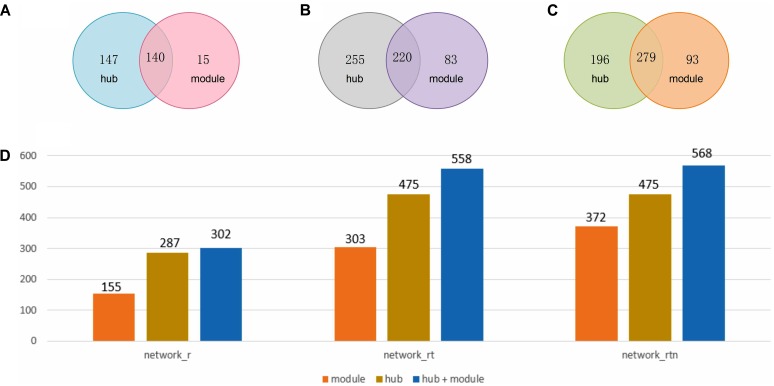
smORFs are small open reading frames of less than 100 codons. Recent low throughput experiments showed a lot of smORF-encoded peptides (SEPs) played crucial rule in processes such as regulation of transcription or translation, transportation through membranes and the antimicrobial activity. In order to gather more functional SEPs, it is necessary to have access to genome-wide prediction tools to give profound directions for low throughput experiments. In this study, we put forward a functional smORF-encoded peptides predictor (FSPP) which tended to predict authentic SEPs and their functions in a high throughput method. FSPP used the overlap of detected SEPs from Ribo-seq and mass spectrometry as target objects. With the expression data on transcription and translation levels, FSPP built two co-expression networks. Combing co-location relations, FSPP constructed a compound network and then annotated SEPs with functions of adjacent nodes. Tested on 38 sequenced samples of 5 human cell lines, FSPP successfully predicted 856 out of 960 annotated proteins. Interestingly, FSPP also highlighted 568 functional SEPs from these samples. After comparison, the roles predicted by FSPP were consistent with known functions. These results suggest that FSPP is a reliable tool for the identification of functional small peptides. FSPP source code can be acquired at https://www.bioinfo.org/FSPP.
Keywords: MS; Ribo-seq; SEP; function; smORF.
Figures
References
-
- Akimoto C., Sakashita E., Kasashima K., Kuroiwa K., Tominaga K., Hamamoto T., et al. (2013). Translational repression of the McKusick–Kaufman syndrome transcript by unique upstream open reading frames encoding mitochondrial proteins with alternative polyadenylation sites. Biochim. Biophys. Acta 1830 2728–2738. 10.1016/j.bbagen.2012.12.010 - DOI - PubMed
LinkOut - more resources
Full Text Sources
Other Literature Sources
