. 2018 Mar 14;12(1):111-140.
doi: 10.3897/CompCytogen.v12i1.20334. eCollection 2018.

The genome structure of Arachis hypogaea (Linnaeus, 1753) and an induced Arachis allotetraploid revealed by molecular cytogenetics

Affiliations

The genome structure of Arachis hypogaea (Linnaeus, 1753) and an induced Arachis allotetraploid revealed by molecular cytogenetics

Eliza F de M B do Nascimento et al. Comp Cytogenet. .

Abstract

Peanut, Arachis hypogaea (Linnaeus, 1753) is an allotetraploid cultivated plant with two subgenomes derived from the hybridization between two diploid wild species, A. duranensis (Krapovickas & W. C. Gregory, 1994) and A. ipaensis (Krapovickas & W. C. Gregory, 1994), followed by spontaneous chromosomal duplication. To understand genome changes following polyploidy, the chromosomes of A. hypogaea, IpaDur1, an induced allotetraploid (A. ipaensis × A. duranensis)4x and the diploid progenitor species were cytogenetically compared. The karyotypes of the allotetraploids share the number and general morphology of chromosomes; DAPI+ bands pattern and number of 5S rDNA loci. However, one 5S rDNA locus presents a heteromorphic FISH signal in both allotetraploids, relative to corresponding progenitor. Whilst for A. hypogaea the number of 45S rDNA loci was equivalent to the sum of those present in the diploid species, in IpaDur1, two loci have not been detected. Overall distribution of repetitive DNA sequences was similar in both allotetraploids, although A. hypogaea had additional CMA3+ bands and few slight differences in the LTR-retrotransposons distribution compared to IpaDur1. GISH showed that the chromosomes of both allotetraploids had preferential hybridization to their corresponding diploid genomes. Nevertheless, at least one pair of IpaDur1 chromosomes had a clear mosaic hybridization pattern indicating recombination between the subgenomes, clear evidence that the genome of IpaDur1 shows some instability comparing to the genome of A. hypogaea that shows no mosaic of subgenomes, although both allotetraploids derive from the same progenitor species. For some reasons, the chromosome structure of A. hypogaea is inherently more stable, or, it has been at least, partially stabilized through genetic changes and selection.

Keywords: Chromosomes; DNA content; FISH; GISH; LTR-retrotransposons; heterochromatic bands; peanut; rDNA.


Figures
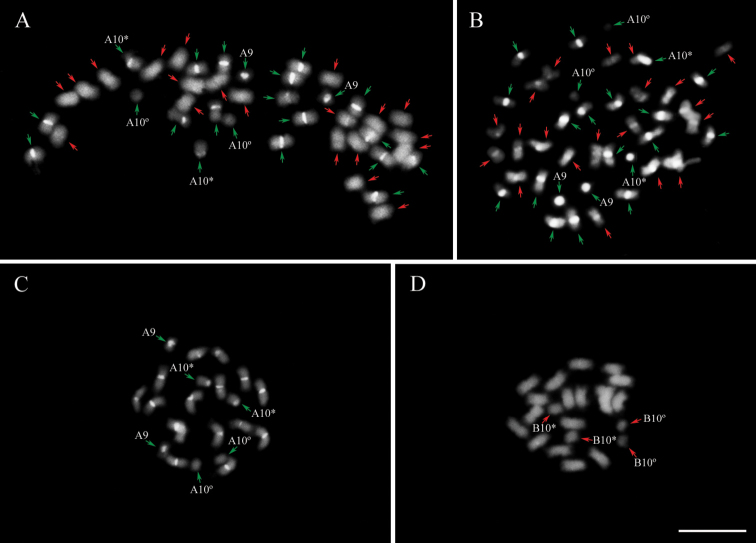
Figure 1.
Figure 1.
Metaphase chromosome spreads from root tips after DAPI staining (bright white) of A IpaDur1 B A. hypogaea C A. duranensis and D A. ipaensis. Chromosomes of the A subgenome (green arrows) and B subgenome (red arrows). Cyt-A9 (A9). Whenever the secondary constriction on cyt-A10 and cyt-B10 is extended, forming the thread-like constriction; the short arm and the proximal segment of the long arm are indicated by an asterisk (*) and the separated satellite is marked by a degree sign (°). Bar = 5μm.
Figure 2.
Figure 2.
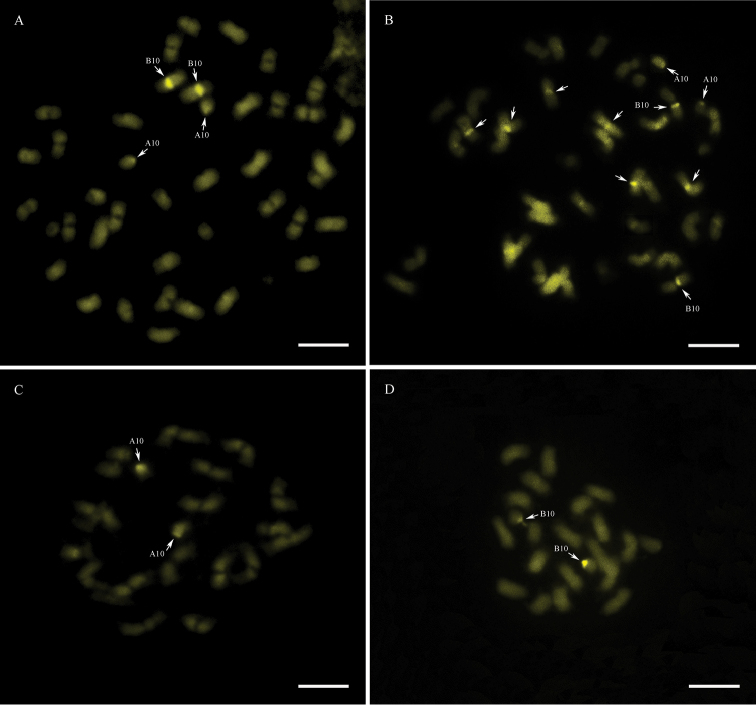
Chromosomes with CMA3+ bands (arrows) on their proximal regions. A IpaDur1 B A. hypogaea C A. duranensis D A. ipaensis. Cyt-A10 (A10) and cyt-B10 (B10). Bar = 5μm.
Figure 3.
Figure 3.
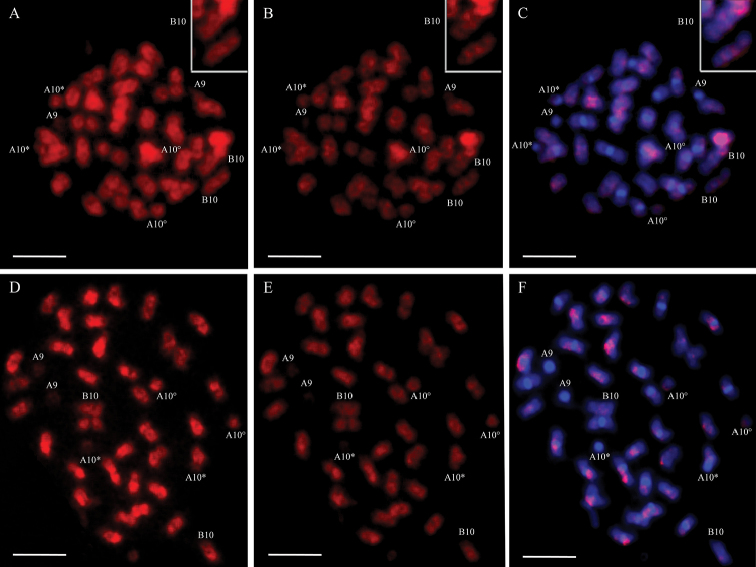
Single GISH on IpaDur1 (A, B, C) and A. hypogaea (D, E, F) chromosomes, followed by DAPI counterstaining (blue C, F). Hybridization with the genomic probe of IpaDur1 A, E A. hypogaea probe B, D and C overlapping of DAPI and A. hypogaea probe on IpaDur1 chromosomes F overlapping of DAPI and IpaDur1 probe on A. hypogaea. Cyt-A9 (A9), CytB-10 (B10). Insets of cyt-B10 of IpaDur1 (A, B, C) showing alternate dark and light bands. When the secondary constriction on cyt-A10 is extended, forming the thread-like constriction, the short arm and the proximal segment of the long arm are indicated by an asterisk (*) and the separated satellite is marked by a degree sign (°). Bar = 5μm.
Figure 4.
Figure 4.
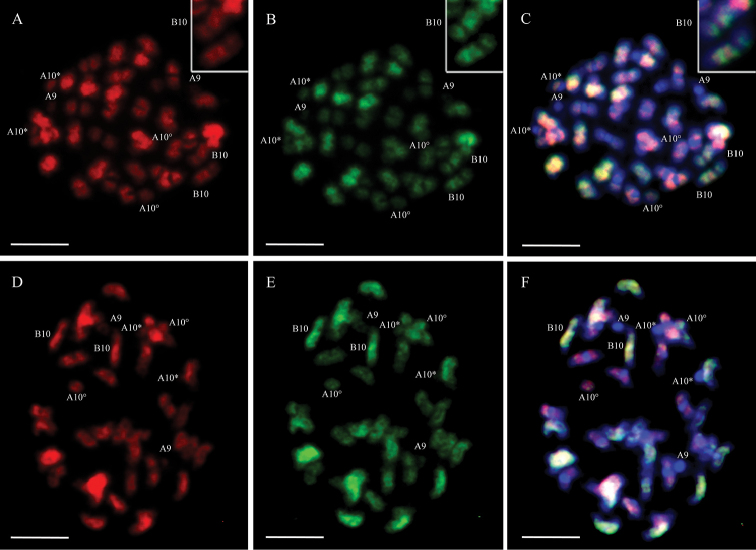
Double GISH on IpaDur1 (A, B, C) and A. hypogaea (D, E, F) chromosomes, followed by DAPI counterstaining (blue C, F). Hybridization with the genomic probe of A. duranensis (red A, D) and A. ipaensis (green B, E). Overlapping of DAPI and both diploid probes on C IpaDur1 and on F A. hypogaea. Cyt-A9 (A9), cyt-B10 (B10). Insets of IpaDur1 cyt-B10 (A, B, C), showing a colored mosaic. When the secondary constriction on cyt-A10 is extended, forming the thread-like constriction, the short arm and the proximal segment of the long arm are indicated by an asterisk (*) and the separated satellite is marked by a degree sign (°). Bar = 5μm.
Figure 5.
Figure 5.
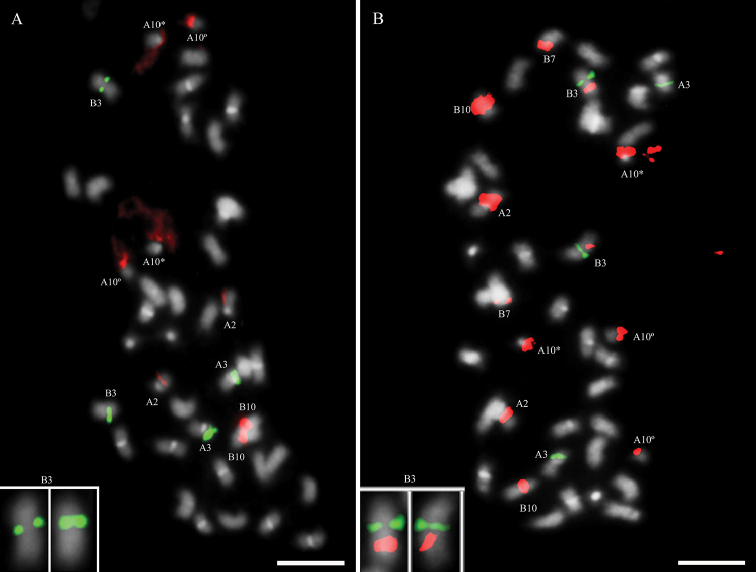
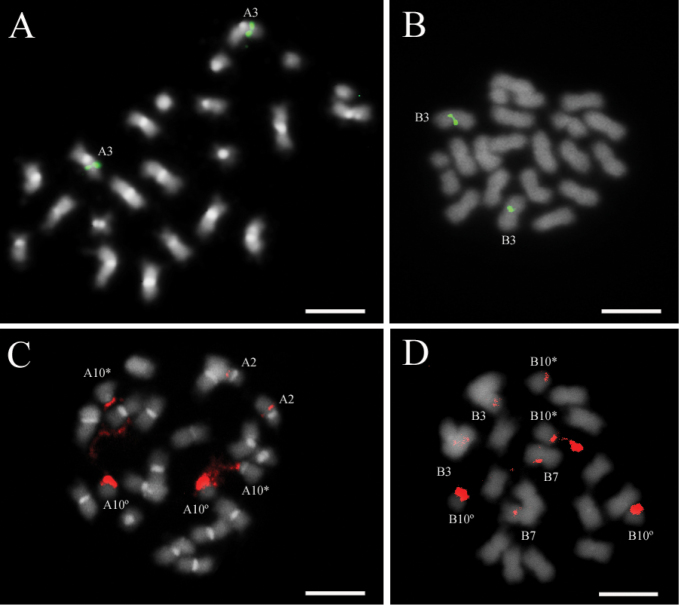
A IpaDur1 and B A. hypogaea chromosomes hybridized with the 5S rDNA probe (green) and 45S (red), followed by DAPI counterstaining (bright white). Cyt-A2 (A2), cyt-A3 (A3), cyt-B3 (B3), cyt-B7 (B7) and cyt-B10 (B10). A. hypogaea cyt-B3 with the co-localization of 5S and 45S rDNA signals. When the secondary constriction on cyt-A10 is extended, forming the thread-like constriction, the short arm and the proximal segment of the long arm are indicated by an asterisk (*) and the separated satellite is marked by a degree sign (°). Bar = 5μm.
Figure 6.
Figure 6.
Mitotic metaphase chromosome hybridized with the 5S rDNA probe (green A, B) and 45S rDNA probe (red C, D), followed by DAPI counterstaining (bright white). A A. duranensis (2n = 2x = 20) showing signals on cyt-A3 (A3) B A. ipaensis (2n = 2x = 20) showing signals on cyt-B3 (B3) C A. duranensis with signals on cyt-A2 (A2) and cyt-A10 (A10) D A. ipaensis showing signals on cyt-B3, B7 and B10. When the secondary constriction on chromosome 10 is extended, forming the thread-like constriction, the short arm and the proximal segment of the long arm are indicated by an asterisk (*) and separated satellite is marked by a degree sign (°). Bar = 5μm.
Figure 7.
Figure 7.
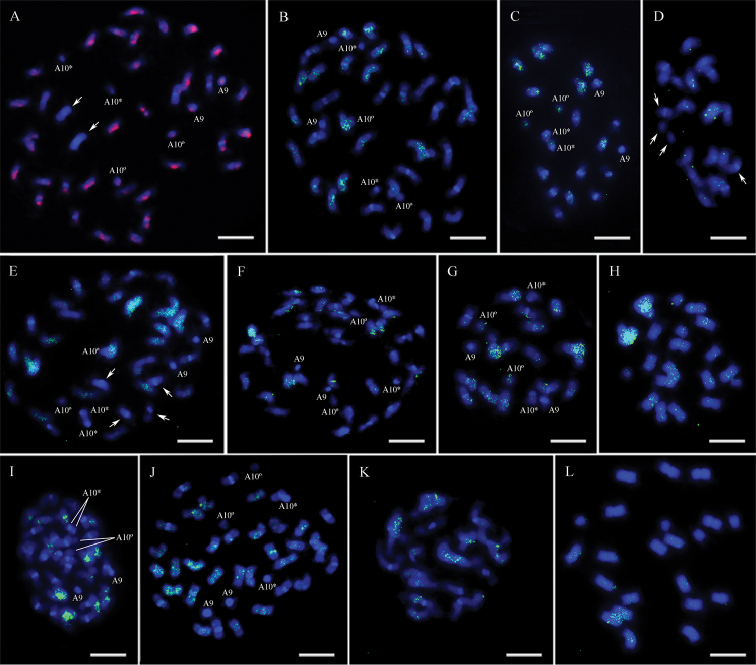
IpaDur1 (A, E, I), A. hypogaea (B, F, J), A. duranensis (C, G, K) and A. ipaensis (D, H, L) chromosomes hybridized with the LTR-retrotransposon probes RE-128-84 (A, B, C, D), Pipoka (E, F, G, H) and Athena (I, J, K, L), followed by DAPI counterstaining (blue). Cyt-A9 (A9). Chromosomes lacking signals (arrow). When the secondary constriction on cyt-A10 is extended, forming the thread-like constriction, the short arm and the proximal segment of the long arm are indicated by an asterisk (*) and the separated satellite is marked by a degree sign (°). Bar = 5μm.
Figure 8.
Figure 8.
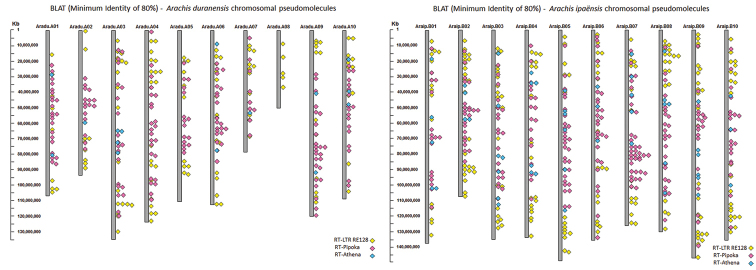
In silico mapping of the LTR-retrotransposon families, RE128-84, Pipoka and Athena on the chromosomal pseudomolecules of A. duranensis (left) and A. ipaensis (right).

References

    1. Adams KL, Wendel JF. (2005) Polyploidy and genome evolution in plants. Current Opinionin Plant Biology 8: 135–141. - DOI - PubMed
    1. Bento M, Pereira HS, Rocheta M, Gustafson P, Viegas W, Silva M. (2008) Polyploidization as a retraction force in plant genome evolution: Sequence rearrangements in Triticale PLoS One 3: 1402. - DOI - PMC - PubMed
    1. Bertioli DJ, Cannon SB, Froenicke Huang G, Farmer AD, Cannon EKS, Liu X, Gao D, Clevenger J, Dash S, Ren L, Moretzsohn MC, Shirasawa K, Huang W, Vidigal B, Abernathy B, Chu Y, Niederhuth CE, Umale P, Araújo ACG, Kozik A, Kim KD, Burow MD, Varshney RK, Wang X, Zhang X, Barkley N, Guimarães PM, Isobe S, Guo B, Liao B, Stalker HT, Schmitz RJ, Scheffler BE, Leal-Bertioli SCM, Xun X, Jackson SA, Michelmore R, Ozias-Akins P. (2016) The genome sequences of Arachis duranensis and Arachis ipaënsis, the diploid ancestors of cultivated peanut. Nature Genetics 48: 438–446. - PubMed
    1. Bertioli DJ, Vidigal B, Nielen S, Ratnaparkhe MB, Lee TH, Leal-Bertioli SCM, Kim M, Guimarães PM, Seijo G, Schwarzacher T, Paterson AH, Heslop-Harrison P, Araujo ACG. (2013) The repetitive component of the A genome of peanut (Arachis hypogaea) and its role in remodelling intergenic sequence space since its evolutionary divergence from the B genome. Annals of Botany 112: 545–559. - DOI - PMC - PubMed
    1. Bonavia D. (1982) Los Gavilanes: mar, desierto y oásis en la historia del hombre: precerámico peruano. Corporación Financiera de Desarrollo, Instituto Arqueologico Aleman.

LinkOut - more resources