Surgical treatment of unilateral severe simple congenital ptosis
- PMID: 29675342
- PMCID: PMC5890581
- DOI: 10.4103/tjo.tjo_70_17
Surgical treatment of unilateral severe simple congenital ptosis
Abstract
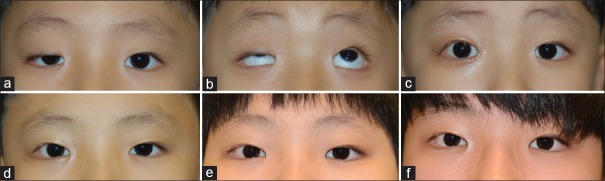
Unilateral congenital ptosis with poor levator function of ≤4 mm continues to be a difficult challenge for the oculoplastic surgeon. Surgical correction can be accomplished with unilateral frontalis suspension, maximal levator resection, or bilateral frontalis suspension with or without levator muscle excision of the normal eyelid. Bilateral frontalis suspension was proposed by Beard and Callahan to overcome the challenge of postoperative asymmetry, allowing symmetrical lagophthalmos on downgaze, postoperatively. However, most surgeons and patients prefer unilateral correction on the abnormal eyelid either with a frontalis suspension or maximal levator resection. Frontalis suspension may be performed through the various surgical techniques using different autogenous or exogenous materials. Autogenous fascia lata is considered the material of choice with low recurrence rates but carries the drawbacks of the difficulty of harvesting and postoperative morbidity from the second surgical site. Recent reports have suggested that maximal levator resection provides improved cosmesis, a more natural contour, and avoids brow scars. Although both treatments have shown to have similar success rates, there is much debate about what the most favorable method for treating severe unilateral ptosis. We review the literature on the various surgical treatments for unilateral severe congenital ptosis, including the rationale, advantages and disadvantages of each technique.
Keywords: Congenital ptosis; frontalis suspension; maximal levator resection; poor levator function.
Conflict of interest statement
The authors declare that there are no conflicts of interests of this paper.
Figures
References
-
- Wong VA, Beckingsale PS, Oley CA, Sullivan TJ. Management of myogenic ptosis. Ophthalmology. 2002;109:1023–31. - PubMed
-
- El Essawy R, Elsada MA. Clinical and demographic characteristics of ptosis in children: A national tertiary hospital study. Eur J Ophthalmol. 2013;23:356–60. - PubMed
-
- Anderson RL, Baumgartner SA. Amblyopia in ptosis. Arch Ophthalmol. 1980;98:1068–9. - PubMed
-
- Berry-Brincat A, Willshaw H. Paediatric blepharoptosis: A 10-year review. Eye (Lond) 2009;23:1554–9. - PubMed
Publication types
LinkOut - more resources
Full Text Sources
Other Literature Sources