


Proton-Pump Inhibitors and Long-Term Risk of Community-Acquired Pneumonia in Older Adults
- PMID: 29676433
- PMCID: PMC6099478
- DOI: 10.1111/jgs.15385
Proton-Pump Inhibitors and Long-Term Risk of Community-Acquired Pneumonia in Older Adults
Abstract
Objectives: To estimate associations between long-term use of proton pump inhibitors (PPIs) and pneumonia incidence in older adults in primary care.
Design: Longitudinal analyses of electronic medical records.
Setting: England PARTICIPANTS: Individuals aged 60 and older in primary care receiving PPIs for 1 year or longer (N=75,050) and age- and sex-matched controls (N=75,050).
Measurements: Net hazard ratios for pneumonia incidence in Year 2 of treatment were estimated using the prior event rate ratio (PERR), which adjusts for pneumonia incidence differences before initiation of treatment. Inverse probability weighted models adjusted for 78 demographic, disease, medication, and healthcare usage measures.
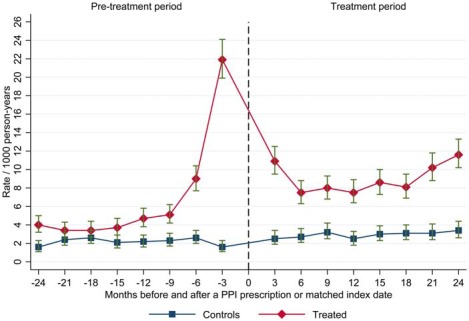
Results: During the second year after initiating treatment, PPIs were associated with greater hazard of incident pneumonia (PERR-adjusted hazard ratio=1.82, 95% confidence interval=1.27-2.54), accounting for pretreatment pneumonia rates. Estimates were similar across age and comorbidity subgroups. Similar results were also obtained from propensity score- and inverse probability-weighted models.
Conclusion: In a large cohort of older adults in primary care, PPI prescription was associated with greater risk of pneumonia in the second year of treatment. Results were robust across alternative analysis approaches. Controversies about the validity of reported short-term harms of PPIs should not divert attention from potential long-term effects of PPI prescriptions on older adults.
Keywords: pneumonia; primary care; proton pump inhibitors.
© 2018 The Authors. The Journal of the American Geriatrics Society published by Wiley Periodicals, Inc. on behalf of The American Geriatrics Society.
Figures
Comment in
-
Long-Term Use of Proton Pump Inhibitors and Community-Acquired Pneumonia: Adverse Effect or Bias?J Am Geriatr Soc. 2018 Dec;66(12):2427-2428. doi: 10.1111/jgs.15575. Epub 2018 Oct 16. J Am Geriatr Soc. 2018. PMID: 30325006 No abstract available.
-
Reply to: Proton Pump Inhibitors and Long-term Risk of Community-acquired Pneumonia in Older Adults.J Am Geriatr Soc. 2018 Dec;66(12):2428-2429. doi: 10.1111/jgs.15637. Epub 2018 Oct 16. J Am Geriatr Soc. 2018. PMID: 30325007 No abstract available.
-
Relationship Between Proton Pump Inhibitors and Pneumonia May Be an Epiphenomenon.J Am Geriatr Soc. 2018 Dec;66(12):2429-2430. doi: 10.1111/jgs.15598. Epub 2018 Oct 16. J Am Geriatr Soc. 2018. PMID: 30325014 No abstract available.
-
PPI-Dauergabe begünstigt Pneumonien.MMW Fortschr Med. 2018 Nov;160(19):35. doi: 10.1007/s15006-018-1079-7. MMW Fortschr Med. 2018. PMID: 30406538 German. No abstract available.
References
-
- Katz PO, Gerson LB, Vela MF. Guidelines for the diagnosis and management of gastroesophageal reflux disease. Am J Gastroenterol 2013;108:308–328. - PubMed
-
- National Institute for Health and Care Excellence (NICE) . Gastro‐Oesophageal Reflux Disease and Dyspepsia in Adults: Investigation and Management, 2014, https://www.nice.org.uk/guidance/cg184/chapter/1-Recommendations - PubMed
-
- Lanas A. We are using too many PPIs, and we need to stop: A European perspective. Am J Gastroenterol 2016;111:1085–1086. - PubMed
-
- Abrahamsen B, Vestergaard P. Proton pump inhibitor use and fracture risk—effect modification by histamine H1 receptor blockade. Observational case‐control study using National Prescription Data. Bone 2013;57:269–271. - PubMed
Publication types
MeSH terms
Substances
Grants and funding
LinkOut - more resources
Full Text Sources
Other Literature Sources
Medical
