


Mixed phylogenetic signal in fish toxicity data across chemical classes
- PMID: 29676862
- PMCID: PMC6016386
- DOI: 10.1002/eap.1698
Mixed phylogenetic signal in fish toxicity data across chemical classes
Abstract
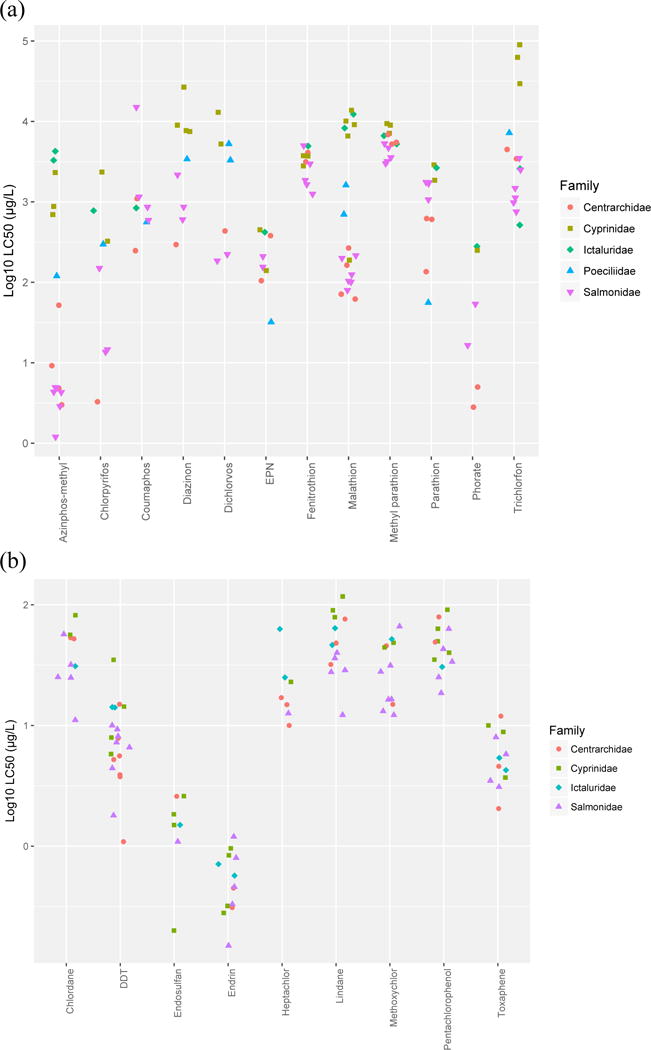
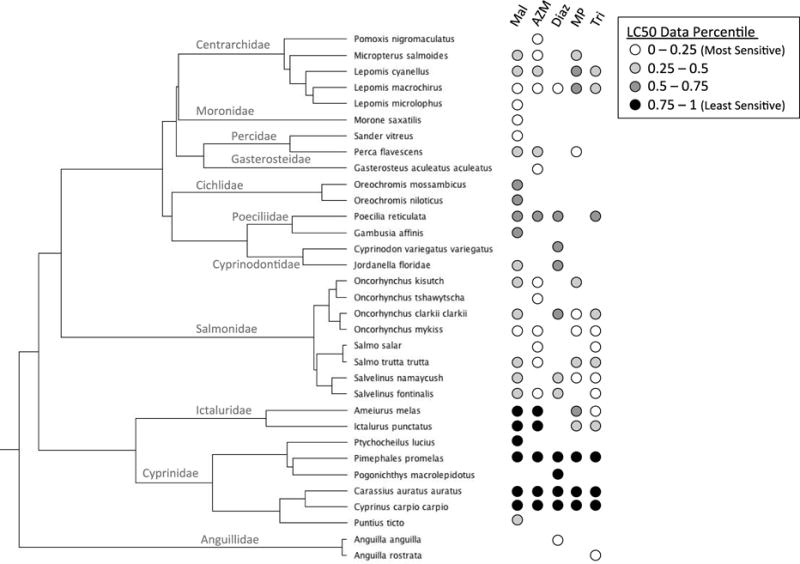
Chemical use in society is growing rapidly and is one of the five major pressures on biodiversity worldwide. Since empirical toxicity studies of pollutants generally focus on a handful of model organisms, reliable approaches are needed to assess sensitivity to chemicals across the wide variety of species in the environment. Phylogenetic comparative methods (PCM) offer a promising approach for toxicity extrapolation incorporating known evolutionary relationships among species. If phylogenetic signal in toxicity data is high, i.e., closely related species are more similarly sensitive as compared to distantly related species, PCM could ultimately help predict species sensitivity when toxicity data are lacking. Here, we present the largest ever test of phylogenetic signal in toxicity data by combining phylogenetic data from fish with acute mortality data for 42 chemicals spanning 10 different chemical classes. Phylogenetic signal is high for some chemicals, particularly organophosphate pesticides, but not necessarily for many chemicals in other classes (e.g., metals, organochlorines). These results demonstrate that PCM may be useful for toxicity extrapolation in untested species for those chemicals with clear phylogenetic signal. This study provides a framework for using PCM to understand the patterns and causes of variation in species sensitivity to pollutants.
Keywords: ecological risk assessment; ecotoxicology; evolutionary toxicology; fish; organochlorine; organophosphate; phylogenetic comparative methods; phylogeny.
© 2018 by the Ecological Society of America.
Figures
References
-
- Ankley GT, Bennett RS, Erickson RJ, Hoff DJ, Hornung MW, Johnson RD, Mount DR, Nichols JW, Russom CL, Schmieder PK, et al. Adverse outcome pathways: A conceptual framework to support ecotoxicology research and risk assessment. Environ Toxicol Chem. 2010;29:730–741. - PubMed
-
- Backhaus T, Snape J, Lazorchak J. The impact of chemical pollution on biodiversity and ecosystem services: the need for an improved understanding. Integr Environ Assess Manag. 2012;8:575–576. - PubMed
-
- Barron MG, Lilavois CR, Martin TM. MOAtox: A comprehensive mode of action and acute aquatic toxicity database for predictive model development. Aquat Toxicol. 2015;161:102–107. - PubMed
-
- Buchwalter DB, Luoma SN. Differences in Dissolved Cadmium and Zinc Uptake among Stream Insects: Mechanistic Explanations. Environ Sci Technol. 2005;39:498–504. - PubMed
Publication types
MeSH terms
Substances
Grants and funding
LinkOut - more resources
Full Text Sources
Other Literature Sources
Medical
