


Are large clinical trials in orthopaedic trauma justified?
- PMID: 29678204
- PMCID: PMC5909275
- DOI: 10.1186/s12891-018-2029-3
Are large clinical trials in orthopaedic trauma justified?
Abstract
Background: The objective of this analysis is to evaluate the necessity of large clinical trials using FLOW trial data.
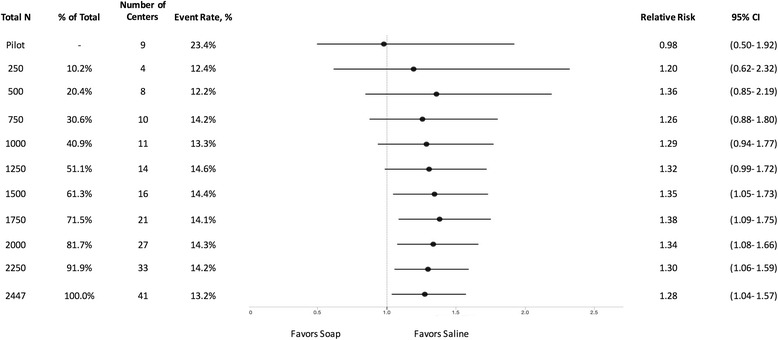
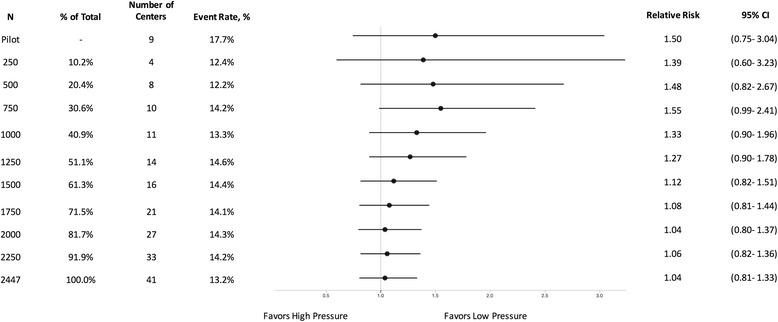
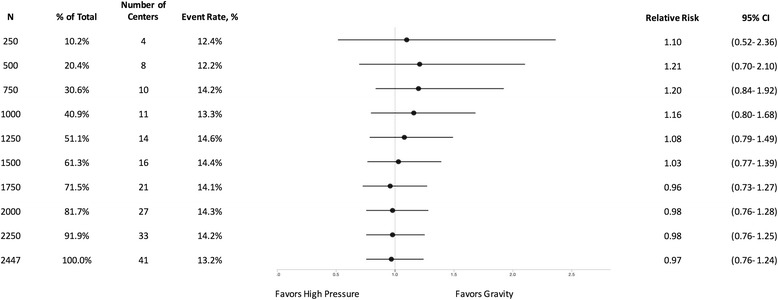
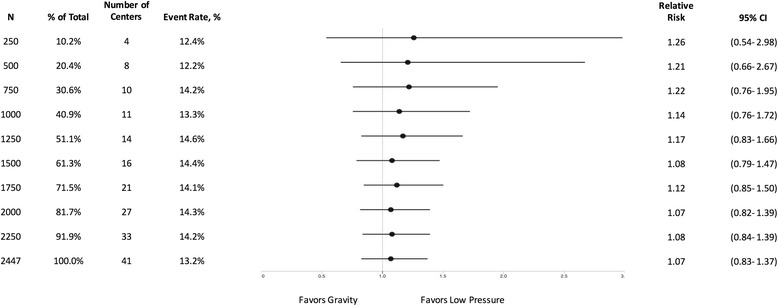
Methods: The FLOW pilot study and definitive trial were factorial trials evaluating the effect of different irrigation solutions and pressures on re-operation. To explore treatment effects over time, we analyzed data from the pilot and definitive trial in increments of 250 patients until the final sample size of 2447 patients was reached. At each increment we calculated the relative risk (RR) and associated 95% confidence interval (CI) for the treatment effect, and compared the results that would have been reported at the smaller enrolments with those seen in the final, adequately powered study.
Results: The pilot study analysis of 89 patients and initial incremental enrolments in the FLOW definitive trial favored low pressure compared to high pressure (RR: 1.50, 95% CI: 0.75-3.04; RR: 1.39, 95% CI: 0.60-3.23, respectively), which is in contradiction to the final enrolment, which found no difference between high and low pressure (RR: 1.04, 95% CI: 0.81-1.33). In the soap versus saline comparison, the FLOW pilot study suggested that re-operation rate was similar in both the soap and saline groups (RR: 0.98, 95% CI: 0.50-1.92), whereas the FLOW definitive trial found that the re-operation rate was higher in the soap treatment arm (RR: 1.28, 95% CI: 1.04-1.57).
Conclusions: Our findings suggest that studies with smaller sample sizes would have led to erroneous conclusions in the management of open fracture wounds.
Trial registration: NCT01069315 (FLOW Pilot Study) Date of Registration: February 17, 2010, NCT00788398 (FLOW Definitive Trial) Date of Registration: November 10, 2008.
Keywords: FLOW trial; Large trials; Orthopaedic trial; Sample size.
Conflict of interest statement
Ethics approval and consent to participate
REB Approval for the FLOW pilot and definitive trial was obtained at the coordinating centre (McMaster University) (REB: 05–299 and 08–268) and at each clinical site. Informed consent was obtained from all participants prior to enrollment. All procedures followed were in accordance with ethical standards of the ethics boards.
Consent for publication
Not applicable.
Competing interests
SS reports grants from the Canadian Institutes of Health Research, employment/salary from McMaster University, and employment/salary from Global Research Solutions outside the submitted work. PTIII reports other from Smith & Nephew and other from Lippincott Williams & Wilkins outside the submitted work. PM reports personal fees from Global Research Solutions outside the submitted work. BP reports grants from Stryker, outside the submitted work. KJJ reports personal fees from Zimmer, personal fees from Lilly USA, LLC, and personal fees from Pacira outside the submitted work. MB reports grants from Canadian Institutes of Health Research, other from Stryker, other from Zimmer, other from Triad Medical, grants from Office of the Assistant Secretary of Defense for Health Affairs through the Orthopaedic Trauma Research Program and the Peer Reviewed Orthopaedic Research Program, and grants from Association Internationale pour l’Osteosynthese Dynamique during the conduct of the study. He reports grants and personal fees from Stryker, personal fees from Smith & Nephew, grants and personal fees from Amgen, grants from DePuy, grants and personal fees from Eli Lilly, grants and personal fees from DJO Global Inc., personal fees from Zimmer, and personal fees from Ferring outside the submitted work. GPS, NNO, and DS have nothing to disclose.
Publisher’s Note
Springer Nature remains neutral with regard to jurisdictional claims in published maps and institutional affiliations.
Figures
References
-
- SPRINT Investigators. Bhandari M, Tornetta P, 3rd, Rampersad SA, Sprague S, Heels-Ansdell D, et al. (Sample) size matters! An examination of sample size from the SPRINT trial study to prospectively evaluate reamed intramedullary nails in patients with tibial fractures. J Orthop Trauma. 2013;27:183–188. doi: 10.1016/j.mporth.2013.02.003. - DOI - PMC - PubMed
MeSH terms
Associated data
Grants and funding
LinkOut - more resources
Full Text Sources
Other Literature Sources
Medical
