


Altered ultradian cortisol rhythmicity as a potential neurobiologic substrate for chronic insomnia
- PMID: 29678398
- PMCID: PMC6524148
- DOI: 10.1016/j.smrv.2018.03.003
Altered ultradian cortisol rhythmicity as a potential neurobiologic substrate for chronic insomnia
Abstract
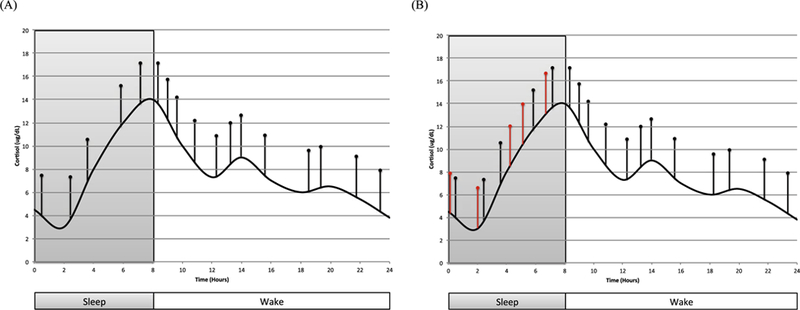
Chronic insomnia is highly prevalent and associated with significant morbidity (i.e., confers risk for multiple psychiatric and medical disorders, such as depression and hypertension). Therefore, it is essential to identify factors that perpetuate this disorder. One candidate factor in the neurobiology of chronic insomnia is hypothalamic-pituitary-adrenal-axis dysregulation, and in particular, alterations in circadian cortisol rhythmicity. Cortisol secretory patterns, however, fluctuate with both a circadian and an ultradian rhythm (i.e., pulses every 60-120 min). Ultradian cortisol pulses are thought to be involved in the maintenance of wakefulness during the day and their relative absence at night may allow for the consolidation of sleep and/or shorter nocturnal awakenings. It is possible that the wakefulness that occurs in chronic insomnia may be associated with the aberrant occurrence of cortisol pulses at night. While cortisol pulses naturally occur with transient awakenings, it may also be the case that cortisol pulsatility becomes a conditioned phenomenon that predisposes one to awaken and/or experience prolonged nocturnal awakenings. The current review summarizes the literature on cortisol rhythmicity in subjects with chronic insomnia, and proffers the suggestion that it may be abnormalities in the ultradian rather than circadian cortisol that is associated with the pathophysiology of insomnia.
Keywords: Circadian rhythm; Cortisol; HPA-axis; Insomnia; Ultradian rhythm.
Copyright © 2018 Elsevier Ltd. All rights reserved.
Conflict of interest statement
Conflicts of interest
The authors report no potential conflicts of interest or financial relationships with commercial interests that are relevant to this work.
Figures
References
-
- Riemann D, Voderholzer U. Primary insomnia: a risk factor to develop depression? J Affect Disord 2003;76:255–9. https://doi.org/10.1016/S0165-0327(02)00072-1. - PubMed
Publication types
MeSH terms
Substances
Grants and funding
LinkOut - more resources
Full Text Sources
Other Literature Sources
Medical
