


Influence Factors of Sexual Activity for Internal Migrants in China
- PMID: 29678558
- PMCID: PMC5960034
- DOI: 10.1016/j.esxm.2018.01.006
Influence Factors of Sexual Activity for Internal Migrants in China
Erratum in
-
Erratum.Sex Med. 2018 Aug 7;6(3):272. doi: 10.1016/j.esxm.2018.05.003. eCollection 2018 Sep. Sex Med. 2018. PMID: 31329785 Free PMC article.
Abstract
Background: Sexual frequency is associated with the quality of life. China's internal migrants that are sexually active are more likely to participate in sexual behavior. However, less work has been undertaken to assess the sexual frequency and its predictors in migrants.
Aim: This study seeks to explore which factors were related to sexual frequency in migrants and how the association varies with different levels of sexual frequency.
Methods: A total of 10,834 men and 4,928 women aged 20-49 years from 5 cities in China were enrolled by multi-stage sampling during August 2013-August 2015.
Outcomes: Sexual frequency among migrants was determined by asking: How many times have you had sexual intercourse with a man/woman in the past 30 days?
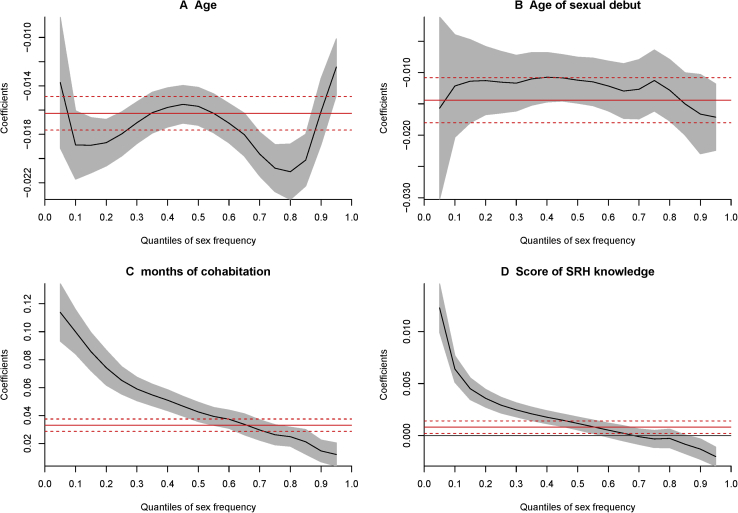
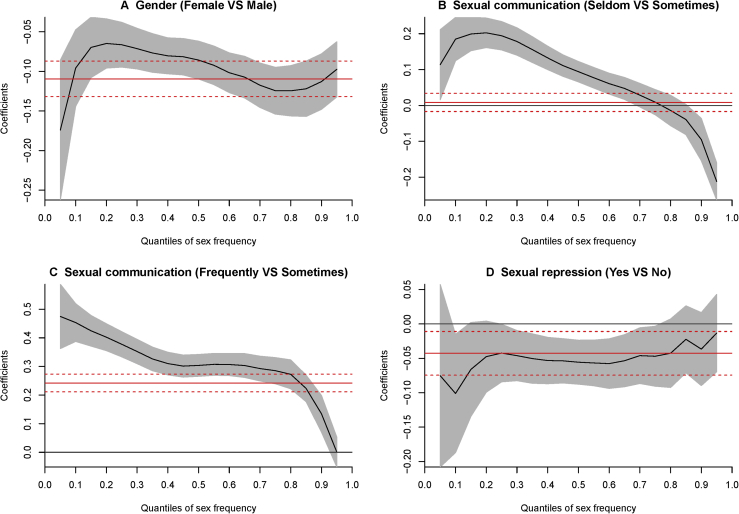
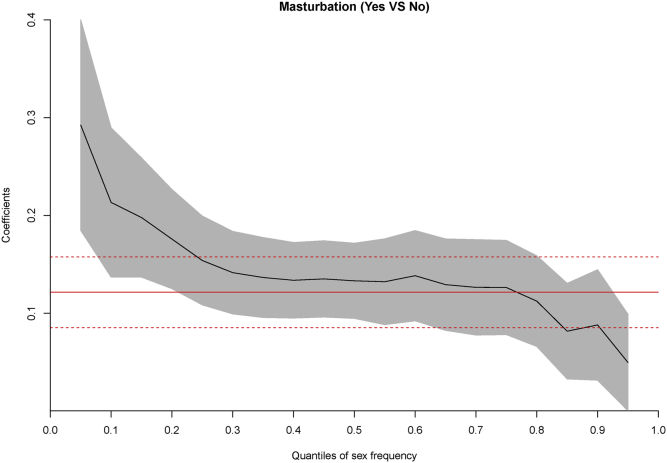
Results: In this study, sexual frequency with an average age of 38.28 years was 5.06 (95% CI 5.01-5.11) time per month. Negative binomial showed that male gender, younger age, earlier age of sexual debut, masturbation, more knowledge of sexual and reproductive health, longer time together with a spouse, and higher school education and incomes were predictors of increased sexual frequency in migrants. Communicating with sexual partners frequently had the largest effect on sexual frequency compared with occasional communicating (β = 0.2419, incidence rate ratio = 1.27, 95% CI 1.23-1.31). In the quantile regression, months of cohabitation (β = 0.0999, 95% CI 0.08-0.12), frequent sexual communication (β = 0.4534, 95% CI 0.39-0.52), and masturbation (β = 0.2168, 95% CI 0.14-0.30) were positively related to lower levels of sexual frequency. Interestingly, migrants who had low and high sexual frequency would be affected in opposite directions by the knowledge of sexual and reproductive health.
Clinical translation: Clinicians can more understand the relationship between sexual frequency and its factors that can as the symptom basis of sexually-related diseases.
Conclusions: The present findings indicate that specific demographic, socioeconomic, and epidemiological characteristics influenced sexual frequency among migrants. Sexual communication as the largest effect predictor to sexual frequency should be paid more attention to, to improve sexual activity of migrants. Zhang J, Wu J, Li Y, et al. Influence factors of sexual activity for internal migrants in China. J Sex Med 2018;6:97-107.
Keywords: China; Influence Factors; Migrants; Quantile Regression; Sexual Activity.
Copyright © 2018 The Authors. Published by Elsevier Inc. All rights reserved.
Figures
References
-
- NHFPC of PRC Abstract of report on 2016 China's migration population development. Adolesc Health. 2016;11:90–91.
-
- Wolffers I., Fernandez I., Verghis S. Sexual behavior and vulnerability of migrant workers for HIV infection. Culture Health Sexuality. 2002;4:459–473.
LinkOut - more resources
Full Text Sources
Other Literature Sources
Miscellaneous
