


The Effect of a School-Based Intervention on Physical Activity and Well-Being: a Non-Randomised Controlled Trial with Children of Low Socio-Economic Status
- PMID: 29679164
- PMCID: PMC5910444
- DOI: 10.1186/s40798-018-0129-0
The Effect of a School-Based Intervention on Physical Activity and Well-Being: a Non-Randomised Controlled Trial with Children of Low Socio-Economic Status
Abstract
Background: Self-determination theory (SDT) has been used to predict children's physical activity and well-being. However, few school-based SDT intervention studies have been conducted, and no research exists with children of low socio-economic status (SES). Therefore, SDT-derived needs-supportive teaching techniques informed the design and analyses of the Healthy Choices Programme (HCP). The aim was to determine if the HCP could enhance moderate-to-vigorous physical activity (MVPA) and well-being among children of low SES through increasing autonomy-support, needs satisfaction and intrinsic motivation.
Method: A mixed factorial two (group) × two (time) wait-list controlled trial was conducted and reported using the TREND guidelines. A total of 155 children (56% females; intervention n = 84, control n = 71) took part and completed measures at baseline (week 0) and post-intervention (week 11). The effect of the intervention on MVPA (model 1) and well-being (model 2) was tested through serial mediation models with three mediators (i.e. autonomy-support, needs satisfaction and intrinsic motivation).
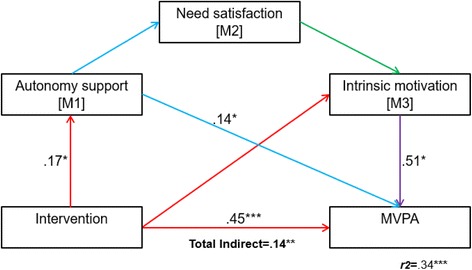
Results: In comparison to the control group, the intervention was related to increases in MVPA (β = .45) and autonomy-support (β = .17). In model 1, analyses revealed partial mediation of the MVPA change through autonomy-support (β = .14), intrinsic motivation (β = .51) and all three SDT mediators in sequence (total r 2 = .34). In model 2, well-being was indirectly enhanced through autonomy-support (β = .38) and autonomy-support and needs satisfaction in sequence (total r 2 = .21).
Conclusions: The HCP enhanced MVPA and well-being by engendering a needs-supportive physical activity environment. The scientific and practical contribution of this study was the application of SDT in all aspects of the HCP intervention's design and analyses. Practitioners may consider integrating SDT principles, as implemented in the HCP, for health promotion.
Trial registration: This study is registered on Research Registry (number researchregistry2852 ).
Keywords: Behaviour change; Health promotion; Motivation; Needs satisfaction; Physical education.
Conflict of interest statement
Ethics Approval and Consent to Participate
Informed consent and assent was sought prior to this study. Ethical approval was granted by the Ulster University, in which we adhere to the Declaration of Helsinki throughout all ethical procedures.
Consent for Publication
The Ulster University approved this study for publication.
Competing Interests
Stephen Shannon, Gavin Breslin, Donncha Hanna, Zoe Younger, Deirdre Brennan and Jessica Hassan declare that they have no competing interests.
Publisher’s Note
Springer Nature remains neutral with regard to jurisdictional claims in published maps and institutional affiliations.
Figures




References
-
- Deci EL, Ryan RM. Hedonia, eudaimonia, and well-being: an introduction. J Happiness Stud. 2008;9:1–11. doi: 10.1007/s10902-006-9018-1. - DOI
-
- Breslin G, Fitzpatrick B, Brennan D, et al. Physical activity and wellbeing of 8–9 year old children from social disadvantage: an all-Ireland approach to health. Ment Health and Phys Act. 2017;(13):9–14.
LinkOut - more resources
Full Text Sources
Other Literature Sources
Miscellaneous
