


Quantitative Microbial Risk Assessment and Infectious Disease Transmission Modeling of Waterborne Enteric Pathogens
- PMID: 29679300
- PMCID: PMC5984175
- DOI: 10.1007/s40572-018-0196-x
Quantitative Microbial Risk Assessment and Infectious Disease Transmission Modeling of Waterborne Enteric Pathogens
Abstract
Purpose of review: Waterborne enteric pathogens remain a global health threat. Increasingly, quantitative microbial risk assessment (QMRA) and infectious disease transmission modeling (IDTM) are used to assess waterborne pathogen risks and evaluate mitigation. These modeling efforts, however, have largely been conducted independently for different purposes and in different settings. In this review, we examine the settings where each modeling strategy is employed.
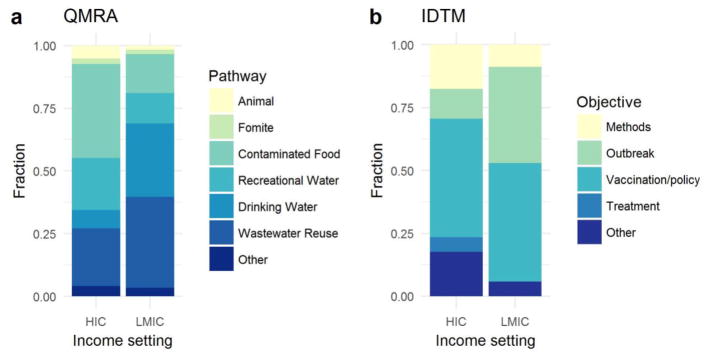
Recent findings: QMRA research has focused on food contamination and recreational water in high-income countries (HICs) and drinking water and wastewater in low- and middle-income countries (LMICs). IDTM research has focused on large outbreaks (predominately LMICs) and vaccine-preventable diseases (LMICs and HICs). Human ecology determines the niches that pathogens exploit, leading researchers to focus on different risk assessment research strategies in different settings. To enhance risk modeling, QMRA and IDTM approaches should be integrated to include dynamics of pathogens in the environment and pathogen transmission through populations.
Keywords: Enteric disease; Human ecology; Infectious disease transmission modeling; Quantitative microbial risk assessment; Waterborne pathogen.
Figures
References
-
- GBD 2015 Mortality and Causes of Death Collaborators. Global, regional, and national life expectancy, all-cause mortality, and cause-specific mortality for 249 causes of death, 1980–2015: a systematic analysis for the Global Burden of Disease Study 2015. The Lancet. 2016;388(10053):1459–1544. - PMC - PubMed
-
- Julian TR. Environmental transmission of diarrheal pathogens in low and middle income countries. Environmental Science: Processes & Impacts. 2016;18(8):944–955. - PubMed
-
- Wade TJ, Sandhu SK, Levy D, Lee S, LeChevallier MW, Katz L, et al. Did a Severe Flood in the Midwest Cause an Increase in the Incidence of Gastrointestinal Symptoms? American Journal of Epidemiology. 2004;159(4):398–405. - PubMed
Publication types
MeSH terms
Grants and funding
LinkOut - more resources
Full Text Sources
Other Literature Sources
Medical
Research Materials
