


Prevalence and characteristics of sleep-disordered breathing in familial dysautonomia
- PMID: 29680425
- PMCID: PMC5918267
- DOI: 10.1016/j.sleep.2017.12.013
Prevalence and characteristics of sleep-disordered breathing in familial dysautonomia
Abstract
Objective: Familial dysautonomia (FD) is an autosomal recessive disorder characterized by impaired development of sensory and afferent autonomic nerves. Untreated sleep-disordered breathing (SDB) has been reported to increase the risk of sudden unexpected death in FD. We aimed to describe the prevalence and characteristics of SDB in FD.
Patients/methods: Seventy-five patients with FD (20 adults and 55 children) underwent in-lab polysomnography, including peripheral capillary oxygen saturation (SpO2) and end-tidal capnography (EtCO2) measurements. A t-test and Spearman's correlation analysis were performed to evaluate the impact of age on sleep, occurrence of apneas, SpO2 and EtCO2 levels; and to determine the relationship between apneas and SpO2/EtCO2 measurements during different sleep stages.
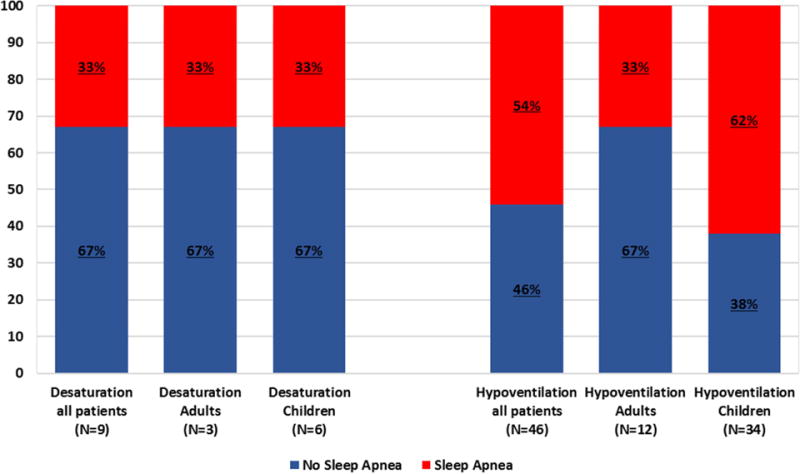
Results: Overall, 85% of adults and 91% of pediatric patients had some degree of SDB. Obstructive sleep apneas were more severe in adults (8.5 events/h in adults vs. 3.5 events/h in children, p = 0.04), whereas central apneas were more severe (10.8 vs. 2.8 events/h, p = 0.04) and frequent (61.8% vs. 45%, p = 0.017) in children. Overall, a higher apnea-hypopnea index was associated with increased severity of hypoxia and hypoventilation, although in a significant fraction of patients (67% and 46%), hypoxemia and hypoventilation occurred independent of apneas.
Conclusion: Most adult and pediatric patients with FD suffer from some degree of SDB. There was a differential effect of age in the pattern of SDB observed. In some FD patients, hypoventilation and hypoxia occurred independently of apneas. Therefore, we recommend including EtCO2 monitoring during polysomnography in all patients with FD to detect SDB.
Keywords: EtCO(2); Familial dysautonomia; Polysomnography; Sleep-disordered breathing; SpO(2).
Copyright © 2018 Elsevier B.V. All rights reserved.
Conflict of interest statement
The authors have indicated no financial support or conflicts of interest.
Figures
Comment in
-
Orthostatic hypotension: does the heart rate matter? And other updates on recent autonomic research.Clin Auton Res. 2018 Jun;28(3):269-271. doi: 10.1007/s10286-018-0532-0. Epub 2018 May 19. Clin Auton Res. 2018. PMID: 29779066 No abstract available.
References
-
- Norcliffe-Kaufmann L, Slaugenhaupt SA, Kaufmann H. Familial dysautonomia: History, genotype, phenotype and translational research. Prog Neurobiol. 2017;152:131–48. - PubMed
-
- Riley CM, Day RL, Greeley DM, Langford WS. Central autonomic dysfunction with defective lacrimation; report of five cases. Pediatrics. 1949;3:468–78. - PubMed
Publication types
MeSH terms
Grants and funding
LinkOut - more resources
Full Text Sources
Other Literature Sources
Medical
Miscellaneous
