Review
. 2018 Jul;39(7):635-647.
doi: 10.1016/j.tips.2018.03.007. Epub 2018 Apr 18.

The Continuing Challenge of Metallo-β-Lactamase Inhibition: Mechanism Matters

Affiliations
Review

The Continuing Challenge of Metallo-β-Lactamase Inhibition: Mechanism Matters

Lin-Cheng Ju et al. Trends Pharmacol Sci. 2018 Jul.

Abstract

Metallo-β-lactamases (MBLs) are a significant clinical problem because they hydrolyze and inactivate nearly all β-lactam-containing antibiotics. These 'lifesaving drugs' constitute >50% of the available contemporary antibiotic arsenal. Despite the global spread of MBLs, MBL inhibitors have not yet appeared in clinical trials. Most MBL inhibitors target active site zinc ions and vary in mechanism from ternary complex formation to metal ion stripping. Importantly, differences in mechanism can impact pharmacology in terms of reversibility, target selectivity, and structure-activity relationship interpretation. This review surveys the mechanisms of MBL inhibitors and describes methods that determine the mechanism of inhibition to guide development of future therapeutics.

Keywords: inhibitor; mechanism; metallo-β-lactamase; spectroscopy.


Figures

Figure 1
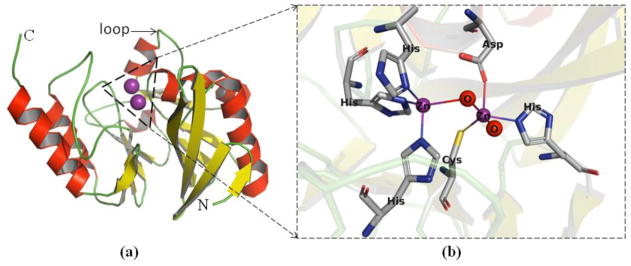
Figure 1. Ribbon diagram of NDM-1
(a) The αββα tertiary fold with metal binding sites of NDM-1 is colored by secondary structure. (b) A close up view of active-site of NDM-1. Zinc ions (purple) and water molecules (red) are represented as spheres. Labeled residues are shown as sticks and coordination bonds as lines. Structures are rendered using Pymol (version 2.0.6) and the PDB coordinates 3SPU. (Abbreviations in this Figure: C: C terminus, N: N terminus, Zn: Zinc ion, O: water molecule, His: histidine, Cys: cysteine, Asp: aspartic acid.)
Figure 2
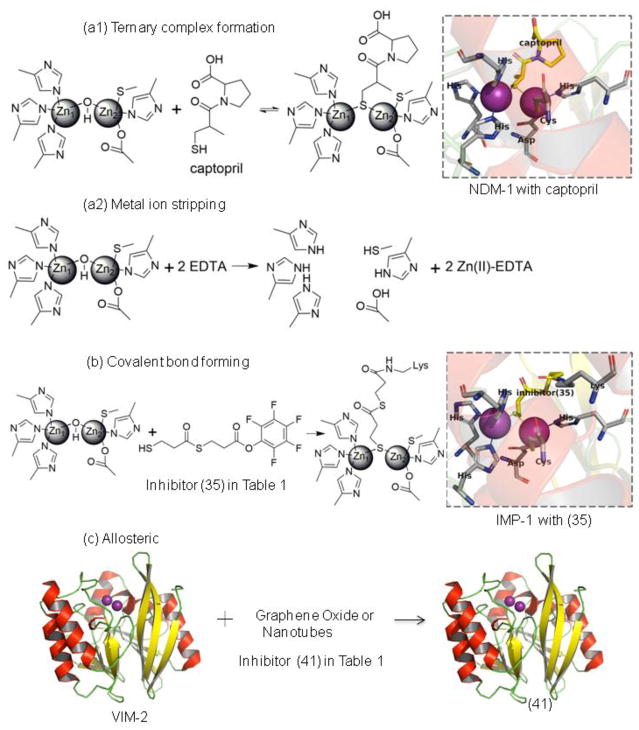
Figure 2. Different mechanisms of inhibition of MBL inhibitors
(a1) Inhibitor that binds metal ions and forms a ternary (MBL:Zn(II):inhibitor) complex, such as the crystal structure of NDM-1 with captopril (PDB code 4EXS). (a2) Inhibitor that removes metal ions from active sites of MBL. (b) Covalent bond formation, such as the crystal structure of IMP-1 with inhibitor (35) (PDB code 1VGN). (c) Allosteric inhibitor, cartoon structure is VIM-2 (PDB code 5LCA). The binding site for allosteric inhibitors has not been characterized in detail and is shown schematically.
Figure 3
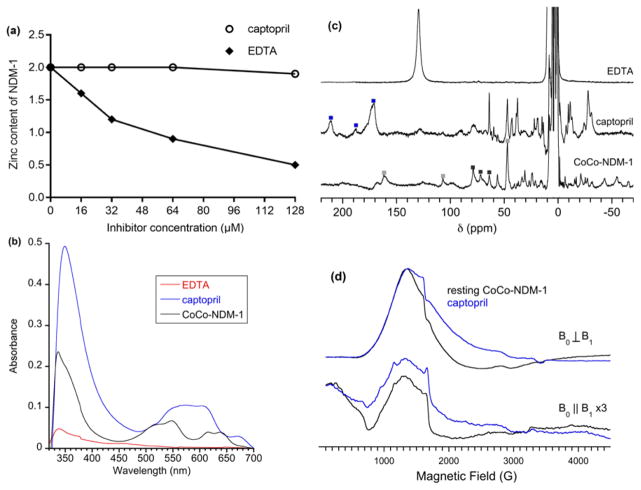
Figure 3. NDM-1 inhibitor studies
(a) Equilibrium dialysis study of the zinc content of NDM-1 (8 μM) after dialysis with various concentrations of captopril (circles) and EDTA (solid rhombuses). Incubation of NDM-1 with captopril results in no loss of zinc, while incubation of NDM-1 with EDTA results in reduction of zinc content. (b) UV-Vis spectroscopy of CoCo-NDM-1 with 2 equivalent EDTA (red line), CoCo-NDM-1 with 2 equivalent captopril (blue line), and CoCo-NDM-1 (black line). Incubation of CoCo-NDM-1 with EDTA results in significant reduction of absorbance at 320–350 nm (which indicates that cysteine is bound to Co(II)) and at 500–650 nm (d-d transitions) (which reveals information about the number of atoms bound to the Co(II) and often the identity of the atoms bound). Incubation of CoCo-NDM-1 with captopril results in an increased absorbance at 320–350 nm and a shift of absorbance at 500–650 nm. (c) 300 MHz 1H NMR spectroscopy of CoCo-NDM-1 with 2 equivalent EDTA (top), CoCo-NDM-1 with 3 equivalent captopril (center) and CoCo-NDM-1 (bottom). Resonances assigned to metal 1 site are marked with black squares. Resonances to metal 2 site are marked with gray squares. Resonances indicative of a ternary (NDM-1:Co(II):captopril) complex are marked with blue squares. The loss of peaks in the NMR spectrum of CoCo-NDM-1 with EDTA indicates the inhibitor removes Co(II) from the active site. The shifted peaks in the NMR spectrum of CoCo-NDM-1 with captopril indicates the binding of the inhibitor to the metal ions in the active site of the protein. (d) X-band EPR spectroscopy of CoCo-NDM-1 (black lines) and CoCo-NDM-1 with 1 equivalent captopril (blue lines). Standard perpendicular mode spectra are on top, and parallel mode spectra (scaled 3-fold) are shown below. The EPR spectra of CoCo-NDM-1 before and after captopril binding shows that the atoms bound to Co(II) in the two enzymes are different. In particular, the peak at 800 G in the bottom figure (parallel mode) demonstrates that a different atom bridges the Co(II) ions: in the resting enzyme the bridging atom is oxygen from water and in the CoCo-NDM-1/captopril complex, the bridging atom is sulfur from captopril.
Figure 4
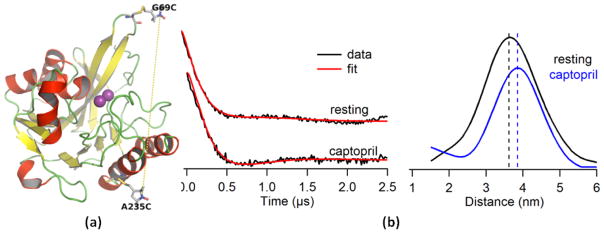
Figure 4. Structure of a site-specifically labeled NDM-1 and DEER spectra of captopril binding to NDM-1
(a) Cartoon structure of double spin labeled NDM-1 (G69C/A235C). The positions are Gly69 on the hairpin loop and Ala235 on a remote α-helix as optimal sites for MTSL labeling (PDB code: 3ZR9). (b) Q-band DEER spectra of the labeled NDM-1. Time domain traces with corresponding fit of the resting, labeled NDM-1 and of NDM-1 complexed with captopril (left). These fits were included to demonstrate how well the data were fitted by the DEER analysis software. Distance distribution spectra of the resting, labeled NDM-1 (black) and of labeled NDM-1 complexed with captopril (blue) (right). The horizontal lines show the average distance between the introduced spin labels in the two samples.

References

    1. Rojas LJ, et al. NDM-5 and OXA-181 Beta-Lactamases, a Significant Threat Continues To Spread in the Americas. Antimicrob Agents Chemother. 2017;61:e00454–17. - PMC - PubMed
    1. Chen L, et al. Notes from the Field: Pan-Resistant New Delhi Metallo-Beta-Lactamase-Producing Klebsiella pneumoniae - Washoe County, Nevada, 2016. MMWR Morbidity and mortality weekly report. 2017;66:33. - PMC - PubMed
    1. Fisher JF, et al. Bacterial resistance to beta-lactam antibiotics: compelling opportunism, compelling opportunity. Chem Rev. 2005;105:395–424. - PubMed
    1. Papp-Wallace KM, Bonomo RA. New beta-Lactamase Inhibitors in the Clinic. Infect Dis Clinics North America. 2016;30:441–464. - PMC - PubMed
    1. Makena A, et al. Biochemical characterization of New Delhi metallo-beta-lactamase variants reveals differences in protein stability. J Antimicrob Chemother. 2015;70:463–469. - PMC - PubMed

Publication types

MeSH terms