


Cognitively-Based Compassion Training (CBCT®) in Breast Cancer Survivors: A Randomized Clinical Trial Study
- PMID: 29681185
- PMCID: PMC6142100
- DOI: 10.1177/1534735418772095
Cognitively-Based Compassion Training (CBCT®) in Breast Cancer Survivors: A Randomized Clinical Trial Study
Abstract
Context: Breast cancer (BC) requires a significant psychological adaptation once treatment is finished. There is growing evidence of how compassion training enhances psychological and physical well-being, however, there are very few studies analyzing the efficacy of compassion-based Interventions on BC survivors.
Objective: To study the efficacy of the Cognitively-Based Compassion Training (CBCT) protocol in a BC survivor sample on quality of life, psychological well-being, fear of cancer recurrence, self-compassion, and compassion domains and mindfulness facets. Furthermore, enrollment, adherence, and satisfaction with the intervention were also analyzed.
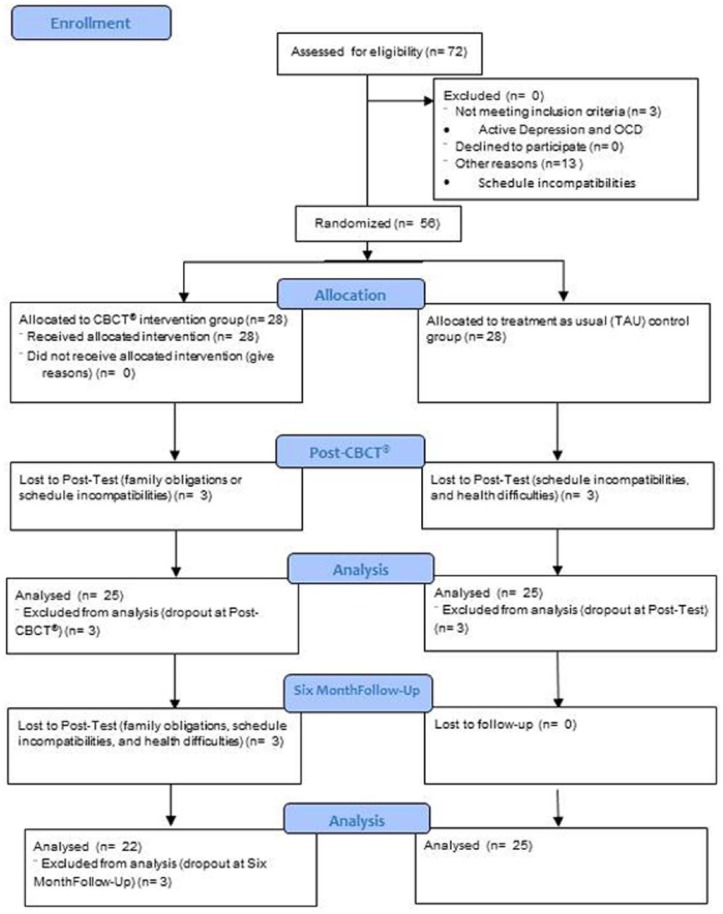
Methods: A randomized clinical trial was designed. Participants (n = 56) were randomly assigned to CBCT (n = 28) or a treatment-as-usual control group (TAU; n = 28). Pre-post intervention and 6-month follow-up measures took place to evaluate health-related quality of life, psychological well-being; psychological stress, coping strategies, and triggering cognitions; self-compassion and compassion; and mindfulness in both intervention and wait-list groups.
Results: Accrual of eligible participants was high (77%), and the drop-out rate was 16%. Attendance to CBCT sessions was high and practice off sessions exceeded expectations). CBCT was effective in diminishing stress caused by FCR, fostering self-kindness and common humanity, and increasing overall self-compassion scores, mindful observation, and acting with awareness skillsets.
Conclusion: CBCT could be considered a promising and potentially useful intervention to diminish stress caused by FCR and enhance self-kindness, common humanity, overall self-compassion, mindful observation, and acting with awareness skillsets. Nevertheless, future randomized trials are needed and a process of deeper cultural adaptation required.
Trial registration: ClinicalTrials.gov NCT03305952.
Keywords: breast cancer; compassion training; contemplative training; fear of cancer recurrence; self-compassion; survivorship; well-being.
Conflict of interest statement
Figures
References
-
- Ferlay J, Soerjomataram I, Dikshit R, et al. Cancer incidence and mortality worldwide: sources, methods and major patterns in GLOBOCAN 2012. Int J Cancer. 2015;136:E359-E386. - PubMed
-
- Nasser M, Baistow K, Treasure J. The Female Body in Mind: The Interface Between the Female Body and Mental Health. New York, NY: Routledge; 2007.
-
- Moorey S, Greer S. Cognitive Behaviour Therapy for People With Cancer. New York, NY: Oxford University Press; 2002.
-
- Bellver A, Sánchez-Cánovas J, Santaballa A, Munárriz B, Pérez-Fidalgo JA, Montalar J. Mujeres con cáncer de mama: evaluación del afecto positivo y negativo y valoración de un programa de intervención psicológica en el ámbito hospitalario. Psicooncología. 2009;6:139-154.
-
- Rosenfeld B, Krivo S, Breitbart W, Chochinov HM. Suicide, assisted suicide, and euthanasia in the terminally ill. In: Chochinov HM, Breitbart W. eds. Handbook of Psychiatry in Palliative Medicine. New York, NY: Oxford University Press; 2000:51-62.
Publication types
MeSH terms
Associated data
LinkOut - more resources
Full Text Sources
Other Literature Sources
Medical
