


Possible Link Between Stress-related Factors and Altered Body Composition in Women with Polycystic Ovarian Syndrome
- PMID: 29681710
- PMCID: PMC5892097
- DOI: 10.4103/jhrs.JHRS_78_17
Possible Link Between Stress-related Factors and Altered Body Composition in Women with Polycystic Ovarian Syndrome
Abstract
Background: Stress is an invisible factor affecting modern day living and is strongly associated with many disease pathogenesis including polycystic ovarian syndrome (PCOS) in women. PCOS is the most frequent endocrinological disorder that affects women of reproductive age, leading to metabolic dysfunction and body composition alterations. Salivary amylase and cortisol are major stress mediators that have been implicated in PCOS. However, their role in altering body composition in PCOS is yet to be deciphered.
Aim: The present study aimed at understanding the relation between stress-associated factors and alterations in body composition among PCOS patients.
Design: This study enrolled a total of 100 patients (PCOS) and 60 age-matched controls. The female patients were of ages between 13 and 30 years.
Materials and methods: Standard assay kits were used to evaluate the α-amylase activity and cortisol level in saliva. The participants were chosen on the basis of the Rotterdam American Society for Reproductive Medicine/European Society of Human Reproduction criteria. Saliva was collected from each participant as per the protocol of Salimetrics, USA.
Statistical analysis: Statistical analysis was performed using SPSS version 20 for Windows. The quantitative variables are described as mean ± standard deviation. P < 0.05 was considered significant.
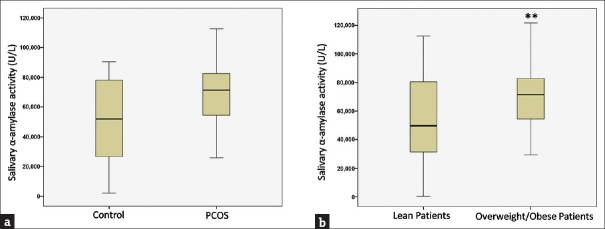
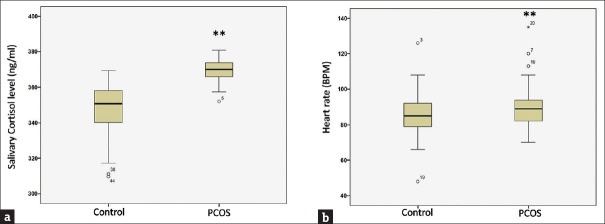
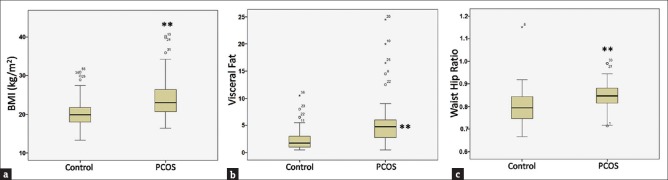
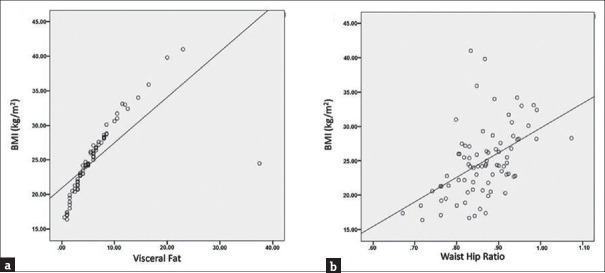
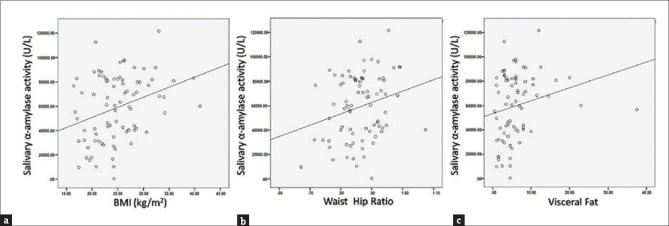
Results: Increased salivary cortisol level and α-amylase activity were seen in the PCOS population as compared to age-matched controls suggesting patients a sustained stress scenario in their system. Moreover, overweight PCOS participants reflected higher amylase activity than the lean patients participants. Pulse rate, body mass index (BMI), visceral adiposity, and waist-hip ratio (WHR) was considerably higher in the PCOS patients participants compared to controls. A significant correlation could be drawn between the α-amylase activity and BMI or WHR, respectively, among PCOS patients. These observations indicate a strong link between the stress marker and alterations in the body composition parameters of PCOS patients participants.
Conclusion: Higher prevalence of stress in PCOS patients participants has a critical role in their altered body composition.
Keywords: Polycystic ovarian syndrome; salivary cortisol; salivary α-amylase; stress.
Conflict of interest statement
There are no conflicts of interest.
Figures
Similar articles
-
Association of fat to lean mass ratio with metabolic dysfunction in women with polycystic ovary syndrome.Hum Reprod. 2014 Jul;29(7):1508-17. doi: 10.1093/humrep/deu096. Epub 2014 May 9. Hum Reprod. 2014. PMID: 24813197 Free PMC article.
-
Visceral adiposity index levels in overweight and/or obese, and non-obese patients with polycystic ovary syndrome and its relationship with metabolic and inflammatory parameters.J Endocrinol Invest. 2017 May;40(5):487-497. doi: 10.1007/s40618-016-0582-x. Epub 2016 Nov 12. J Endocrinol Invest. 2017. PMID: 27838846
-
Women with polycystic ovary syndrome have intrinsic insulin resistance on euglycaemic-hyperinsulaemic clamp.Hum Reprod. 2013 Mar;28(3):777-84. doi: 10.1093/humrep/des463. Epub 2013 Jan 12. Hum Reprod. 2013. PMID: 23315061 Clinical Trial.
-
Childhood, adolescent, and adulthood adiposity are associated with risk of PCOS: a Mendelian randomization study with meta-analysis.Hum Reprod. 2023 Jun 1;38(6):1168-1182. doi: 10.1093/humrep/dead053. Hum Reprod. 2023. PMID: 37015099 Free PMC article.
-
[Body composition and polycystic ovary syndrome].Medicina (Kaunas). 2010;46(2):142-57. Medicina (Kaunas). 2010. PMID: 20440089 Review. Lithuanian.
Cited by
-
Assessment of prevalence, knowledge of polycystic ovary syndrome and health-related practices among women in klang valley: A cross-sectional survey.Front Endocrinol (Lausanne). 2022 Aug 29;13:985588. doi: 10.3389/fendo.2022.985588. eCollection 2022. Front Endocrinol (Lausanne). 2022. PMID: 36105409 Free PMC article.
-
Mitochondrial DNA copy number variation and gene mutations mediate polycystic ovary syndrome: research progress.Am J Transl Res. 2024 Nov 15;16(11):6303-6313. doi: 10.62347/KEWS9270. eCollection 2024. Am J Transl Res. 2024. PMID: 39678554 Free PMC article. Review.
-
Lean Women on Metformin and Oral Contraceptives for Polycystic Ovary Syndrome Demonstrate a Dehydrated Osteosarcopenic Phenotype: A Pilot Study.Nutrients. 2019 Sep 2;11(9):2055. doi: 10.3390/nu11092055. Nutrients. 2019. PMID: 31480705 Free PMC article.
-
Polycystic Ovary Syndrome: An Evolutionary Adaptation to Lifestyle and the Environment.Int J Environ Res Public Health. 2022 Jan 25;19(3):1336. doi: 10.3390/ijerph19031336. Int J Environ Res Public Health. 2022. PMID: 35162359 Free PMC article. Review.
-
Stress responses to bacterial and viral mimetics in polycystic ovary syndrome model rats.Brain Behav Immun Health. 2024 Apr 9;38:100772. doi: 10.1016/j.bbih.2024.100772. eCollection 2024 Jul. Brain Behav Immun Health. 2024. PMID: 38650845 Free PMC article.
References
-
- Rotterdam ESHRE/ASRM-Sponsored PCOS Consensus Workshop Group. Revised 2003 consensus on diagnostic criteria and long-term health risks related to polycystic ovary syndrome (PCOS) Hum Reprod. 2004;19:41–7. - PubMed
LinkOut - more resources
Full Text Sources
Other Literature Sources