


Alexithymia in Gastroenterology and Hepatology: A Systematic Review
- PMID: 29681874
- PMCID: PMC5897673
- DOI: 10.3389/fpsyg.2018.00470
Alexithymia in Gastroenterology and Hepatology: A Systematic Review
Abstract
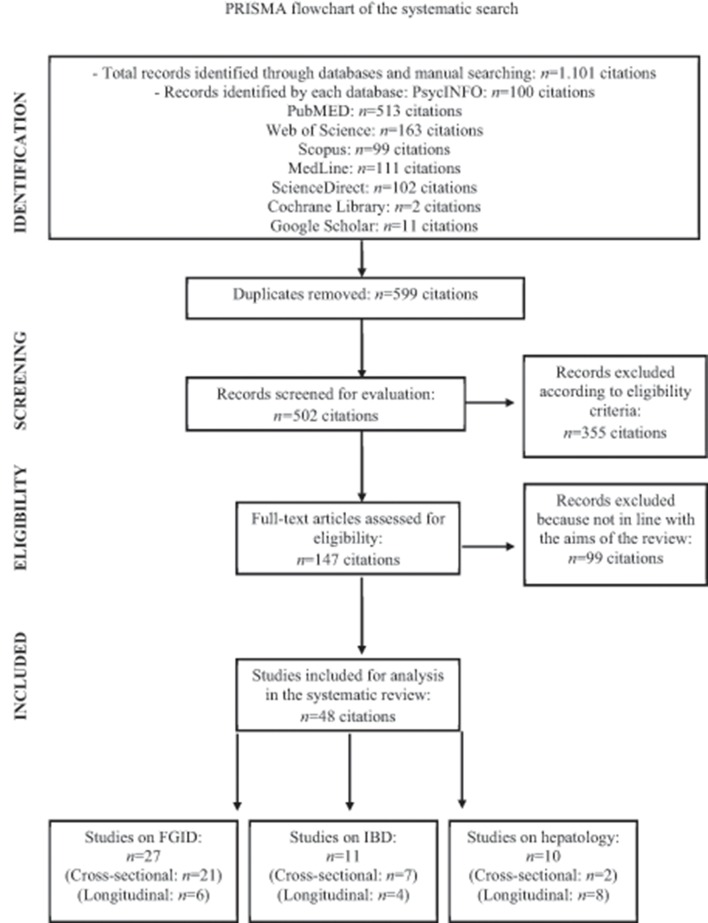
Background: Alexithymia is a multifaceted personality construct that represents a deficit in the cognitive processing of emotions and is currently understood to be related to a variety of medical and psychiatric conditions. The present review aims to investigate the relationship of alexithymia with gastrointestinal (GI) disorders as functional gastrointestinal disorders (FGID, as irritable bowel syndrome (IBS) and functional dyspepsia) and inflammatory bowel disease (IBD) [ulcerative colitis (UC) and Crohn's disease (CD)] and liver diseases as chronic hepatitis C (CHC), cirrhosis, and liver transplantation. Methods: The articles were selected from the main electronic databases (PsycInfo, Medline, PubMed, Web of Science, Scopus, Cochrane, and ScienceDirect) using multiple combinations of relevant search terms (defined GI and liver diseases, articles in English, use of the Toronto scales [TAS] for alexithymia). The TAS was selected as inclusion criterion because it is the most widely used measure, thus allowing comparisons across studies. Results: Forty-eight studies met the inclusion criteria, of which 38 focused on GI disorders (27 on FGID and 11 on IBD) and 10 on liver diseases. Most studies (n = 30, 62%) were cross-sectional. The prevalence of alexithymia was higher in FGID (two third or more) than IBD and liver diseases (from one third to 50% of patients, consistent with other chronic non-GI diseases) than general population (10-15%). In functional disorders, alexithymia may be viewed as a primary driver for higher visceral perception, symptom reporting, health care use, symptom persistence, and negative treatment outcomes. Also, it has been found associated with psychological distress and specific GI-related forms of anxiety in predicting symptom severity as well as post-treatment outcomes and is associated with several psychological factors increasing the burden of disease and impairing levels of quality of life. A number of critical issues (small sample sizes, patients referred to secondary and tertiary care centers, cross-sectional study design, use of one single scale for alexithymia) constitutes a limitation to the generalization of findings. Conclusions: Alexithymia showed to play different roles in gastroenterology according to the clinical characteristics and the psychological burden of the various disorders, with main relevance in increasing subjective symptom perception and affecting negatively post-treatment outcomes.
Keywords: Toronto Alexithymia Scale; alexithymia; gastroenterology; hepatology; somatization.
Figures
References
-
- American Psychiatric Association (2013). Diagnostic and Statistical Manual of Mental Disorders. DSM-5, 5th Edn. Arlington: American Psychiatric Publishing.
LinkOut - more resources
Full Text Sources
Other Literature Sources
Miscellaneous
