Review
. 2018 Feb 26:2018:1959506.
doi: 10.1155/2018/1959506. eCollection 2018.

Markers of Oral Lichen Planus Malignant Transformation

Affiliations
Review

Markers of Oral Lichen Planus Malignant Transformation

Mircea Tampa et al. Dis Markers. .

Abstract

Oral lichen planus (OLP) is a chronic inflammatory disease of unknown etiology with significant impact on patients' quality of life. Malignant transformation into oral squamous cell carcinoma (OSCC) is considered as one of the most serious complications of the disease; nevertheless, controversy still persists. Various factors seem to be involved in the progression of malignant transformation; however, the mechanism of this process is not fully understood yet. Molecular alterations detected in OLP samples might represent useful biomarkers for predicting and monitoring the malignant progression. In this review, we discuss various studies which highlight different molecules as ominous predictors of OLP malignant transformation.


Figures
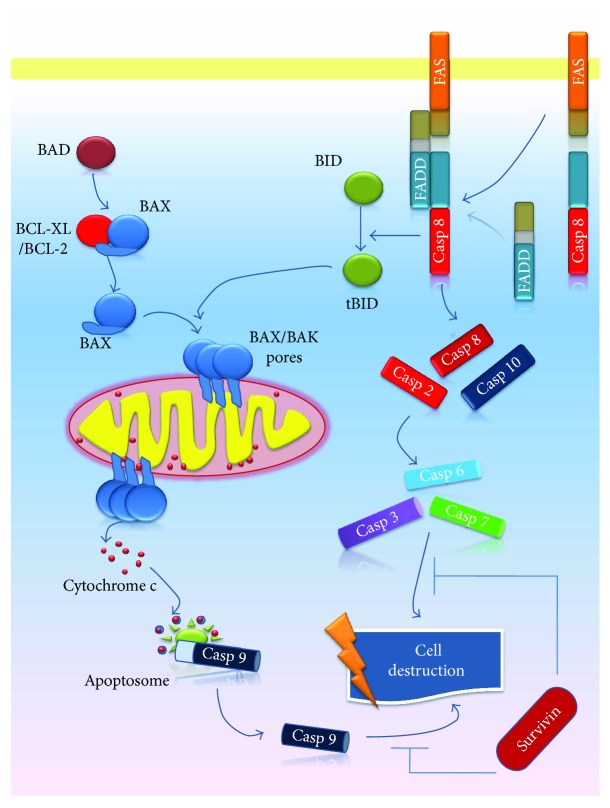
Figure 1
Figure 1
Schematic illustration of apoptosis. Intracellular apoptotic signaling pathways are represented by the intrinsic (mitochondrial) pathway—the activation of BAX and BAK proapoptotic proteins, release of cytochrome c from mitochondria, formation of the apoptosome, and caspase 9 activation—and the extrinsic (death receptor) pathway—FasR/FasL interaction, association of FADD to the complex, followed by DISC formation, and caspase 8 activation. The end point of both intrinsic and extrinsic pathways is cell destruction.
Figure 2
Figure 2
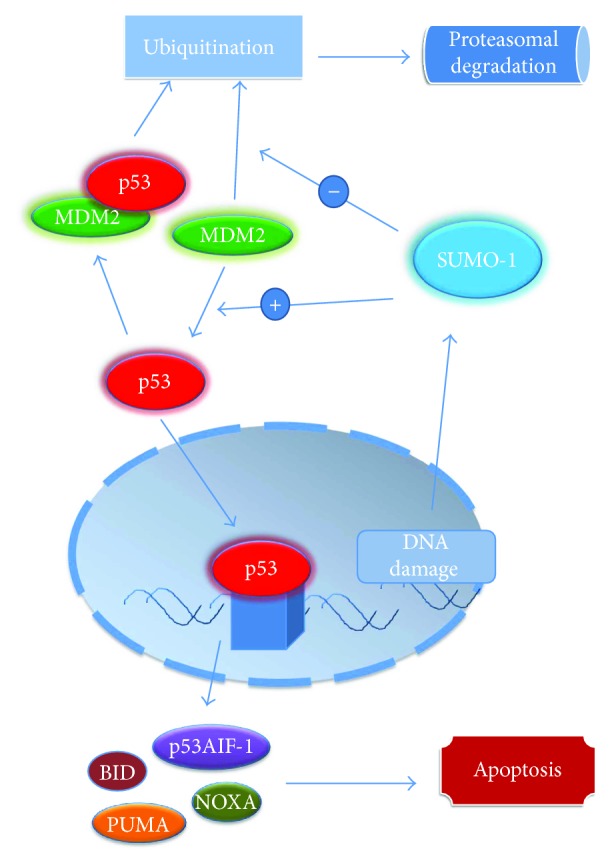
The relationship of p53, MDM2, and SUMO-1 in apoptosis regulation. MDM2 induces p53 ubiquitination and its proteasomal degradation, acting as an E3 ubiquitin ligase; the decrease in p53 level will lead to an inhibition of apoptosis. Under normal conditions, SUMO-1 regulates MDM2 level: MDM2 is undergoing self-ubiquitination and proteasomal degradation; DNA damage leads to SUMO-1 binding MDM2 and blocking its self-ubiquitination, conducting to an increase in MDM2 ubiquitin ligase activity towards p53. While p53 acts by inducing transcription of p53AIF-1, PUMA, BID, and NOXA, leading to the induction of apoptosis, reducing p53 levels by MDM2- and SUMO-1-conjugated action will lead to inhibition of apoptosis.
Figure 3
Figure 3
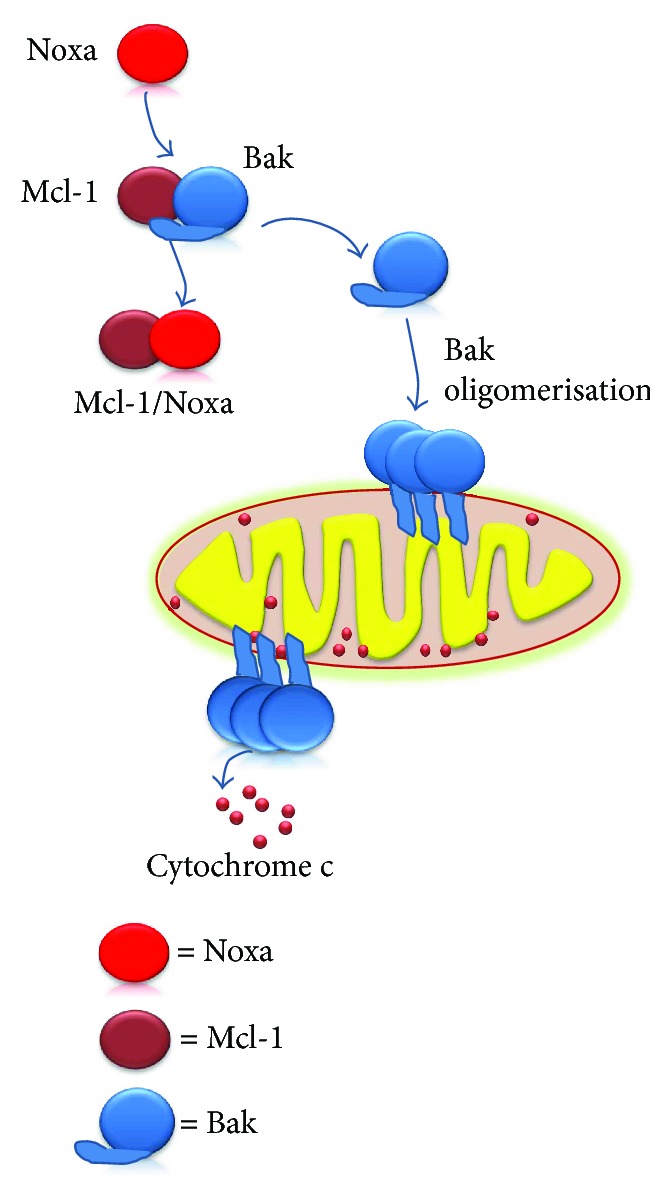
The role of MCL-1 in apoptosis. Under normal conditions, MCL-1 binds BAK. As a result of various cytotoxic signals, NOXA can displace BAK from this bondage. Subsequently, BAK leads to channel formation in mitochondria, cytochrome c release, and caspase activation.

References

    1. Zhang L., Michelsen C., Cheng X., Zeng T., Priddy R., Rosin M. P. Molecular analysis of oral lichen planus. A premalignant lesion? The American Journal of Pathology. 1997;151(2):323–327. - PMC - PubMed
    1. Georgescu S. R., Ene C. D., Nicolae I., et al. Reflectometric analysis for identification of various pathological conditions associated with lichen planus. Revista de Chimie. 2017;68(5):1103–1108.
    1. Shen Z. Y., Liu W., Feng J. Q., Zhou H. W., Zhou Z. T. Squamous cell carcinoma development in previously diagnosed oral lichen planus: de novo or transformation? Oral Surgery, Oral Medicine, Oral Pathology, Oral Radiology, and Endodontology. 2011;112(5):592–596. doi: 10.1016/j.tripleo.2011.05.029. - DOI - PubMed
    1. Peng Q., Zhang J., Ye X., Zhou G. Tumor-like microenvironment in oral lichen planus: evidence of malignant transformation? Expert Review of Clinical Immunology. 2017;13(6):635–643. doi: 10.1080/1744666X.2017.1295852. - DOI - PubMed
    1. Sathiyasekar A. C., Chandrasekar P., Pakash A., Kumar K. U., Jaishlal M. S. Overview of immunology of oral squamous cell carcinoma. Journal of Pharmacy & Bioallied Sciences. 2016;8(Supplement 1):S8–S12. doi: 10.4103/0975-7406.191974. - DOI - PMC - PubMed

MeSH terms

Substances