. 2018 Apr 9;4(4):1193-1207.
doi: 10.1021/acsbiomaterials.7b00072. Epub 2017 Mar 21.

The Hair Follicle: An Underutilized Source of Cells and Materials for Regenerative Medicine

Affiliations

The Hair Follicle: An Underutilized Source of Cells and Materials for Regenerative Medicine

Mehrdad T Kiani et al. ACS Biomater Sci Eng. .

Abstract

The hair follicle is one of only two structures within the adult body that selectively degenerates and regenerates, making it an intriguing organ to study and use for regenerative medicine. Hair follicles have been shown to influence wound healing, angiogenesis, neurogenesis, and harbor distinct populations of stem cells; this has led to cells from the follicle being used in clinical trials for tendinosis and chronic ulcers. In addition, keratin produced by the follicle in the form of a hair fiber provides an abundant source of biomaterials for regenerative medicine. In this review, we provide an overview of the structure of a hair follicle, explain the role of the follicle in regulating the microenvironment of skin and the impact on wound healing, explore individual cell types of interest for regenerative medicine, and cover several applications of keratin-based biomaterials.

Keywords: biomaterials; hair follicle; keratin; regenerative medicine; stem cells; wound healing.


Figures
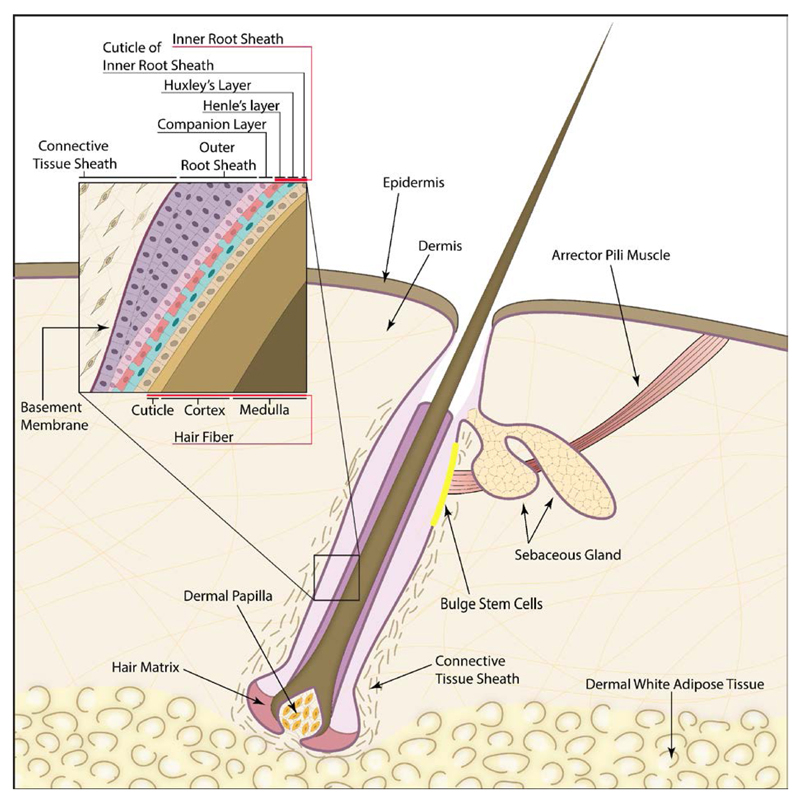
Figure 1
Figure 1. Schematic of the human hair follicle.
The hair follicle contains both mesenchymal and epithelial components, separated by a basement membrane. The mesenchymal dermal papilla and connective tissue sheath (dermal sheath) direct growth and differentiation of subjacent epithelial cells. In the epithelial compartment, stem cells exit the bulge, proliferate, and contribute to the outer root sheath. Cells in the matrix, which forms from the hair germ in the telogen to anagen transition, proliferate, differentiate, and migrate upwards towards the skin surface giving rise to the three concentric layers of the hair fiber (medulla, cortex and cuticle), the three layers of the inner root sheath (cuticle, Huxleys, and Henles), and the companion layer.
Figure 2
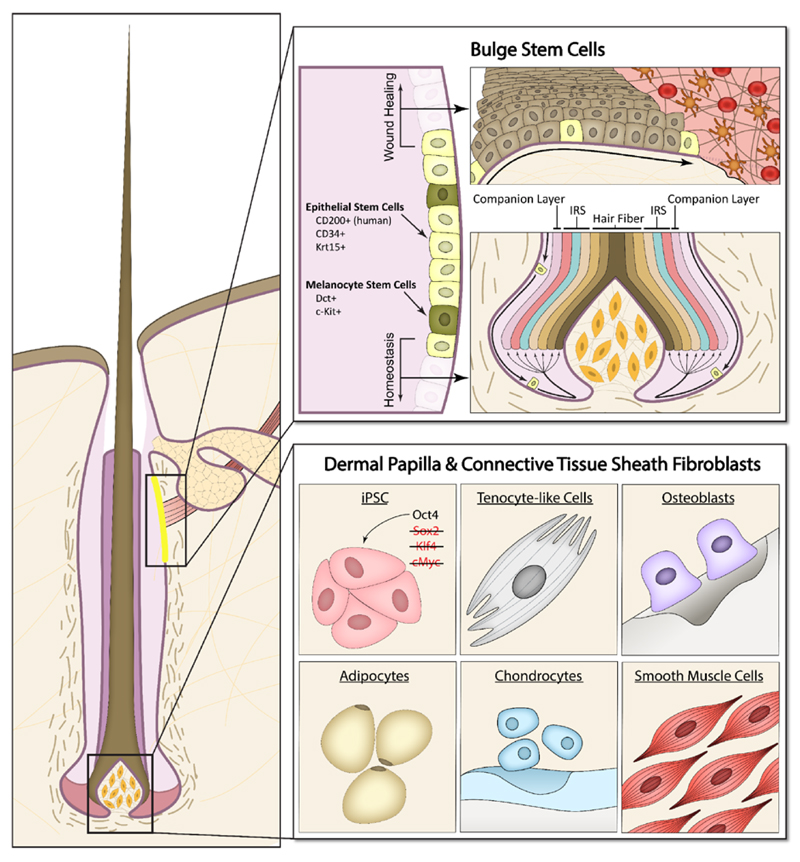
Figure 2. Regenerative medicine application of cells from the hair follicle.
Epithelial stem cells located in the bulge can give rise to the different epithelial lineages of the hair follicle. In response to wounding in the skin, bulge stem cells contribute to re-epithelialization of the epidermis. Comparatively, hair follicle dermal papilla and connective tissue sheath (dermal sheath) cells can differentiate into many cell types including osteoblasts and adipocytes. In a clinical trial for tendinosis, sheath cells are believed to differentiate into tenocyte-like cells.
Figure 3
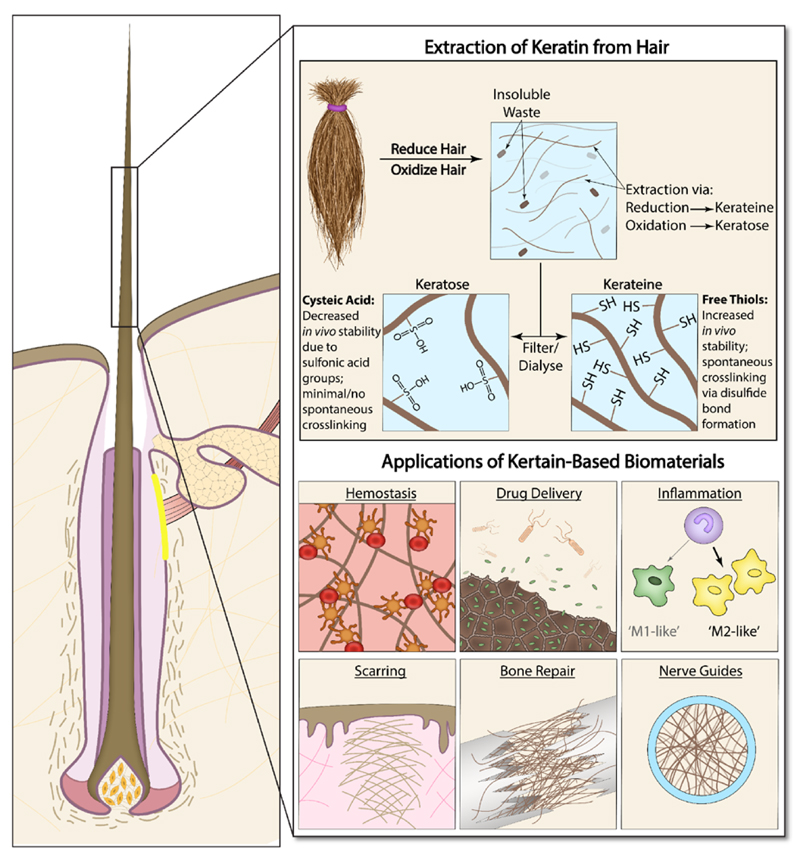
Figure 3. Regenerative medicine applications of biomaterials from the hair follicle.
The use of keratin as a biomaterial. (Top) Extraction of keratin from source materials such as hair is a straightforward process. Following reduction or oxidation of disufide bonds, the solution is filtered and extracted as either kerateine or keratose. (Bottom) Keratin-derived materials have been developed for a range of medical applications. These include promoting hemostasis, controlling drug delivery, modulating inflammation, reducing scarring, promoting bone repair, and acting as neural guides.

References

    1. Schultz AH. The Density of Hair in Primates. Hum Biol. 1931;3(3):303–321.
    1. Szabo G. The Regional Anatomy of the Human Integument with Special Reference to the Distribution of Hair Follicles, Sweat Glands and Melanocytes. Phil Trans B. 1967;252(779):447–485. doi: 10.1098/rstb.1967.0029. - DOI
    1. Sandel AA. Brief communication: Hair density and body mass in mammals and the evolution of human hairlessness. Am J Phys Anthropol. 2013;152(1):145–150. doi: 10.1002/ajpa.22333. - DOI - PubMed
    1. Cash TF. Losing Hair, Losing Points - the Effects of Male Pattern Baldness on Social Impression-Formation. J Appl Soc Psychol. 1990;20(2):154–167. doi: 10.1111/j.1559-1816.1990.tb00404.x. - DOI
    1. Wheeler PE. The Loss of Functional Body Hair in Man - the Influence of Thermal Environment, Body Form and Bipedality. J Hum Evol. 1985;14(1):23–28. doi: 10.1016/S0047-2484(85)80091-9. - DOI